Politics · Climate
Liberal MPs now say “climate change” far less than they did under Trudeau, and in 2026 they are talking about climate far less. Meanwhile, Ottawa’s own projections show Canada moving further from its 2030 target.
Published 24 November 2026 · Open Data Canada Source House of Commons Hansard via OpenParliament.ca
The United Nations climate summit in Türkiye, COP31, ended on Nov. 22 without an overall final agreement, after countries split over how, or whether, to mention fossil fuels (UN News). Canada went with a pitch built on methane cuts and climate finance. Prime Minister Mark Carney did not attend the leaders’ summit, The Canadian Press reported (CTV News). Environment Minister Julie Dabrusin led Canada’s delegation (Environment and Climate Change Canada).
It is a different pitch from the one that defined Justin Trudeau’s years in office. In the House of Commons, the difference can be measured. (An earlier comparison of how Carney and Trudeau speak found Trudeau leaned on care and climate, Carney on budgets.)
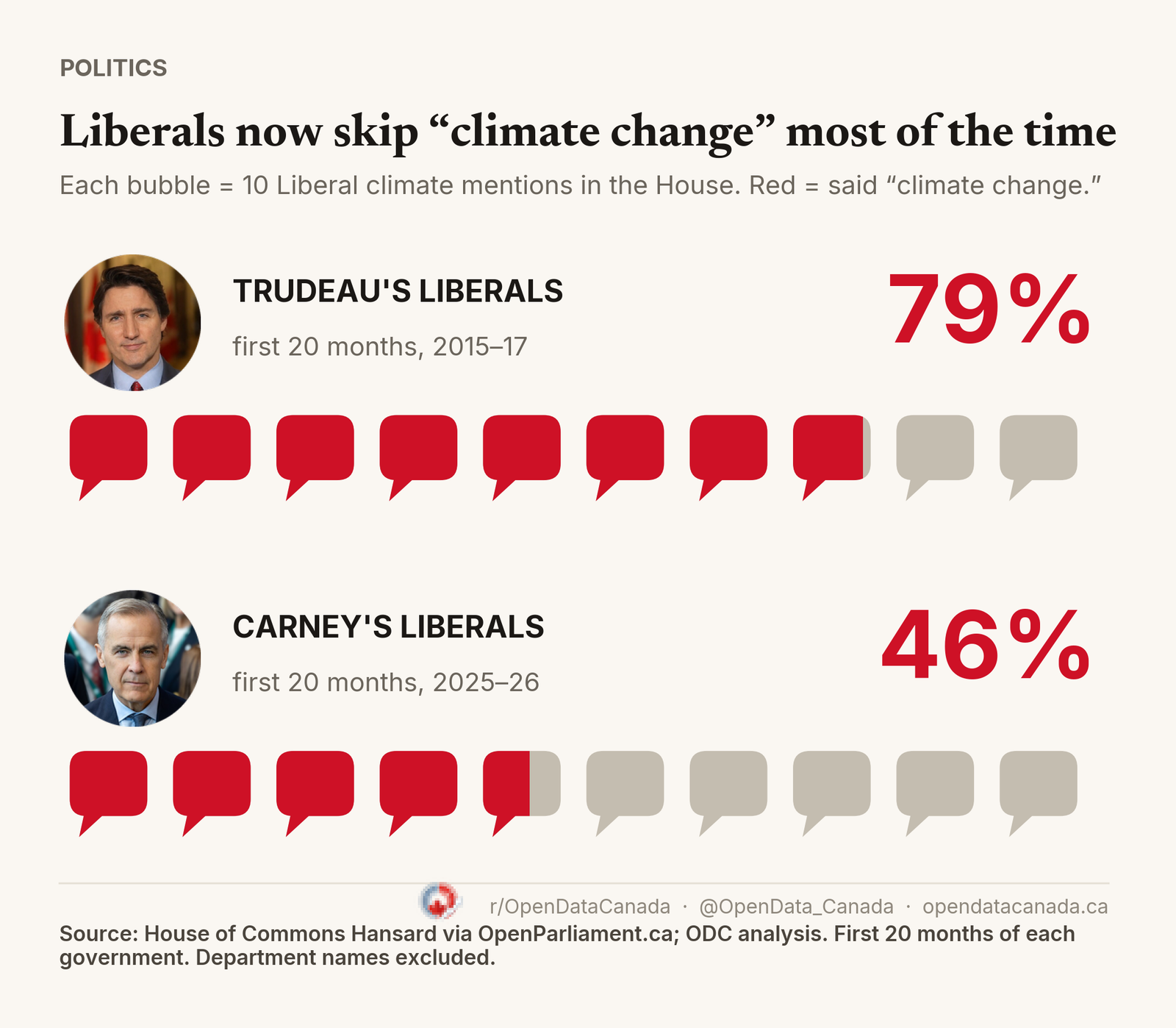
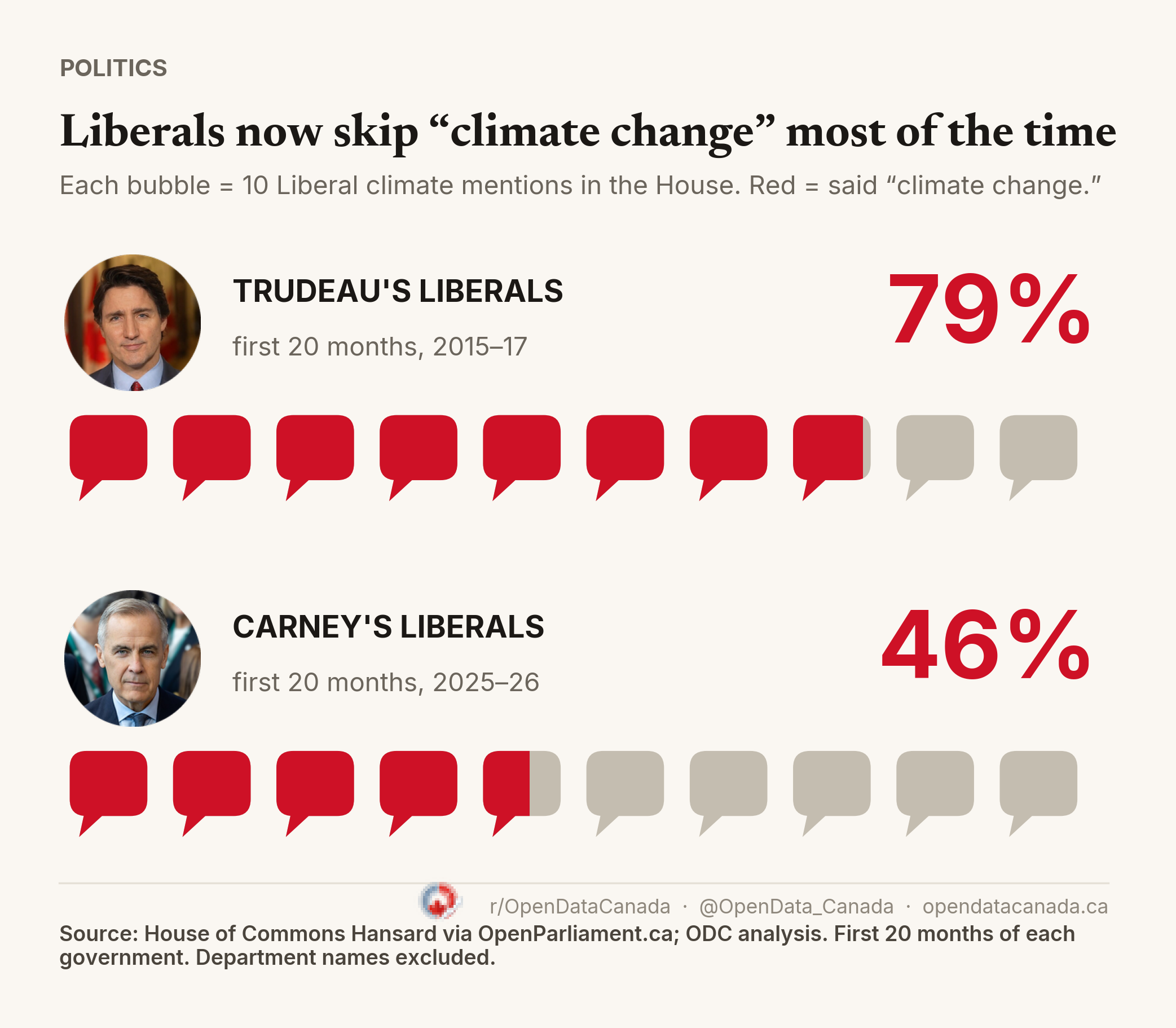
In their first 20 months in government, Trudeau’s Liberals said “climate change” in 79% of their climate mentions. In Carney’s first 20 months, that share fell to 46%.
Over those 20 months, Carney’s Liberals brought up climate about as often as Trudeau’s did at the same stage: 337 times per million words spoken in the House, against 341. What changed was the wording.
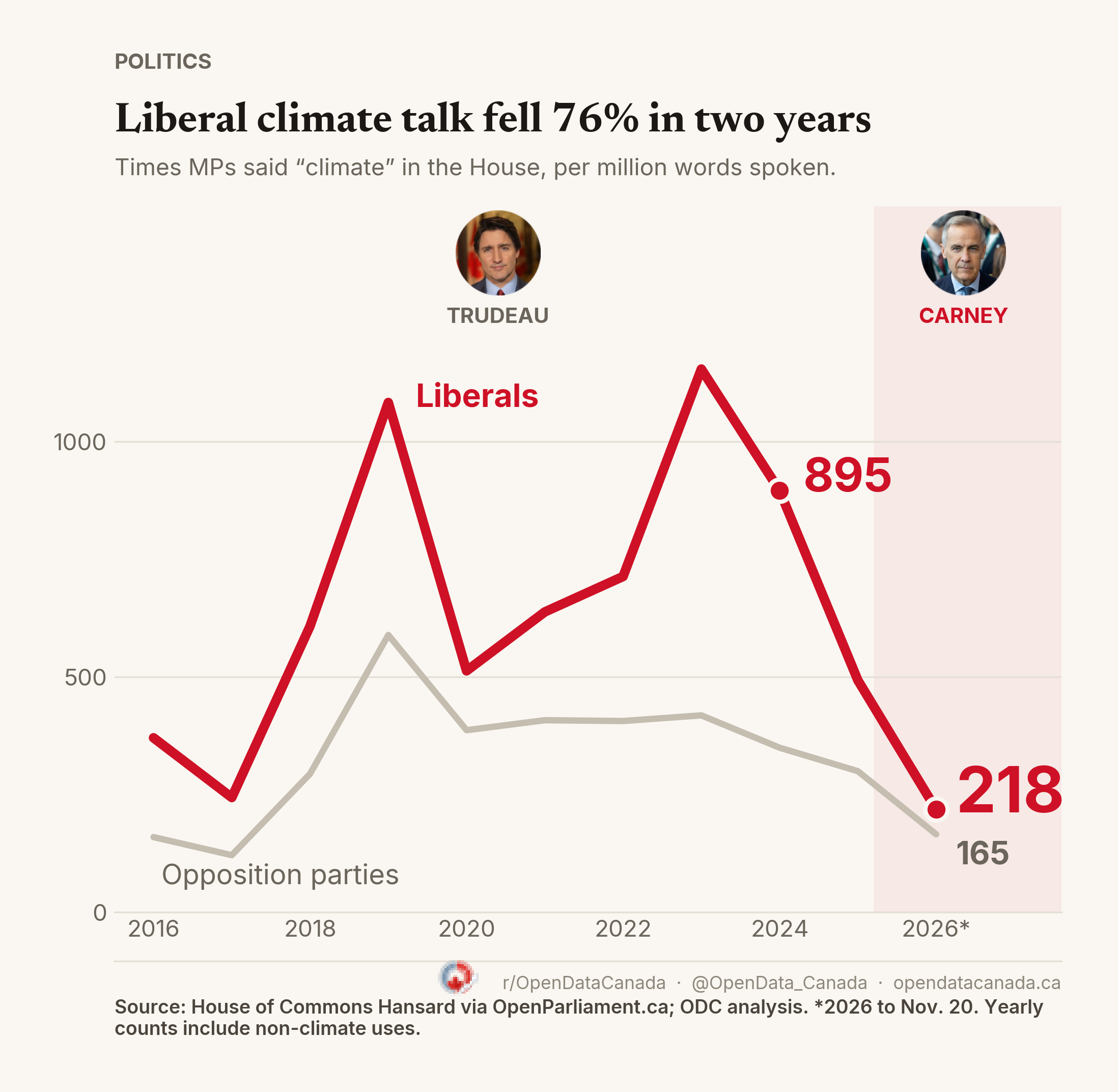
Then the talk itself fell. In 2024, Liberal MPs used a climate word 895 times per million words. In 2026 so far, the figure is 218.
The change in words came as Carney’s government reworked the climate policies it inherited, and as Ottawa’s own projections show Canada moving further from its 2030 target.
The two prime ministers differ too. In his first 20 months, Trudeau said “climate change” 40 times in the House, 15 of them in the Paris debate described below. Carney, who did not have a seat until May 2025 and speaks in the House far less, has said it twice. Word for word, that is about one-fifth as often as Trudeau. The counts are small. Carney has also told the House “the climate crisis is real” and that Canada “will respect our Paris commitments for climate change.” Half the time he says “climate,” he is citing the Canadian Climate Institute on carbon pricing or naming his “climate competitiveness strategy.”
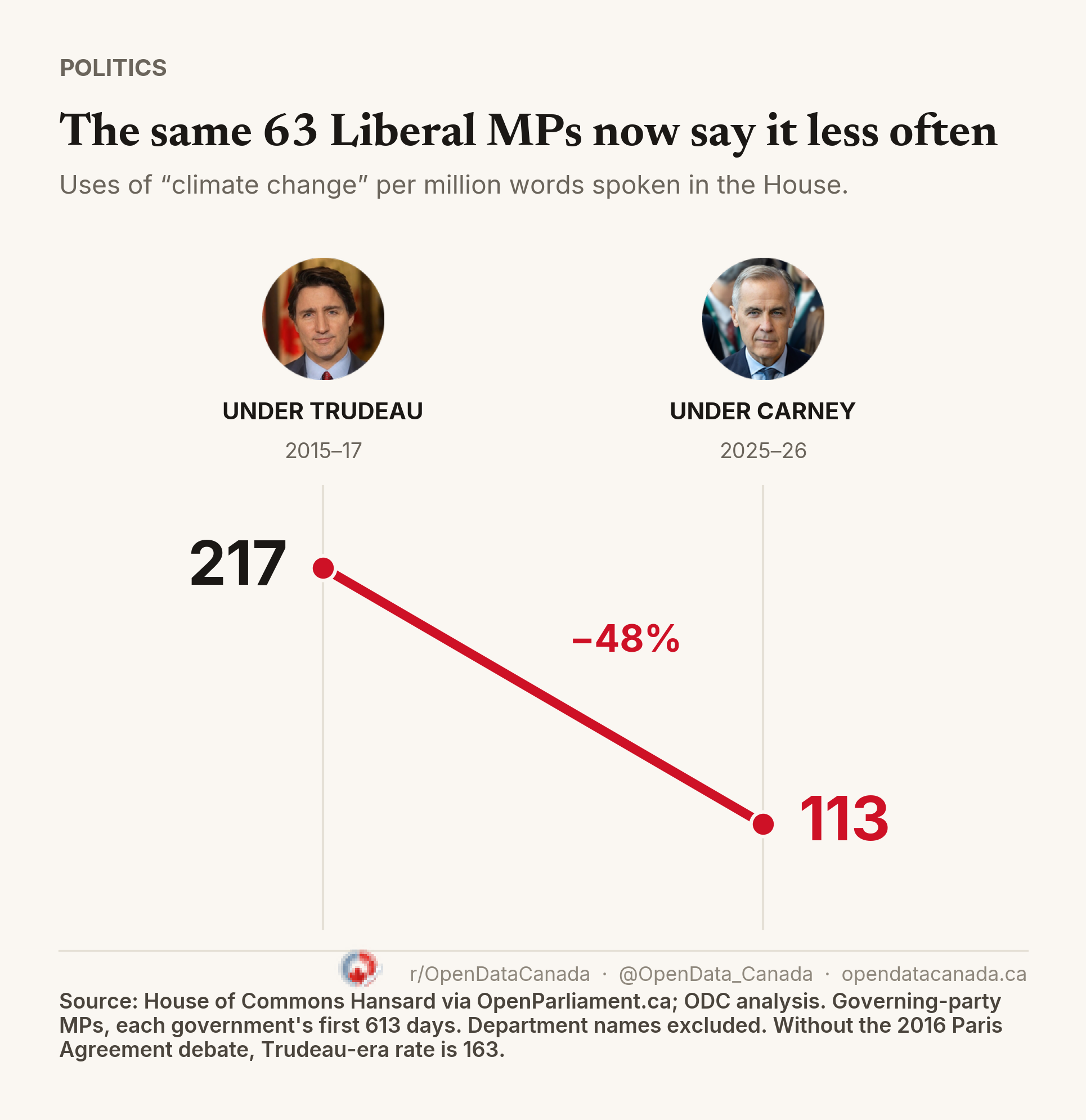
It is not only new faces. Sixty-three Liberals spoke in the House in both Trudeau’s first 20 months and Carney’s. Back then, they said “climate change” 217 times per million words. Now it is 113. Leaving out the Paris debate described below, the drop is from 163 to 113, about a third. MPs first elected under Carney or late in Trudeau’s tenure moved furthest: among the 63 returning MPs, “climate change” is still 60% of climate mentions, against 46% for all Liberals.
The Liberals were late to this shift. Opposition MPs moved away from the phrase years earlier: since 2020, fewer than half of their climate mentions have said “climate change.” The Liberals stayed at 59% to 73% through Trudeau’s last five years, then fell to 46% in 2025, the year Carney took over.
Part of Trudeau’s early lead comes from three days of debate on ratifying the Paris Agreement in October 2016, which hold about a quarter of his MPs’ uses of the phrase in his first 20 months. Without them, Trudeau’s Liberals said “climate change” 201 times per million words, against 155 for Carney’s. That is still lower under Carney, but the gap is small enough that it could come down to which debates happened to come up. The share is the clearer measure: with or without the Paris debate, about eight in 10 Trudeau-era climate mentions said “climate change,” against fewer than half now.
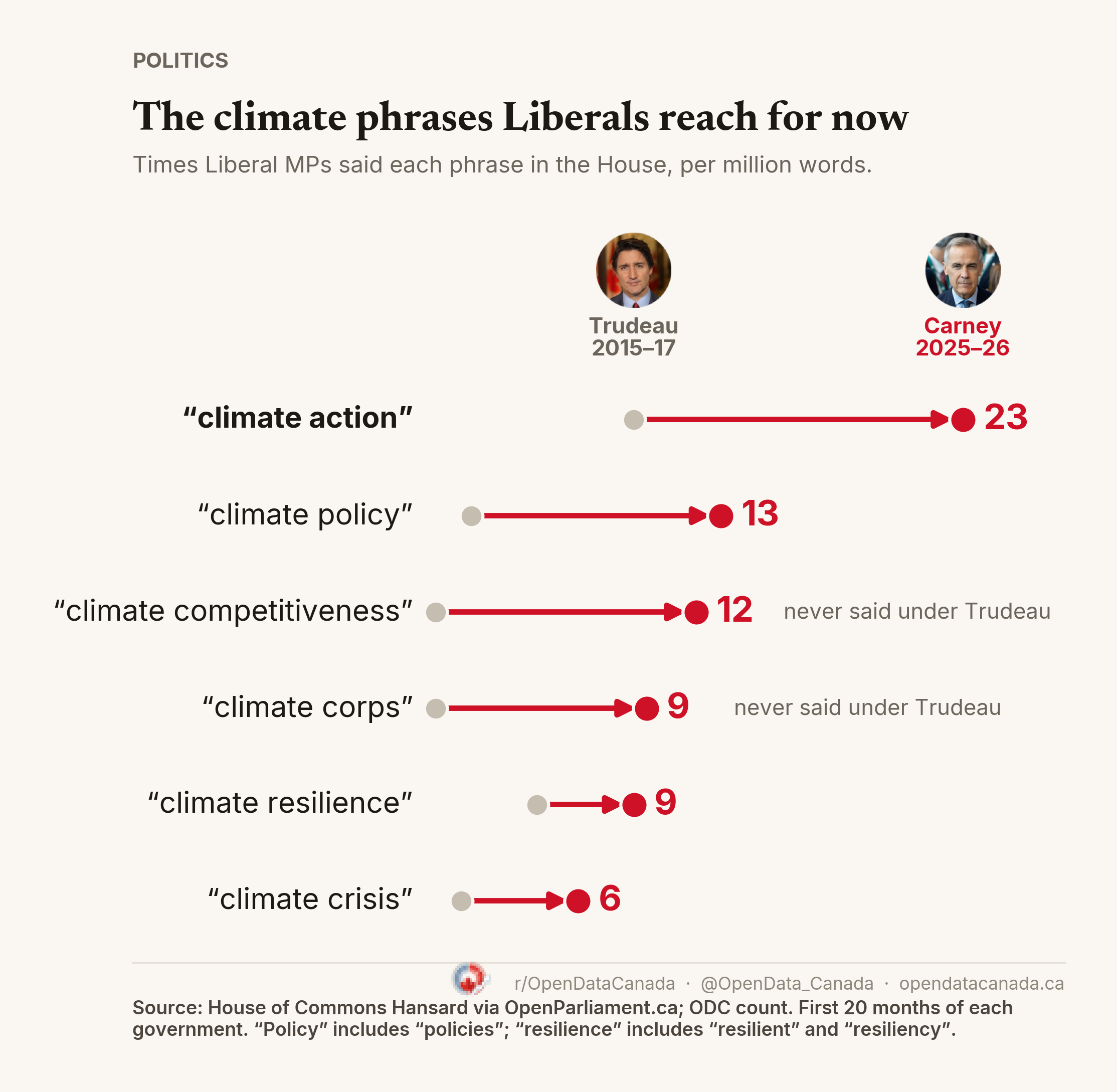
The new words name what the government is doing, not the problem. Carney’s MPs say “climate action” more than twice as often as Trudeau’s did. “Climate competitiveness” and “climate corps” went from nothing to regular use. Both are names of Budget 2025 programs: the Climate Competitiveness Strategy (Budget 2025) and the Youth Climate Corps. The strategy’s section of the budget says “climate change” three times. Word counts show how a government describes its plans. They don’t show what those plans will do to emissions.
In 2025, Carney’s first year, Liberals talked about climate about half as much as in 2024, and in different words. Their use of “climate change” fell by two-thirds from 2024, while the opposition’s barely moved.
In 2026 the subject itself dropped away. Liberal MPs have used a climate word 218 times per million words this year, less than half the 2025 rate. That is lower than in any year of Trudeau’s government. They have said “climate change” 100 times per million words, close to the average under Stephen Harper’s Conservatives (90). Under Trudeau, the Liberal average was 470.
The whole House is quieter. Opposition MPs have said “climate change” 66 times per million words this year, their lowest since at least 2006. From 2025 to 2026, both sides cut their use of the phrase by more than half.
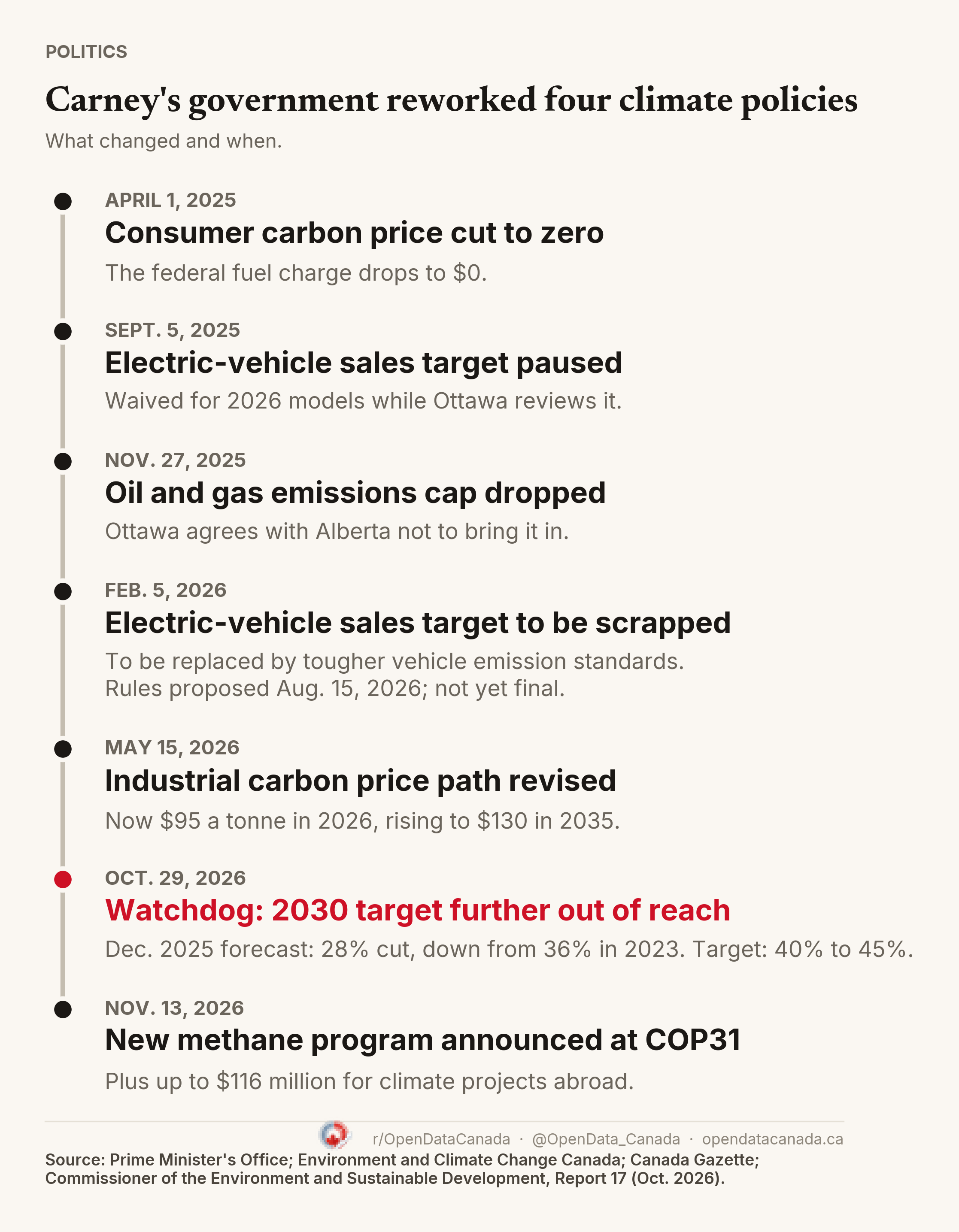
The new words arrived alongside new policies. The speech data can’t show that one caused the other, but the list is long.
- The consumer carbon price was set to zero on April 1, 2025 (Finance Canada).
- The 2026 electric-vehicle sales requirement was waived in September 2025 (PMO). In February 2026, the government said it would repeal the requirement and rely on tougher vehicle emission standards instead (ISED). The new rules were proposed in August and are not yet final.
- Under the November 2025 agreement with Alberta, Ottawa said it “will not implement the Oil and Gas Emissions Cap” (PMO).
- In May 2026, Ottawa set a new path for the industrial carbon price: $95 a tonne this year, rising to $130 by 2035 (Environment and Climate Change Canada). The environment commissioner lists industrial carbon pricing as “weakened.”
The government says its climate competitiveness strategy can still cut emissions while protecting jobs and investment. It points to methane rules, industrial carbon pricing, clean-investment tax credits and new electricity projects. Catherine Abreu, a former member of the federal Net-Zero Advisory Body, sees it differently. She told the Commons environment committee in June that the climate competitiveness strategy “repealed or weakened virtually every climate policy and regulation Canada had developed in the last decade” (committee transcript).
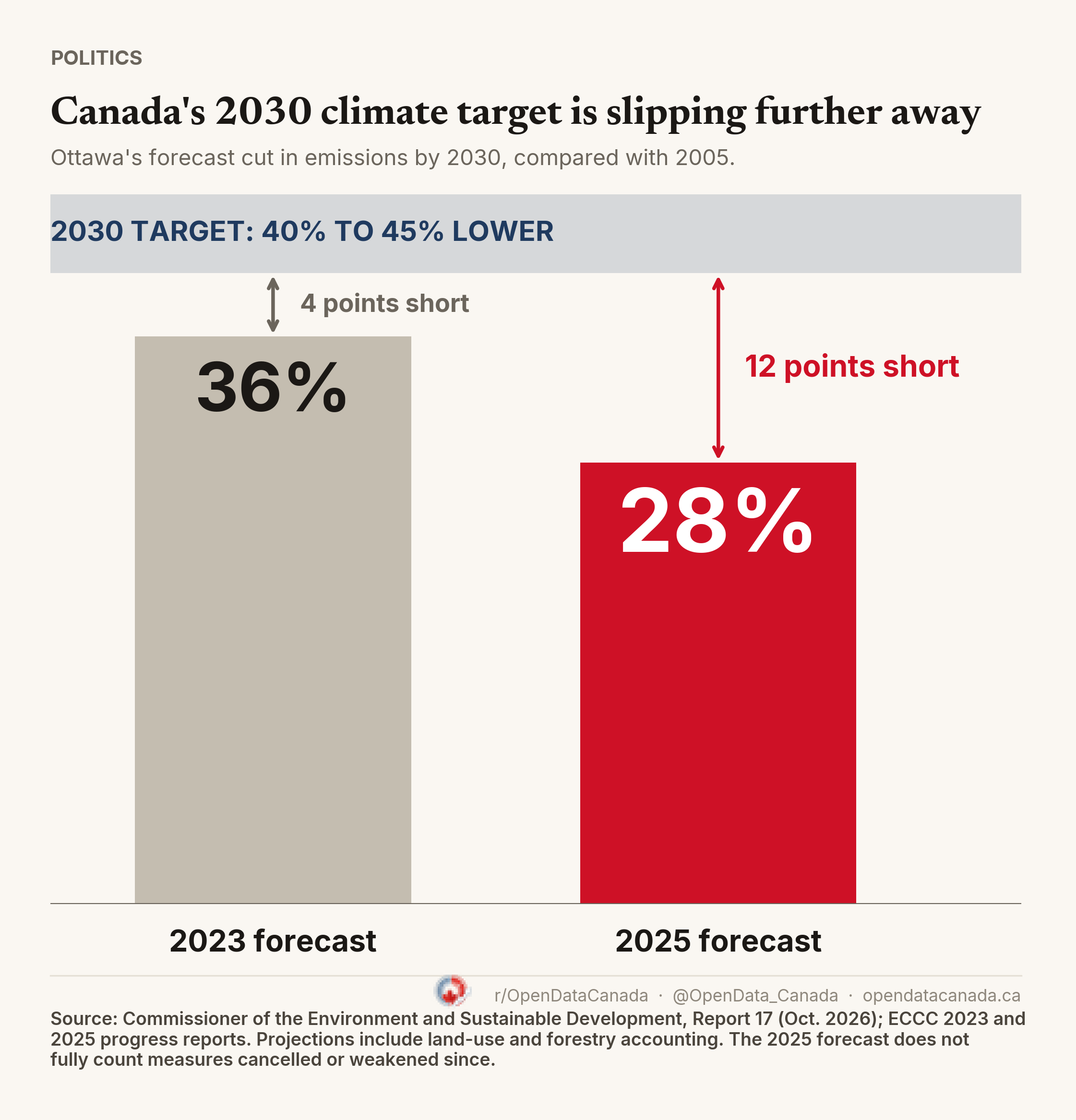
Canada has promised to cut its greenhouse gas emissions 40% to 45% below 2005 levels by 2030.
In 2023, Ottawa’s projections had Canada reaching a 36% cut. The latest projections, published in December 2025, show 28% (Commissioner of the Environment and Sustainable Development). Those projections “do not yet fully account for the impact of recent decisions to cancel or weaken several emissions reduction measures,” the commissioner’s office said on Oct. 29, so the real gap may be wider.
The report lists six measures from the government’s own emissions plan that were cancelled or weakened in 2025 and 2026: the consumer carbon price, the oil and gas cap, industrial carbon pricing, the electric-vehicle sales target, the 2 Billion Trees program and a low-carbon fuel purchasing program. It found Environment and Climate Change Canada “did not report on how it would close the emissions gap” left by those changes (report). The commissioner does not say what drove the slide from 36% to 28%, or how much, if any, of it comes from these changes.
Actual emissions show how far there is to go. Canada emitted 685 megatonnes in 2024, 0.3% less than in 2023 and about 10% below 2005 (National Inventory Report 2026). That figure leaves out land use and forestry, which the forecasts count, so it cannot be set directly against the 28%.
Abroad, the message is that Canada is still in. At COP31, it said it intends to put up to $116 million into 12 international climate finance projects (ECCC). It launched a program to export Canadian methane-cutting know-how and took the chair of the Global Methane Initiative (ECCC). Its COP31 announcement also pointed to a goal set in April: $13 billion in climate support for developing countries over five years (ECCC).
None of that is abandoning climate policy. It is a different mix, sold in a different language. The question is whether it adds up to the cuts Canada has promised. On the government’s own numbers, it does not yet.
The Trudeau government made “climate change” part of its political identity. Carney’s government has put competitiveness at the centre of its pitch. Whether that new approach delivers will show up in emissions, not speeches.