
Quick overview
- Spot gold (XAU/USD) is trading near $3,605, up about 1.9% after a significant decline last week.
- The 10-year Treasury yield fell below 5%, providing support for gold as lower yields reduce the cost of holding it.
- Inflation expectations dropped sharply, with consumers now expecting a 3.7% rise in prices over the next year.
- Analysts suggest that gold may find near-term relief as ETF holdings remain resilient despite recent volatility.
Spot gold (XAU/USD) is trading near $3,605 in Monday’s Asian session, November 23, up about 1.9% after its worst week since March. The 10-year Treasury yield fell back below 5% on Friday and consumers’ inflation expectations dropped sharply, giving gold its first real support in weeks. The level that matters is $3,593, with US PMI data due at 14:45 GMT.
My view: cautiously bullish above $3,592.83. A 2-hour close above $3,651 targets $3,696 and $3,742, while a break below $3,501 reopens the downside.
Yields Fall Back Below 5%
The 10-year Treasury yield, the interest the US government pays to borrow for 10 years, dropped about 0.10 percentage points on Friday to roughly 4.94%, its lowest in several weeks. The 2-year yield, which closely tracks where traders expect Fed rates to go, eased to about 4.65%. Lower yields help gold because it pays no interest, so holding it costs less when bonds pay less.
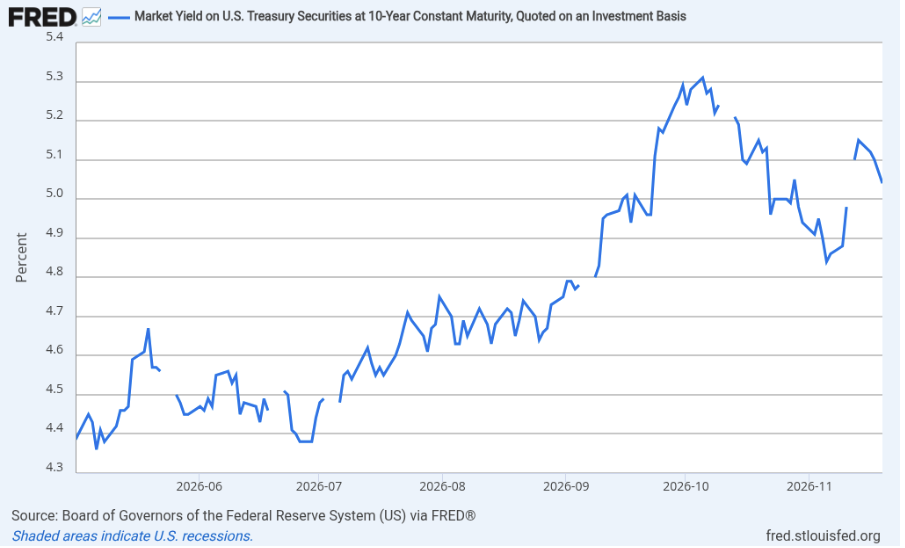
10-year Treasury yield since May, data through November 19, before Friday’s drop to about 4.94%.
For me, the 5% line on the 10-year yield has been the key gauge all month. Every gold bounce in November failed while yields stayed above it, so a hold below 5% this week would give this rebound a much better chance.
Inflation Expectations Drop a Full Point
The University of Michigan’s final November survey showed consumers expect prices to rise 3.7% over the next year, down from 4.7% in October. Longer-term expectations eased to 3.3% from 3.5%, and the sentiment index rose to 51.5, its highest since August. Inflation expectations matter because the Fed worries that if people expect higher prices, they behave in ways that keep inflation high.
The data helped markets scale back bets on a half-point hike in December, although a 25-basis-point move is still expected at the December 8 to 9 meeting. A basis point is one-hundredth of a percentage point.
Treasury Secretary Scott Bessent also added to the debate earlier this month. “To hike too much into an energy supply shock when it’s coming down, these are very noisy numbers,” he told CNBC on November 13, Al Jazeera reported.
Why Gold Fell Again on Friday
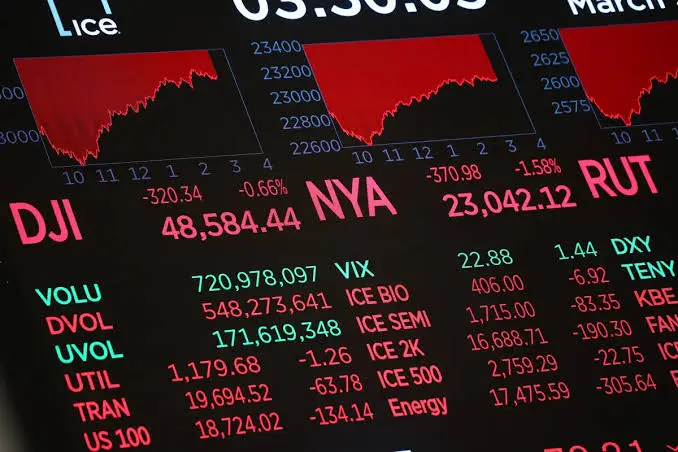
Lower yields did not stop gold from falling on Friday. Spot gold ended near $3,537.90, down 2.38%, after touching $3,502.93, its lowest since September 2025, as stocks crashed. The S&P 500 plunged 3.70% to 6,910, more than 10% below its October 6 record, which puts it in correction territory. The Nasdaq tumbled 5.28% and is now negative for 2026. That extended the selling I covered in Friday’s gold forecast.
When stocks fall this hard, some investors sell gold to raise cash or cover losses elsewhere. “Renewed forced selling may be playing a role following another sell-off in technology stocks,” Commerzbank analyst Carsten Fritsch said. Gold lost roughly 9.5% last week.
Analysts See Signs of a Bottom
TD Securities said gold-backed ETF holdings, funds that hold physical gold for investors, remain resilient. It added that high volatility could push CTAs, trend-following funds that trade on price momentum, to cover their short bets, which would give gold near-term relief. Saxo Bank’s Ole Hansen said markets may be overpricing Fed tightening: “We may see another rate hike, but not the series currently being priced in.”
Longer term, CIBC warned the US could hit its $41.1tn debt ceiling, the legal limit on federal borrowing, as early as late February. “Gold continues to play an important role as a hedge against growing sovereign debt risks,” the bank said. Société Générale keeps a 10% gold allocation and expects $5,000 by the end of 2027.
What’s Next: PMIs, GDP and PCE Before Thanksgiving
- Today, 14:45 GMT: preliminary November PMIs, surveys of purchasing managers that give an early read on business activity.
- Later this week: Q3 GDP and October PCE inflation, the Fed’s preferred inflation gauge. A soft PCE reading would be the strongest support for this rebound.
- Thursday: US Thanksgiving holiday, so trading will be thin and moves can be sharper than usual.
The big risk is stocks. If the sell-off resumes, forced selling could drag gold lower again regardless of yields.
Gold Technical Analysis: XAU/USD Rebounds From $3,501, Reclaims $3,593 Fib
On the 2-hour chart, gold trades at $3,608.36, flat in the current candle, after bouncing twice from $3,501.56. That double bottom, two lows at the same level, is a sign of buyer support. Price has reclaimed the 23.6% Fibonacci retracement at $3,593.34, a tool that measures how much of a drop has been recovered. Buyers stepped in fast, though the trend stays bearish under both moving averages, average-price lines at $3,686.21 and $3,781.78.
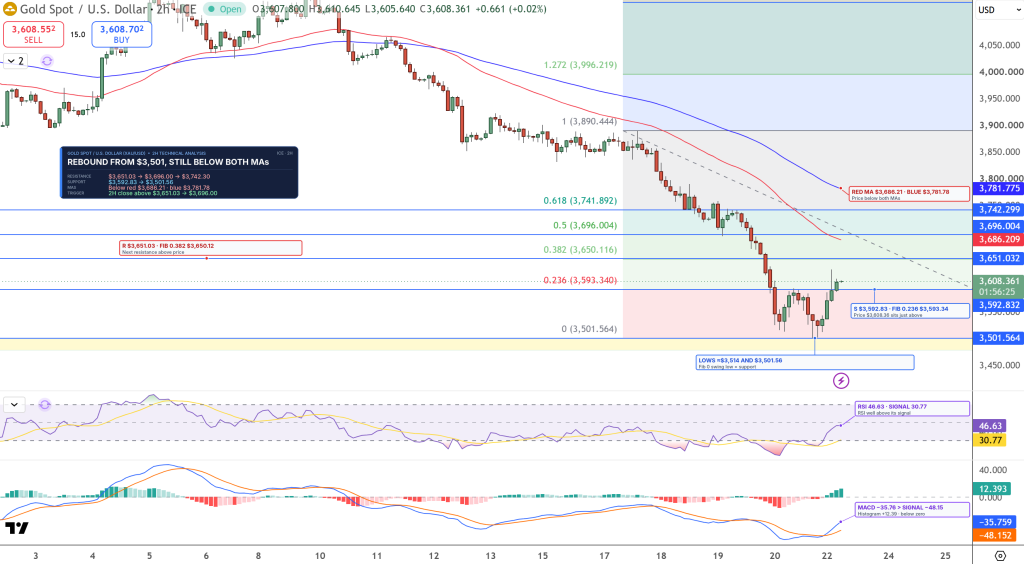
The RSI, a 0 to 100 momentum gauge, has climbed to 46.63, well above its signal line at 30.77. MACD, another momentum tool, reads -35.76, above its signal at -48.15, showing buyers are gaining strength.
I’m cautiously bullish above $3,592.83. A 2-hour close above $3,651 targets $3,696 and $3,742, while a break below $3,501 reopens the downside.
- Resistance: $3,651.03 | $3,696.00
- Support: $3,592.83 | $3,501.56
Latest FXLeaders Live Session
Saturday’s FXLeaders live session is a price action masterclass on reading market structure, drawing the support and resistance zones that matter, and trading breakouts and retests with risk defined.
FAQs
Why is gold rebounding today?
The 10-year Treasury yield fell below 5% and consumers’ one-year inflation expectations dropped to 3.7% from 4.7%, easing pressure from Fed hike bets.
Why did gold fall on Friday despite lower yields?
The S&P 500 dropped 3.7% into correction territory, and some investors sold gold alongside stocks to raise cash.
What is the key level for gold?
The key support is $3,593. A 2-hour close above $3,651 would open $3,696, then $3,742, while a break below $3,501 reopens the downside.

Arslan Ali Butt
Lead Markets Analyst – Multi-Asset (FX, Commodities, Crypto)
Arslan Ali Butt serves as the Lead Commodities and Indices Analyst, bringing a wealth of expertise to the field. With an MBA in Behavioral Finance and active progress towards a Ph.D., Arslan possesses a deep understanding of market dynamics.
His professional journey includes a significant role as a senior analyst at a leading brokerage firm, complementing his extensive experience as a market analyst and day trader. Adept in educating others, Arslan has a commendable track record as an instructor and public speaker.
His incisive analyses, particularly within the realms of cryptocurrency and forex markets, are showcased across esteemed financial publications such as ForexCrunch, InsideBitcoins, and EconomyWatch, solidifying his reputation in the financial community.