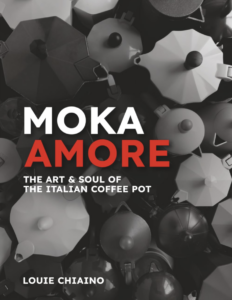
Moka Amore: The Art & Soul of the Italian Coffee Pot, by Louie Chiaino
Review by Pamela Dorazio Dean
Part of my graduate studies in history focused on material culture, the study of what objects can tell us about the people who make, use, and keep them. We do a casual version of this whenever we glance into someone else’s grocery cart and draw conclusions about their life. A cart filled with juice boxes, chicken nuggets, and cereal suggests a different household than one holding a single steak and a bottle of wine. Those impressions may not tell the whole story, but they begin with the simple idea that the things people choose reveal something about them. As museum curators, we take that curiosity further, examining objects for evidence of daily routines, personal values, family traditions, and broader historical change.
Italian and Italian American life offers a wealth of objects to explore this way. A hand-cranked pasta machine, a well-used pizzelle iron, a wooden polenta board, or a winepress in the basement can tell stories about work, ingenuity, and traditions carried across generations and oceans. Religious medals and statues brought from Italy connect faith with memories of home. Even an ordinary set of espresso cups can reveal something about hospitality and the importance of making time for company. Their significance comes from both their use and the people and experiences associated with them.
And, of course, there is the moka pot. This familiar stovetop coffee maker brings together so many of those connections between objects, daily rituals, and cultural identity. Its significance extends beyond the coffee it brews. It can evoke memories of a parent’s kitchen, conversations around a table, or the familiar sounds and aromas that mark the beginning of a day. We see it so often that we rarely stop to think about its history or what it means to us. This is why I was excited when author Louie Chiaino sent me a copy of his new book, Moka Amore: The Art & Soul of the Italian Coffee Pot. I was glad to see a book that explores the moka pot’s history in a way that is easy to follow, with plenty of images to help tell the story.
Before getting into the content, I have to mention the book’s appearance. We are told not to judge a book by its cover, but when the subject is a physical object, the way it is presented matters. The hardcover edition is designed as a coffee table book, an appropriate place for a book about a coffee pot. A less expensive softcover edition has just as much visual appeal. Colorful pages and wonderful images are interspersed with insightful observations, analysis, and engaging stories. The images allow readers to examine the shapes, colors, and details of objects they might otherwise know only through a written description. For those familiar with the moka pot, there is something satisfying about seeing an everyday object given this attention, along with the opportunity to notice something new. For others, the photographs help them get to know the moka pot and understand its appeal. It is a book you can read from beginning to end or pick up and browse, stopping at an image that catches your attention and reading the story that goes with it.
Chiaino’s interest in moka pots began at home, in the Italian household where he grew up. Making coffee was part of the family’s daily routine and a reason to sit together. His collection, however, began with three pots at a neighbor’s rummage sale. Learning that they had belonged to her mother and that nobody wanted them brought back his own childhood memories. He bought all three, beginning a collection that would eventually number in the hundreds. Sharing those pots through exhibitions and public events led to conversations with people who had their own memories to share. Those encounters encouraged him to put his stories on paper, both to explore the variety of moka designs and to share the traditions surrounding Italian coffee.
The book places that personal story within a broader history. Chiaino discusses coffee’s role in Italian society, including gathering places such as Venice’s Caffè Florian, before exploring subjects ranging from Futurism to the contributions of Alfonso and Renato Bialetti. Chapters on Alessi, changing designs, and the moka pot as a collectible show how much there is to consider beyond its practical function. Other sections address the Italian diaspora, coffee beans, and the workings of the pot itself. This range gives readers several ways to connect with the subject, whether their interests lean toward history, design, collecting, or simply making coffee.
Moka Amore is simply a great read. I enjoyed returning to it to see what came next, whether it was a personal story, a bit of history, or an unusual coffee pot design. It is packed with variety, and the information comes in manageable pieces that make it easy to keep reading. Readers do not need an academic background or even a particular interest in material culture to appreciate how Chiaino connects his experiences as a collector with the history behind these objects. His account of those first three unwanted pots brings me back to the questions we ask as curators: What can an object tell us, and whose stories does it preserve? A moka pot purchased at a rummage sale may have little monetary value, yet carry decades of family history. The book also left me thinking about the familiar objects in our own homes and the stories we might want to learn, record, and share.
The combination of history, personal connection, and visual appeal makes Moka Amore: The Art & Sould of the Italian Coffee Pot a thoughtful gift as the holidays approach. Anyone interested in Italian culture, design, or collecting will find something to enjoy, and a coffee lover may discover a new appreciation for a favorite daily ritual. It could be a particularly meaningful gift for someone who remembers a moka pot in a parent’s or grandparent’s kitchen, prompting conversations and the sharing of family memories. Pair it with a moka pot and some good coffee, and you have a gift with a story to tell.
The book is available on Amazon.