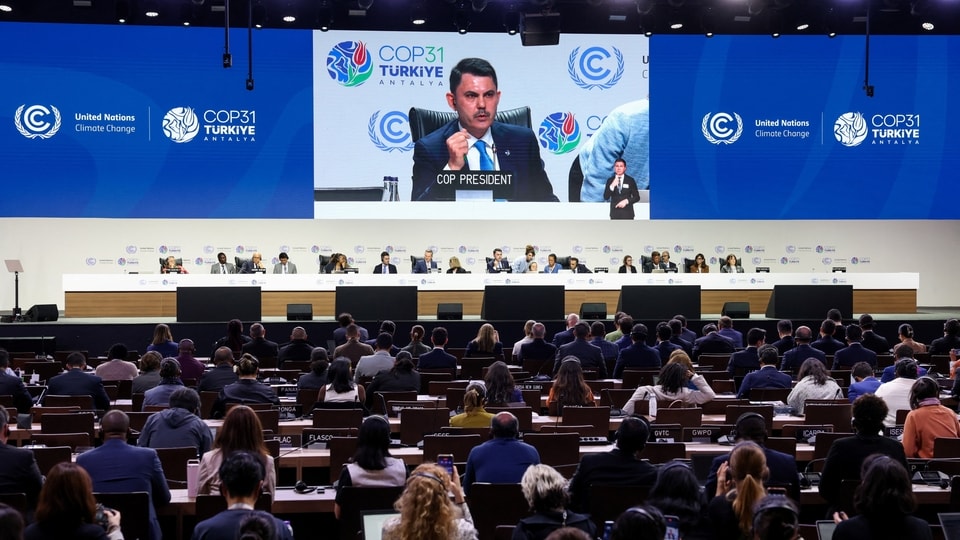
The COP31 in Turkey became the longest-ever United Nations climate conference, with the summit running 44 hours past its scheduled closing time as negotiations over a final agreement remain deadlocked.
This comes even as the European Union on Sunday rejected a proposed “cover decision” which makes no explicit mention of fossil fuels. The EU said its member states would not endorse the ‘Antalya pact’ in its current form, arguing that any agreement that failed to mention fossil fuels – the primary driver of climate change – would fall short of action needed to address the climate crisis.
“We will not endorse a cover decision or an Antalya pact that does not even mention fossil fuels, which is the key driver of climate change, and we will not accept negotiating backward in time, and we will not accept a COP that green-washes fossil fuel,” news agency Reuters cited the EU delegation spokesman, Ireland minister Darragh O’Brien, as saying.
Also Read | Carbon capture is a key flashpoint at COP31. Why it is contested & how it differs from CO2 removal
He said the chances of the world securing a deal at COP31 were diminishing “by the hour”, adding that the proposed text “lacks the climate ambition that is needed to tackle this climate crisis.”
The Turkey summit, which was scheduled to conclude on Friday, surpassed the previous record for the longest UN climate conference, held by COP25 in Madrid in 2019. That summit ended at 1.55 pm on Sunday, instead of its scheduled closing time of 6 pm on Friday, according to the Earth Negotiations Bulletin, an independent service that tracks UN treaty negotiations.
At COP31, negotiations continued more than 40 hours beyond the deadline, with delegates struggling to reach consensus on the pace of the transition away from fossil fuels, the expansion of carbon capture technology and financial support for developing nations.
Draft agreement’s ‘omission’ of fossil fuels remains sticking point
The latest draft agreement, put forward by summit co-hosts Turkey and Australia, triggered opposition from the EU and smaller island nations after it omitted an explicit reference to fossil fuels. The proposed text requires consensus among nearly 200 countries to be adopted.
The text makes an indirect reference to a 2023 global agreement to transition away from fossil fuels but does not explicitly name them.
The EU delegation said the drafts presented to countries did not adequately address the climate emergency. Belgium’s climate minister Jean-Luc Crucke criticised the proposal, saying it was unacceptable for countries to agree to a text that failed to address the issue. “It is unacceptable. It’s not the end of multilateralism, but there has to be courage to say no,” he said.
The draft’s language as faced resistance from oil-producing nations and countries heavily dependent on fossil fuels, including Saudi Arabia. A German official said oil-producing countries were putting up a “fierce fight” during the negotiations.
Attempts to bridge the differences continued over the weekend. Threats of a walkout on Saturday prompted Turkey and Australia to convene an urgent meeting between the EU and Saudi Arabia, but no compromise emerged.
The latest draft also retains a push to expand carbon capture technology, which is backed by the fossil fuel industry but criticised by environmental groups as costly and ineffective in reducing emissions.
COP31 presidency appeals for consensus, electrification proposed as alternative pathway
As the talks entered unprecedented overtime, COP31 President Murat Kurum urged countries to find common ground and adopt the proposed text.
“While no one obtained everything they might have desired, everyone can find a place for themselves within this text—that is the very essence of consensus,” Kurum said, expressing hope that the outcome would demonstrate that multilateralism could still deliver results.
Also Read | COP31 goes into overtime: Fossil fuel, adaptation finance impasse persists
He later said the proposed cover decision would be presented to countries shortly, leaving its fate to the participating nations. He added that if the agreement was not adopted, those responsible for pushing the COP process into a deadlock would need to reflect on their position.
Meanwhile, even as they face resistance over explicit fossil fuel commitments, Turkey and Australia have sought to build consensus around electrification as a way to reduce emissions and strengthen energy security. Electrification involves replacing technologies that directly burn fossil fuels, such as diesel-powered vehicles and gas-based heating systems, with electric alternatives.
The draft calls for global efforts to increase electricity’s share of total final energy consumption to 35 per cent by 2035 and expand the use of clean energy. However, it does not explicitly require that the electricity used for this transition come from renewable sources.