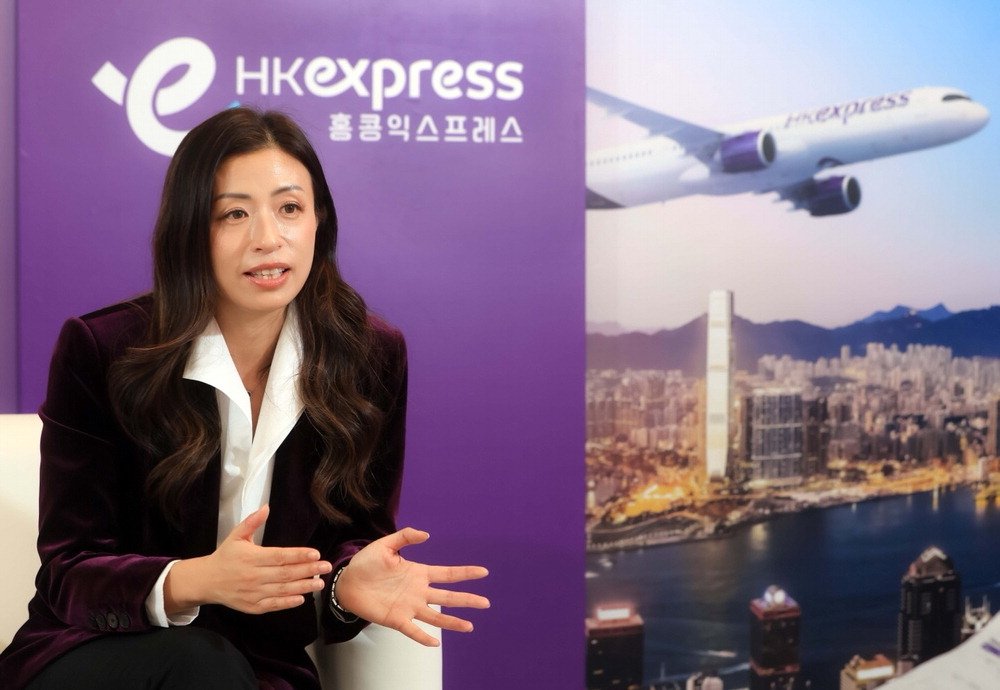

Understand Avenue in Seongsu-dong, Seoul, on November 12. On one side of the alley, the boarding gate in the airport popped up. Once you’ve checked in past the gate, the trip has already begun. I also heard a cup of Hong Kong-style milk tea in my hand. I feel like I reached Hong Kong first without going to the airport. The owner of the space, which is considered perhaps the smallest airport in the world, is Hong Kong’s low-cost airline (LCC) Hong Kong Express (HK Express). It is the first consumer pop-up in 12 years since the first Incheon-Hong Kong route was launched in 2014. “When you go to Hong Kong?” Janet Mao, CEO of Hong Kong Express, attended the pop-up event named Hong Kong Express Airlines, drawing attention.
I think he just said that Korea was the first overseas market he visited. It means to us that Korea is very special.” Mao’s first words were firm. Although it has focused on domestic demand in Hong Kong, it has decided that Hong Kong alone is not enough because of its rapid growth. After all, it is Korea that has touched the eye. “The number of Koreans using Hong Kong Express has increased by 36% over the past 10 months,” he said. “Korean travelers who want to travel young and cost-effective yet high-quality fits well with the direction we are pursuing.” Between January and October this year, the number of passengers on Korean routes exceeded 1 million, up more than 20% from the same period last year. However, there are still more users from Hong Kong to Korea. This is why it was sold in Seongsu-dong to increase demand for passengers from Korea.
He didn’t just tell good stories. There are many complaints online that baggage standards are strict and seat spacing is narrow. In response, Mao said he already knew. The alternative answer is ‘transparency’. “We launched the ultra-light fare in response to the demand that why we can’t ride it cheaper when we only have one bag. If you need more space to stretch your legs, you can add a front row or emergency exit seat, and if you have a lot of luggage, you can add luggage. You should clearly show what kind of services you receive according to the cost you spend.” It is suitable for MZ travelers who are pursuing cost-effectiveness these days or those who go alone with a backpack.
There are three competitive advantages in the fierce Korean aviation market: operational efficiency, route network, and optional fares. The strategy is to reduce costs to provide reasonable prices and expand travel options to routes connecting 36 Asian cities. As Cathay Pacific is a wholly owned subsidiary, some flights are co-operated (code-sharing) with Cathay Pacific. It is also possible to travel from regions such as Busan, Jeju, and Daegu to long-distance destinations such as London, England, and New York, USA via Hong Kong. CEO Mao explained, “You can transfer from Hong Kong and go to the wider world, and depending on your journey, luggage and in-flight meals are included in the connection.”
Then, what is Hong Kong’s unique charm that the head of the Hong Kong Express chooses. CEO Mao surprisingly first pointed out that Hong Kong is sixth behind Japan and others in the list of Korean destinations. He did not back down, citing the weak yen. “Hong Kong has a busy city center, but you can go to the island or walk through the mountains if you move a little bit. You can tour several cities with different charms with one trip, he said, adding, “In 20 minutes, Macau and Shenzhen, China are included in one schedule.” “In fact, this is the best time to visit Hong Kong,” he said, adding, “It is a paradise for things to enjoy, such as winter festivals, New Year’s countdowns, and fireworks.”
He also introduced how he filled his experiences above the sky like Hong Kong. On board, you can taste snacks, desserts, and milk tea in partnership with local brands. The most popular in-flight meal Curry Fishball sold 850,000 units. There is also a “Celebration in the Sky” package that hands cakes to lovers. In addition to operating Korean language websites and counseling centers for Korean customers, it also introduced Kakao Pay and Naver Pay, and hired Korean flight attendants. He also hinted that eight new aircraft will come in next year and that the total amount to be delivered from 2027 is 22.
What CEO Mao wanted from Korean travelers was simple. “I want Koreans to think of the Hong Kong Express first when planning a trip to Hong Kong. It is the role of low-cost airlines to get more people to fly and travel more often.” The small boarding gate in Seongsu-dong Alley was the first step in the appointment.
[Jang Joo Young Travel + Reporter]