Quick overview
- Micron Technology’s stock is currently trading at $1,087.61, supported by a strong semiconductor industry cycle and record revenue.
- A potential labor disruption in Taiwan poses a short-term risk, as a union has authorized strike action over profit-sharing disputes.
- Micron’s Q4 results showed significant growth, with revenue reaching $54.23 billion, and the company expects tighter supply-demand conditions in fiscal years 2027 and 2028.
- Customer commitments have surged to $32 billion, indicating strong future demand, particularly driven by AI infrastructure.
Micron Technology, Inc. (NASDAQ: MU) currently trades around $1,087.61, with the ongoing semiconductor industry cycle supporting prices, earnings, and visibility. The biggest short-term risk may be labor disruption in Taiwan where a Micron Union has recently voted to strike, although no strike date has been set. Recently, Micron reported strong results, with record revenue and increasingly strict supply of memory chips. Management expects memory and storage supply-demand conditions to be much tighter in fiscal 2027 and 2028 than they were in 2026.
I will maintain a bullish outlook, so long as MU trades above $1,030.76 and the rising trendline. A break above $1,107.66 reinforces the case for a move to $1,177.80 and a break below $990.88 negates the current bullish scenario.
Taiwan Labor Risk Becomes the Freshest Concern
The newest company-specific issue is the Taiwan labor dispute. A union representing Micron employees at its Taoyuan operations said 99% of 1,994 members who voted, authorized strike action over an employee profit-sharing dispute. Micron employs about 15,000 people in Taiwan and two unions in Taoyuan and Taichung represent about 80% of the workforce at these two locations.
No strike date has been set, and the planned October 19 labor rally in Taipei does not necessarily mean a strike. Regardless, the situation is significant given Taiwan is one of the most important locations for Micron’s DRAM and HBM memory chip fabrications. In an already constrained memory chip market, even a brief production disruption would increase supply chain risk for customer deliveries.
Q4 Results Confirm Extraordinary AI Demand
Micron’s Q4 results, announced on 30th September, illustrated the power of the current memory cycle. Quarterly revenue hit a record high of $54.23 billion, up from $41.46 billion in the previous quarter and $11.32 billion the year prior. Q4 GAAP net income was $37.70 billion, or $32.87 per share, compared to $28.24 billion, or $24.67 per share, in the previous quarter. Non-GAAP net income came out to be $38.40 billion, or $33.42 per share.
For the full fiscal year, 2026, Micron’s revenue more than tripled to $133.19 billion from $37.38 billion in 2025, with GAAP net income coming out to be $84.97 billion. Adjusted free cash flow for the year was $62.31 billion.
Q1 Guidance Raises the Bar Again
The more exciting part of the report was forward-looking guidance. Micron projected Q1 revenue at $61.5 billion, plus or minus $1.5 billion, exceeding the consensus estimate of $57.02 billion. Adjusted EPS was projected at $38.15, plus or minus $1 per share, exceeding the consensus of $35.40. Capacity and production expansions will remain a priority for the company, with the flexibility provided by strong free cash flow and financial strength.
The guidance indicates that the current memory upcycle is not peaking. Demand from AI infrastructure is absorbing advanced DRAM and HBM supply, and prices are strong. Over time, the market will test if Micron can keep pace as it ramps up capacity.
Customer Commitments Jump to $32 Billion
Long-term supply agreements are one of the better leading indicators. Micron noted that financial commitments from customers have increased from $22 billion to $32 billion, with the vast majority taking the form of cash deposits. Additionally, remaining performance obligations increased from $100 billion to $150 billion.
With this visibility into the future, management expects conditions in the memory market could become even tighter in FY 2027 and 2028.
HBM Supply Is Already Mostly Spoken For
Micron has most of its calendar 2027 HBM bit supply already spoken for, having secured agreements for the majority of its supply. This is a positive for Micron as it gives the company better visibility into revenues. HBM is constrained compared to the rest of the AI hardware supply chain due to the need for greater wafer capacity.
Historically, Micron has been cyclical, especially with memory. This scarcity, however, has helped Micron achieve better pricing and be less cyclical. Hyperscaler spending is expected to remain high, so HBM is expected to remain one of the strongest profit drivers in the semiconductor sector.
Samsung Reinforces the Memory Shortage Thesis
Industry data from Samsung further adds support to Micron’s viewpoint. Samsung also reported a very strong third quarter with AI demand boosting memory, and Micron expects memory and storage supply-demand conditions to remain tight through 2028.
TrendForce expects conventional DRAM contract prices to increase by 10% to 15% in the fourth quarter of 2026, from the third quarter. If true, that would represent a slowdown in the DRAM price increase from the 60% increase seen in the second quarter of 2026. However, pricing would remain strongly supportive of Micron’s revenue and margins.
Capacity Expansion Is the Next Constraint
In July 2026, Micron said it expected long-term U.S. investments would exceed $250 billion through 2035, and additional capacity was under development in Japan. The company expects initial wafer output from its first Idaho fab to begin in the middle of 2027, while initial output from its Japan DRAM expansion is expected in late 2028. Management said it could take several quarters for a new fab to ramp meaningful volumes.
In fiscal 2026, Micron reported capital expenditures of $27.37 billion, with $10.77 billion in expenditures in the fourth quarter of fiscal 2026. That expenditure level creates execution risk given the current outlook for demand and the development of additional capacity for AI applications.
The Main Risk Is No Longer Demand, but Execution
The strongest part of the Micron thesis is clear: the demand for AI memory is extremely strong, and customer commitments are increasing while supply is constrained. The greatest risks are now execution and managing expectations.
A labor disruption in Taiwan, slower spending by the hyperscalers, faster competitors expanding capacity or weaker pricing could all negatively impact Micron. MU is clearly pricing in very robust future financials, so any kind of slowdown could increase volatility.
Micron Technology Technical Analysis: $1,107.66 Is the Next Breakout Test
Micron is currently trading at $1,087.61 on the 4-hour chart, and what is interesting is that price is trading above a rising trendline and both moving averages after a sharp move higher from the $1,030.76 support area. A sequence of higher lows is in place which keeps the larger trend higher in place.
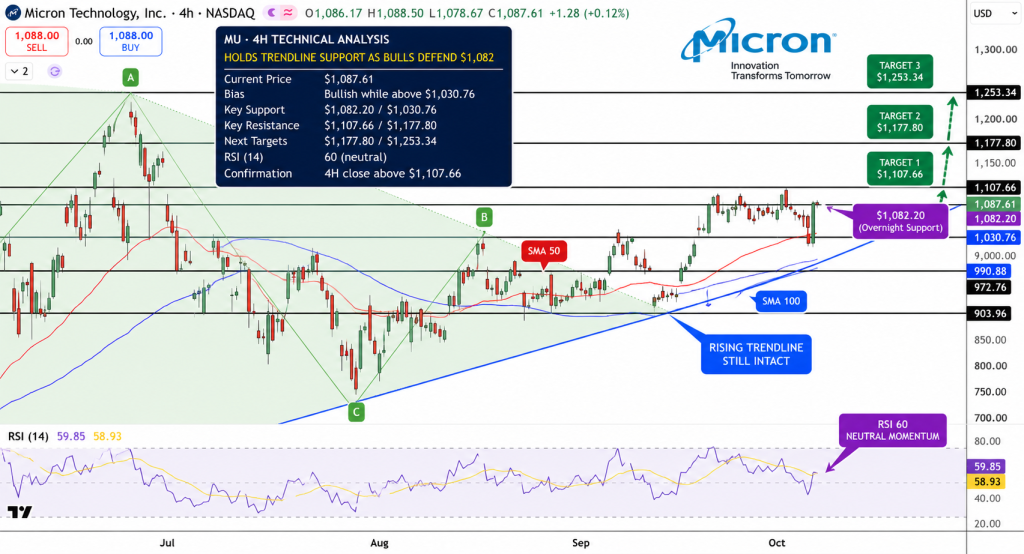
I have $1,107.66 as the first area of resistance, and above that price would target $1,177.80, and $1,253.34. On the other side, $1,030.76 would be the first area of support, with $990.88, $972.76 and $903.96 coming into play if that support fails.
RSI is at 60 and above its signal line, indicating that the trend is positive, but not overextended. As long as price is above $1,030.76 and the rising trendline, I will be bullish. A break above $1,107.66 would bring a target of $1,177.80 into play, and a break below $990.88 would negate the overall bullish trend.
Resistance: $1,107.66, $1,177.80, $1,253.34
Support: $1,030.76, $990.88, $972.76, $903.96
Frequently Asked Questions
Why is Micron benefiting from the AI boom?
AI accelerators require large high-bandwidth memory and advanced DRAM. The supply of both is currently restricted, which is helping Micron’s pricing and margins.
What is Micron’s biggest near-term risk?
The biggest near-term risk is the Taiwan labor dispute. Slower spending on AI and the normalization of memory prices would also increase risks.
What is the key MU breakout level?
The key breakout level is around $1,107.66. If $1,107.66 is broken through, the next levels of resistance are approximately $1,177 and $1,253.

Arslan Ali Butt
Lead Markets Analyst – Multi-Asset (FX, Commodities, Crypto)
Arslan Ali Butt serves as the Lead Commodities and Indices Analyst, bringing a wealth of expertise to the field. With an MBA in Behavioral Finance and active progress towards a Ph.D., Arslan possesses a deep understanding of market dynamics.
His professional journey includes a significant role as a senior analyst at a leading brokerage firm, complementing his extensive experience as a market analyst and day trader. Adept in educating others, Arslan has a commendable track record as an instructor and public speaker.
His incisive analyses, particularly within the realms of cryptocurrency and forex markets, are showcased across esteemed financial publications such as ForexCrunch, InsideBitcoins, and EconomyWatch, solidifying his reputation in the financial community.