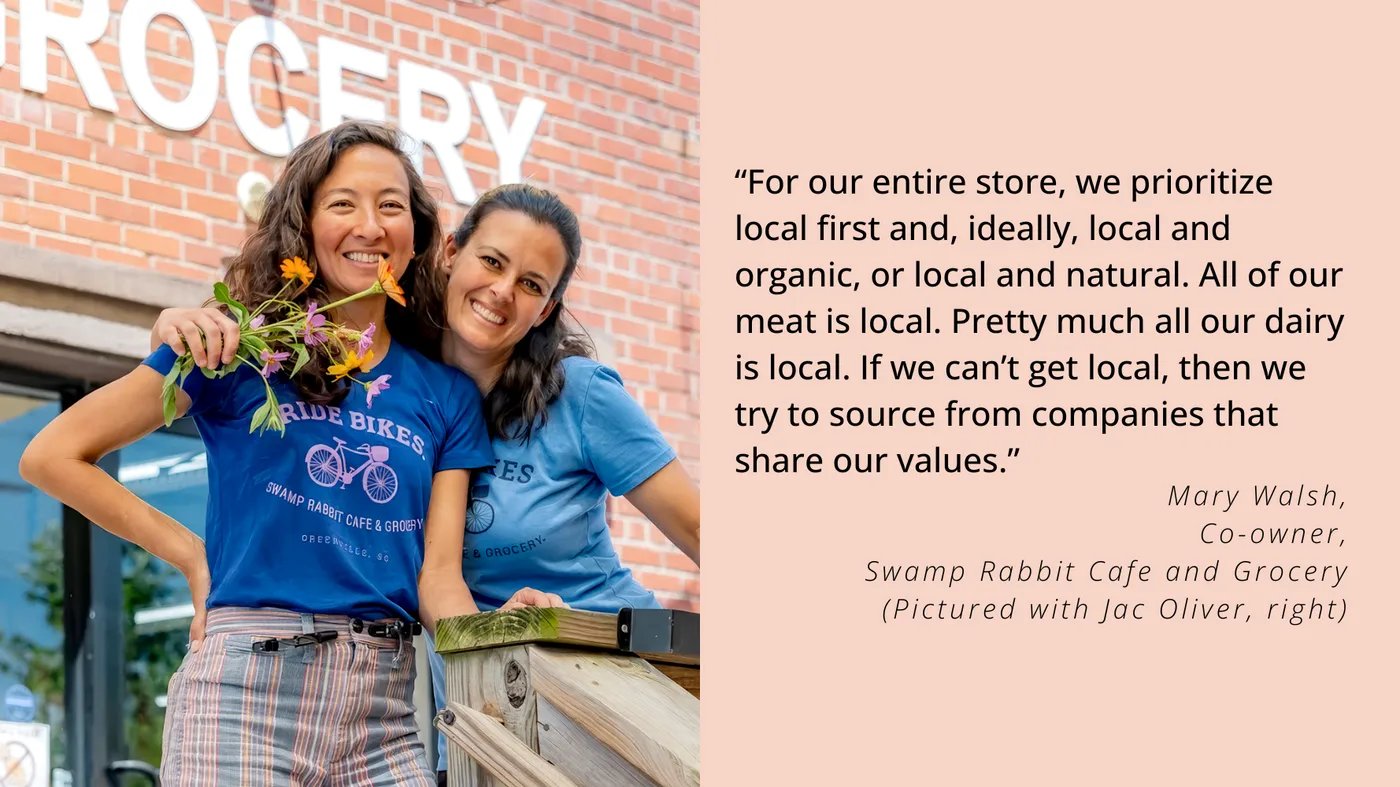
Several years back, Mary Walsh and Jac Oliver, then coworkers at an environmental nonprofit, bonded over their shared passion for locally produced food. They discussed how their Greenville, South Carolina, community could really benefit from a bustling neighborhood grocery store, eatery and gathering spot that sold food from area farmers and makers year-round.
“Like a lot of small businesses, it started with ‘We really want this thing and it doesn’t exist; nobody else is going to do it, so we might as well!’” Walsh says. In 2011, she and Oliver made it happen, opening Swamp Rabbit Cafe and Grocery in an old building alongside the city’s recently expanded Swamp Rabbit Trail, a multiuse recreational greenway.
The co-owners started small, with 1,200 square feet and only their husbands helping out, but their impact on the local food ecosystem was immediately significant. Over the years, Swamp Rabbit grew steadily in both size and scope, adding a wholesale business in 2016 and expanding its roster of regional growers and producers into the hundreds. And with sustainability woven into its mission, the company has achieved some impressive eco-feats as well. Here, Walsh shares more about this unique and thriving business.
So, in your early discussions with Jac, you both observed an abundance of local food that just needed a market?
Mary Walsh: Yes, the growing season here is long, and since we opened, we’ve expanded our network. We used to have farmers an hour away at most, and they’d deliver to us. But now we work with farmers in the Low Country, so the Charleston area, and as far up as the Charlotte [North Carolina] area. The more our business grows, the more we can buy, and it helps justify someone driving farther to bring us fresh strawberries every day.
Do you purchase all of your inventory directly from farmers?
MW: No. Right now, our purchasing is over 60% direct from farmers. We’re always trying to get better, but we’re also proud to have 60%.
What are Swamp Rabbit’s sourcing criteria?
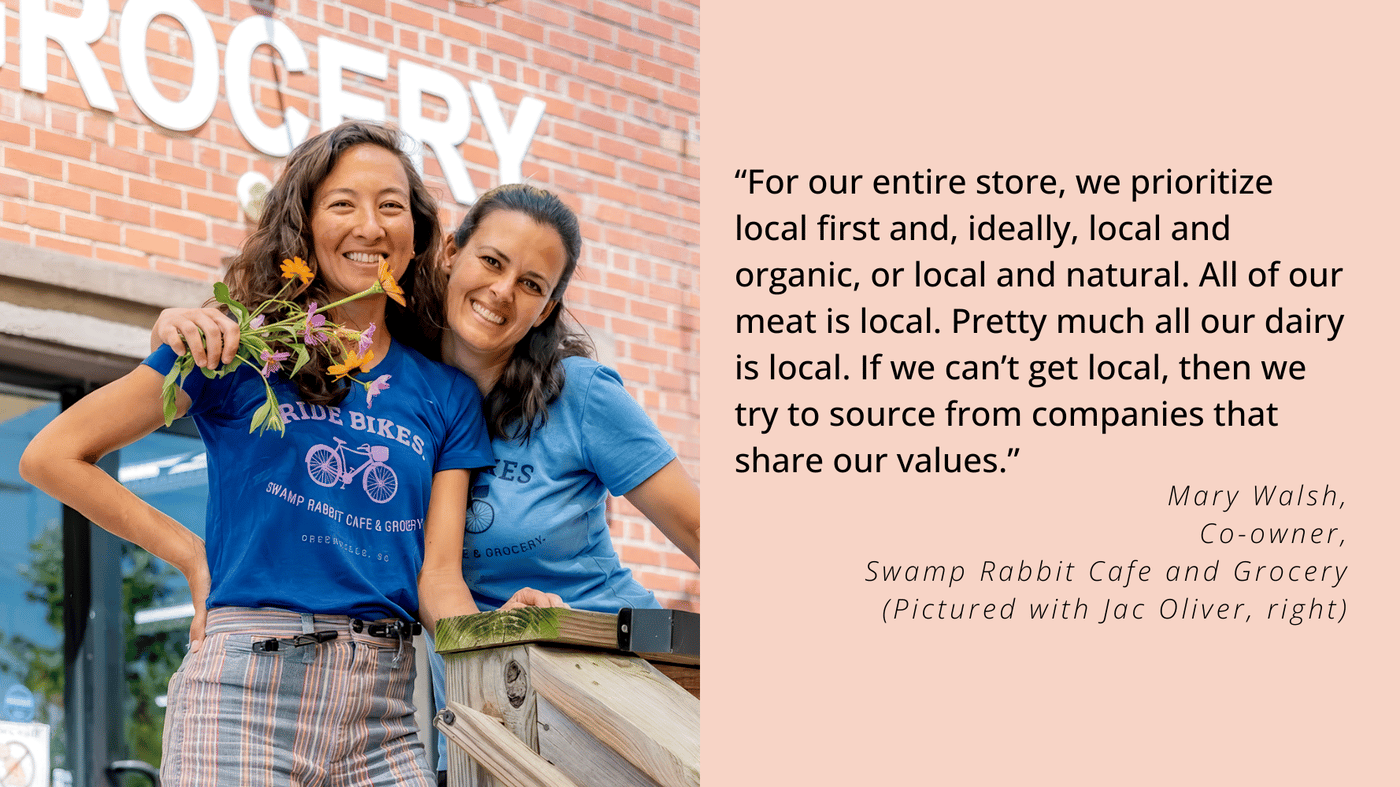
MW: For our entire store, we prioritize local first and, ideally, local and organic, or local and natural. All of our meat is local. Pretty much all our dairy is local. If we can’t get local, then we try to source from companies that share our values, like B Corporations that source local to them, or we buy certified-organic items, because you can trust how it was grown or made. In winter, when there are a lot fewer local items available, the produce department becomes mostly organic.
But overall, the key for us is sourcing intentionally, prioritizing local and transparency on how a product came to be. We have a list of ingredients that we never allow in our store. Simpler is better.
Please tell us about the Cafe.
MW: We make a lot from scratch. We have sandwiches, salads, breakfast items. We have a bakery and a big coffee program. We bake a lot of Stecca bread, which is an Italian bread brushed with olive oil and salt—that’s definitely something we’re known for in the community.
Why did you decide to launch a food hub?
MW: About five years into the business, we realized we were already spending all this time sourcing from over 300 farmers, so we started offering our product list to area restaurants and markets. So now we have a little wholesale operation where we deliver local food to places around town.
Do you aggregate the food at the store or have a separate facility?
MW: Not quite two years ago, we were bursting at the seams, so we purchased a warehouse. Luckily, it’s within walking distance of our main operation. Our store is now almost 15 years old, so we’re established and can confidently buy a lot from a farmer, but the food hub was tricky because of our limited space. Now that we have a warehouse, our wholesale business has grown a lot because we can confidently buy products and know we’ll have space to store them. Now we get anywhere from 40 to 100 wholesale orders in a week, depending on what we have available.
How does Swamp Rabbit prioritize sustainability?
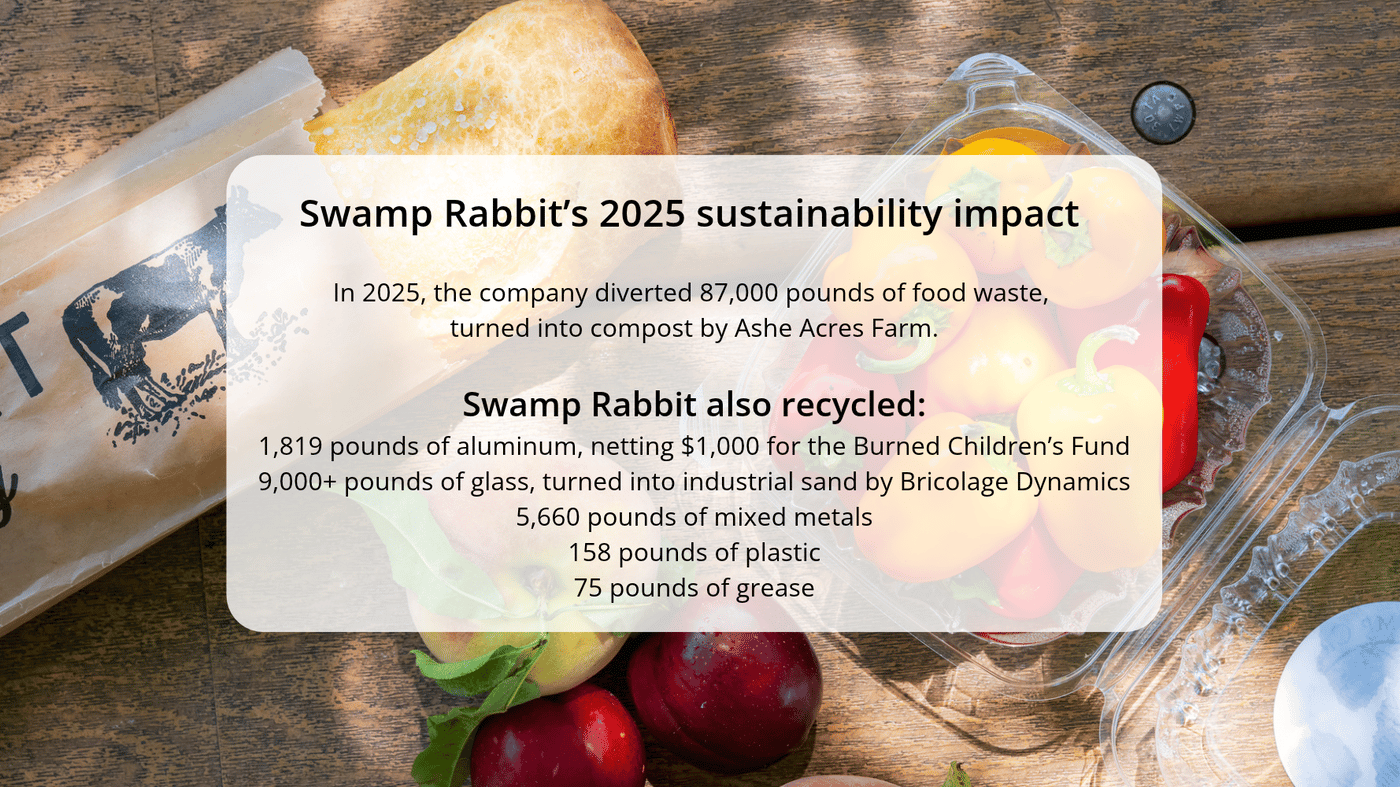
MW: We do a lot! Probably the most impactful thing sustainability-wise is our sourcing—buying locally makes such a big difference. And it’s sustainable that we’re in a spot people can access safely by walking or biking.
Then, we actually started a sustainability committee because our city stopped accepting recycling. It’s much cheaper to throw it all in the trash, but we’ve found ways to minimize waste and reuse. We began working with a local glass recycler and paying other small businesses to collect glass and cardboard. You have to be really passionate about this because there’s a lot of communication and coordination involved. We have a staff person who started a composting company, and we’ve diverted a significant amount of waste from the landfill by composting and getting creative.
Another cool partnership is the fire department across the street put two can trailers on our property, so we can now recycle metal cans. Once the trailers are full, they drive them to a scrap metal place where they get money to donate to burn victims.
What else makes Swamp Rabbit special?
MW: A big part of our store is we’re on a bicycle trail. I’m one of those people who, if I can bike there, I will, so being on a trail was really important to me. Our city, like most, is designed for cars to go fast, so 15 years ago, finding a place in Greenville that you could safely walk or bike to was very challenging; we were lucky to find our location. At the time, our city had just started building out an old rail line and turning it into a trail. Back then, the trail wasn’t very busy, but now, on the weekends, it’s packed with people, so that’s neat to see.
Also, our store is just designed differently. Our parking is horrendous. We could add more spots, but instead of a giant parking lot, we have grassy areas. We even have a fenced-in area with toys, so if you bring children, it’s a place to sit and they can entertain themselves. We did this because we started having babies after we opened and needed a way to contain our kids so we could work, and it blossomed into this unofficial playground.
What do you love most about your work?
MW: Buying local means I see and talk to the people who grew the products we’re selling, and I love that. Our local vendors deliver and then shop at our store. We are a mission-driven business, and our team is very friendly and passionate about what we do.
And then, I think with our store and outdoor space, we just have that community thing that naturally leads to people being happier without even realizing it. Because it’s not just a transaction—it’s an experience. We see so many people meet here and make new friends, or have spontaneous run-ins with neighbors and old friends. We’re responsible for several marriages. I think that whole combination just makes the experience pleasant for everybody, and that’s very gratifying.
Any plans for a second store?
MW: No, we’re pretty busy with one location. As much as I think the world would be better if we had more Swamp Rabbits in other cities, it’s a lot of work. Because of the way we source and choose to have our layout, it makes operations complex. We wouldn’t want to do something that would distract us from our current location. That doesn’t mean if we got there in five years … well, we’re definitely not seeking that out!