Video games and pinball machines share a long history of arcade entertainment, but finding a physical pinball table based on a video game remains surprisingly uncommon. While countless franchises have received merchandise, arcade cabinets, and collectible toys, relatively few have made the jump to traditional pinball.
The crossover makes plenty of sense, considering both hobbies appeal to players who enjoy chasing high scores, mastering challenging mechanics, and competing for bragging rights. That scarcity makes video game-themed pinball machines interesting for collectors and arcade enthusiasts. Manufacturers have occasionally adapted recognizable franchises into physical tables, incorporating familiar characters, music, locations, and gameplay elements into an entirely different format.
Spy Hunter Has High-Speed Arcade Action

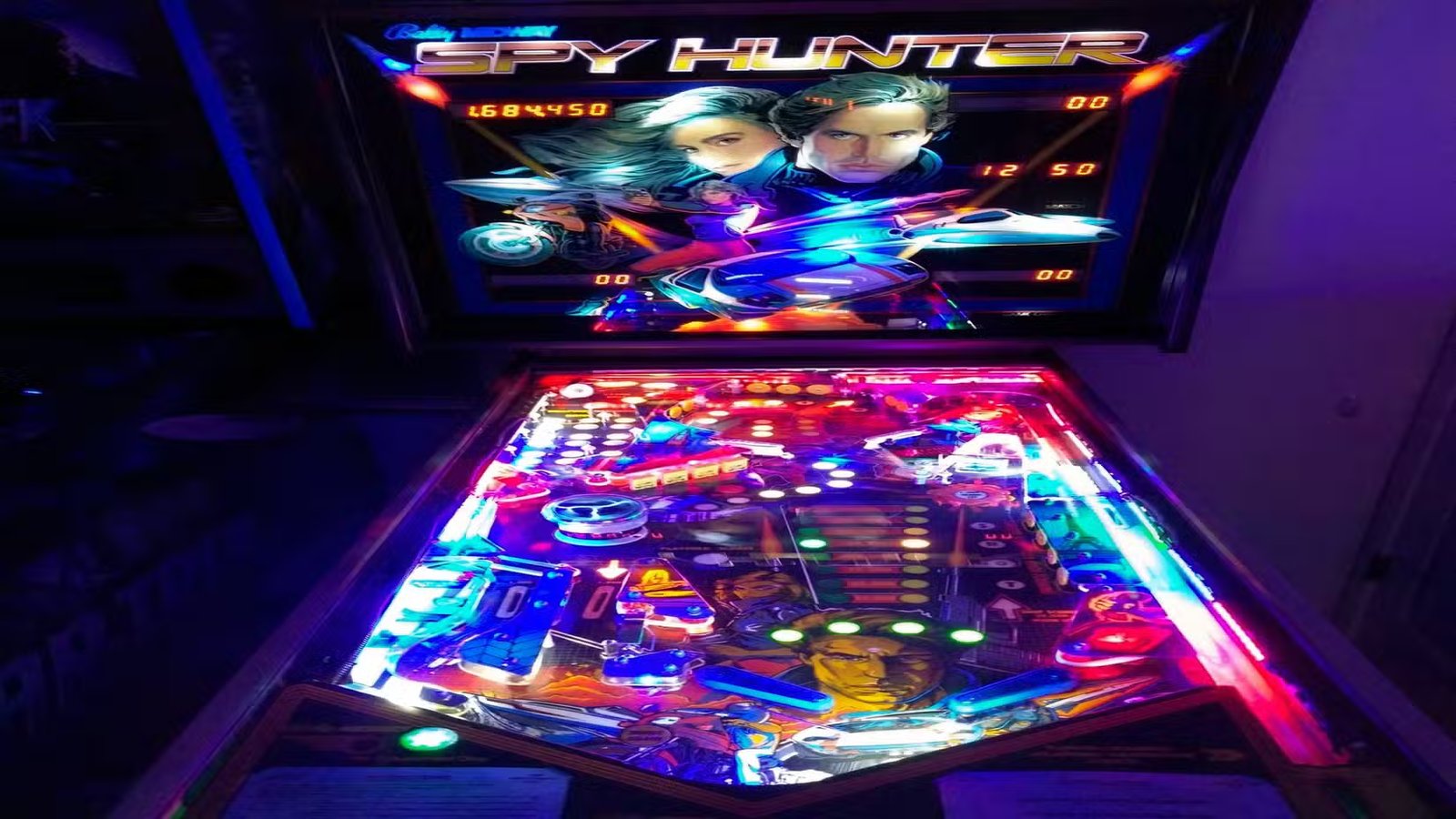
Bally brought the high-speed mayhem of Midway’s 1983 arcade hit Spy Hunter to pinball with its 1984 machine of the same name. The original video game puts players behind the wheel of an armed sports car, racing down highways while battling enemy vehicles in a spy-themed adventure with a distinct Mad Max feel. The pinball adaptation carries that secret-agent fantasy onto the playfield, featuring familiar imagery from the arcade game, including its distinctive white Interceptor sports car.
The machine trades the original game’s driving mechanics for a traditional pinball challenge that rewards timing and careful ball control. Its straightforward design puts the emphasis on keeping the ball in play and learning the table’s rhythm, giving it an old-school feel that suits its 1980s origins. Rather than overwhelming players with complicated modes, Spy Hunter focuses on delivering an arcade-inspired experience through its recognizable theme and classic pinball action.
Although the machine lacks the elaborate features found in many later pinball releases, its connection to one of the most recognizable arcade games of the era gives it a distinct place in gaming history. The familiar vehicles and spy-themed presentation help capture the personality of the original game without simply relying on its name. For fans of Midway’s arcade classic, Bally’s adaptation offers a charming tribute to a high-speed gaming adventure.
Street Fighter II Is Arcade Fighting Meets Pinball

Street Fighter II is known for its precise fighting mechanics and the fast-paced action of its two-dimensional battle arenas, but pinball probably isn’t the first thing that comes to mind when people think about Capcom’s legendary franchise. Nevertheless, Gottlieb partnered with Capcom to bring the fighting game to arcades in an entirely different format, producing more than 5,000 machines. The result features an unusual three-level playfield with entrances that raise and lower as players progress through the game.
Its five flippers give the machine plenty of movement, while a rotating flipper inspired by Chun-Li’s Spinning Bird Kick adds an unexpected twist to the traditional pinball experience. The table also includes a miniature playfield recreating the famous car-smashing bonus stage, giving players a chance to revisit one of the original game’s most recognizable challenges. These unusual features help distinguish the machine from other licensed pinball adaptations of the early 1990s.
The main attraction involves taking on the 12 fighters from the original game, with each opponent represented by an illuminated target that players must hit to advance through the competition. Defeating opponents requires accurate shots and careful ball control, making the machine feel more like an arcade tournament than a conventional pinball game. Random encounters with roaming ninjas add another surprise, while the One-Two Punch feature gives players additional opportunities to earn points.
These touches help capture the personality of Street Fighter II without relying entirely on its familiar characters and artwork. Although it may not reach the legendary status of machines like The Addams Family, Gottlieb’s adaptation offers an entertaining combination of fighting game nostalgia and inventive pinball design. For fans of Capcom’s arcade classic, the machine provides a memorable way to experience its world outside the original fighting game.
Super Mario Bros Brought Mario Mania to Pinball

Gottlieb brought Nintendo’s iconic platforming franchise to pinball with Super Mario Bros., a four-player solid-state machine released in 1992. The game marked an important milestone for the manufacturer because it introduced Gottlieb’s first dot-matrix display, which allowed animated sequences and interactive features to accompany the traditional pinball action. Its colorful artwork draws on familiar characters and locations from the Nintendo games, giving the machine an unmistakable connection to Mario’s adventures.
The playfield combines traditional pinball mechanics with elements inspired by the platforming series, including ramps, targets, and a raised upper section. Players work through the table while spelling out “SUPER” and completing objectives tied to the game’s seven worlds. A spinning castle adds a memorable mechanical feature, giving players a satisfying visual reward as they advance through the machine’s challenges.
The ultimate goal mirrors Mario’s familiar quest: players must conquer seven castles across seven worlds to rescue Princess Peach. This structure gives the machine a sense of progression beyond simply chasing a high score, while its themed objectives keep the Nintendo connection central to the experience. By pairing recognizable imagery with inventive playfield features and an early dot-matrix display, Super Mario Bros. stands out as a distinctive video game adaptation from the early 1990s for fans of both arcade worlds.
Space Invaders Is One of the Best Alien Invasions in Pinball

Bally’s *Space Invaders* stands out as a major milestone in arcade history because this widebody machine became the first commercially produced pinball table based on a video game, bringing Taito’s popular 1978 arcade hit into an entirely different format. Artist Paul Faris painted the machine’s striking alien artwork, while animated infinity lights behind the backglass create an impressive sense of depth that makes the invaders appear to stand out from the display.
The machine proved highly successful, although its artwork attracted controversy because the alien creatures resemble those from Ridley Scott’s *Alien* more than the pixelated invaders from Taito’s original game, prompting a copyright dispute with 20th Century Fox. Bally carried the arcade game’s atmosphere into the pinball experience with familiar sound effects, including an increasingly frantic heartbeat-inspired soundtrack that builds tension as players continue through the game.
The scoring system rewards accurate shots, with five red Invader targets advancing a separate bonus worth up to 60,000 points, while blue Invader rollovers activate additional scoring opportunities and extra-ball features. Players can also aim for the central horseshoe shot to increase the bonus multiplier up to 5X, while repeated captive ball hits provide another scoring opportunity and reward careful, consistent play.
Baby Pac-Man Has a Better Pinball Machine Than His Parents

Bally Midway introduced one of the strangest combinations of arcade gaming and traditional pinball with Baby Pac-Man, released in October 1982. As the infant child of Pac-Man and Ms. Pac-Man, Baby Pac-Man joins the arcade family alongside siblings Jr. Pac-Man and the original maze-running couple.
Despite its unusual premise, the character headlined one of the most distinctive arcade machines of its era, combining a familiar Pac-Man-style maze with a miniature pinball playfield housed directly beneath the video screen. Players guide Baby Pac-Man through a maze while avoiding four ghosts and collecting dots, but there’s one major difference from the original arcade game: the maze contains no power pellets.
Instead, players must enter the escape tunnels at the bottom of the screen to activate the pinball portion and earn the power-ups needed to fight back against the ghosts. This unusual arrangement makes both halves of the machine dependent on each other, rather than treating pinball as a separate bonus activity.
Although Baby Pac-Man can feel unforgiving compared with traditional pinball machines or straightforward maze games, its unusual combination of mechanics makes it a memorable arcade experiment. Bally Midway produced approximately 7,000 units, giving the machine a distinctive place in the history of early video game and pinball crossovers. Its strange family connection and even stranger gameplay helped make it one of the most unusual entries in the Pac-Man franchise.
Rollercoaster Tycoon Gives Pinball Some Thrills

RollerCoaster Tycoon is another standout Stern pinball machine, designed by Pat Lawlor and based on one of the most recognizable PC games of the 2000s. The development team wanted an amusement park theme, while Stern wanted a licensed property that could bring that concept to life, and the popular simulation game offered both.
The machine features four distinctive roller coaster ramps, each presenting a different challenge as players navigate the playfield, but learning how to handle those shots is part of the fun. Players must shoot the rides to move their indicator lights from red to yellow and finally green, opening attractions as they progress through the game.
The Rocket provides one of the most exciting shots, launching the ball high toward the playfield glass before sending it back into the action. Each successful ride activation brings players closer to unlocking more of the park’s attractions.
The machine also adds plenty of amusement park personality through attractions such as the Scrambled Eggs spinning ride, Bumper Cars, and a Dunk the Dummy game featuring a moving troll. Players can collect park guests to earn bonus points and extra balls, while opening rides helps unlock multiball opportunities and larger jackpots. These playful details help RollerCoaster Tycoon capture the charm of its PC inspiration while giving pinball fans an amusement park adventure of their own.