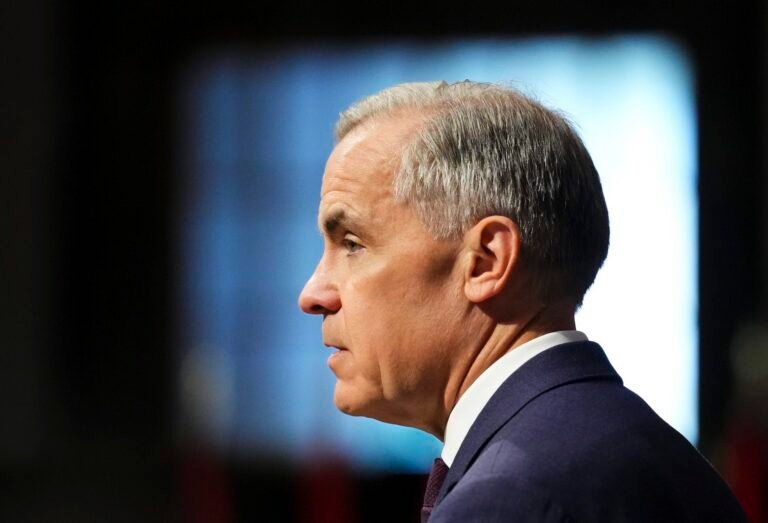
An economist from a global investment bank dropped by this week. He was over from London, gathering intelligence that can’t be found on his Bloomberg Terminal. He was more upbeat about Canada than when I last met him, a year earlier, although you could sense that he’s wondering if the Canada Investment Summit was a mirage. He’ll need to see a few major projects move beyond the announcement stage before he advises his clients to go all-in on a Canadian economic renaissance.
The conversation was a reminder that building Canada strong will take more than vibes. In the 1990s, then prime minister Jean Chrétien and his finance minister, Paul Martin, had to overcome similar doubts. Their challenge was convincing global investors that the government of Canada was creditworthy. Prime Minister Mark Carney must do the opposite. There’s plenty of demand for Canadian debt. It’s the money managers seeking double-digit returns who need convincing. Net purchases of equities and investment fund shares were negative in five of nine months through September, according to data that Statistics Canada published this week.
Related Articles
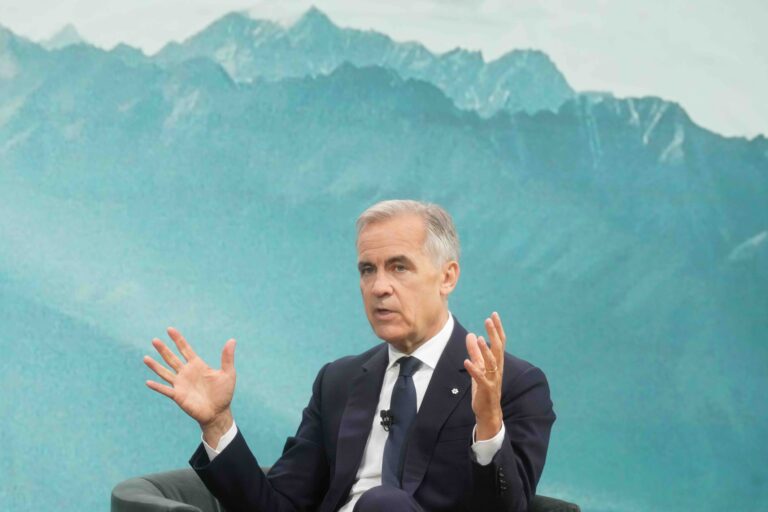
My visitor from London asked an interesting question: How much does the reorientation of Canada’s economy depend on one man? It’s a variable that someone who advises long-term investors must take into account.
There’s social science research based on natural experiments that finds a correlation between highly educated leaders and economic growth, and that shows countries led by former economics students grow faster than those governed by leaders trained in other disciplines. Prime Minister Mark Carney has a doctorate in economics from Oxford. By comparison, former prime minister Justin Trudeau had bachelor’s degrees in English literature and education, and Opposition leader Pierre Poilievre has a bachelor’s degree in international relations. That research might not prove the great man theory of history, but it suggests that if rebooting the economy is a national imperative, it helps to hire the right person for the job.
Carney’s importance to the mission of restoring Canada’s credibility with international investors is vital for another reason. Some of the natural experiments into the importance of individuals are based on what happens after a leader dies. What would become of Carney’s agenda without him?
Canada’s political class has a track record of steering clear of sovereign default, but its embrace of industrial strategy is very recent. Would we be as keen to become maîtres chez nous with Finance Minister François-Philippe Champagne as our leader? Could “Captain Canada” Doug Ford inspire the confidence of international investors? Would corporate Canada get back to building without a prime minister like Carney around to hector them?
The answers to each of those hypothetical questions is obvious. That’s why the risk premium investors attach to Canada can only be higher than it would be otherwise. Is it Canada Strong, or is it only Carney strong? Often, it feels like it’s mostly the latter, in part because the new government and its new leader have done less than they could to make their nation-building agenda anti-fragile. Carney’s agenda is brittle because it’s too dependent on him.
In 1995, the Federal Reserve Bank of Kansas City invited Martin to speak at its annual gathering of the global economic elite in Jackson Hole, Wyo. Martin didn’t spend much time on economics or his favourite policy measures. His speech was primarily about the variables that economists tend to ignore because they can’t easily model them.
Martin told his audience that the reason he made the deep spending cuts that his predecessors wouldn’t was that the “national psychology” had changed. Erasing the deficit wasn’t the objective; it was an element of a “comprehensive game plan” to reboot an economy hobbled by a recession in 1990 and 1991. An initial pledge to narrow the deficit to three per cent of gross domestic product was an “essential political anchor” that forced the government to do hard things, while also making the politics “manageable” because ministers and their various constituencies understood that trade-offs would be inevitable.
How does that compare with today? Once again, the national psychology has flipped, creating the conditions for Carney’s political ascent and back-to-back pro-business budgets. The new national security strategy suggests there’s a comprehensive game plan. What Carney is missing is a political anchor as weighty as Martin’s deficit target. Building Canada Strong is just a slogan. Doubling non-U.S. exports and “catalyzing” investment of $1 trillion is a target that might anchor the work of International Trade Minister Maninder Sidhu and Gurinder Grewal, the new chief executive of Invest in Canada, but what about everyone else?
Carney might know where he intends to go, but if we’re honest, more than a year and a half after he became prime minister, the rest of us are still kind of guessing. Talk of “building” and “sovereignty” can help muster an army, but they don’t tell it where to go.
As long as Carney has the confidence of more than half of the electorate, he probably can do what he wants. But without him, would we remain committed to doing hard things in the name of economic sovereignty? Or would our desire for short-term relief drive the political class in another direction?
I keep a candle lit for Scotiabank chief economist Jean-François Perrault’s 2025 idea of an economic growth target. To be sure, guiding a market-based economy to a certain level of output is more complex than cutting a certain amount of program spending. But if policy is now the catalyst for economic growth, then surely the forecasting wizards at Finance or the Bank of Canada could divine a realistic estimate. The budget includes a “higher investment” scenario that would result in inflation-adjusted economic growth of two per cent in 2027 and 2.3 per cent in 2028. That could be Carney’s political anchor, with the proviso that wars or pandemics or tariffs could send everything off course.
This is what a confident government would do. The objective wouldn’t be to hit the growth target precisely. It would be to create an accountability mechanism. The power of Martin’s deficit targets was in the symbolism. He scrapped five-year outlooks, which he called “political never-never land,” in favour of rolling two-year forecasts, which he famously committed to achieve “come hell or high water.” The importance of this change is often forgotten in the lore from those years. The narrow window reinforced the deficit target and provided creditors with regular updates of success. “Without credibility, any positive market effects of a budget will be delayed as skeptics adopt a wait-and-see attitude,” Martin said.
Too many of Carney’s targets exist in political never-never land. Maybe he sees a clear path out. I see elevated risk that he could get lost there.
Kevin Carmichael is The Logic’s economics columnist and editor-at-large. He has spent more than two decades covering economics, business and finance for outlets including Bloomberg News, The Globe and Mail and the Financial Post, where he also served as editor-in-chief.