Walking into the Irving Penn exhibition at the Maison Européenne de la Photographie (MEP), you might wonder how much difference there really is between a retrospective and a séance. Both depend on acts of looking backwards—on trying to make the absent present again. In this case, photographs lie at the centre: over one hundred images invite us to search their surface for clues, almost as a hand might follow a planchette across a board in the hope of receiving something from the other side. Twenty-five years after the photographer’s death, they seem to press forward from the walls, returning in the spider-lashed eyes of Naomi Sims, the severe elegance of Jean Patchett, and the innumerable faces that Penn once coaxed into stillness. On show until 17 January 2027, the exhibition spans original photographs drawn from the MEP’s permanent collection alongside loans from the Irving Penn Foundation, the Nicola Erni Collection, and the Miyake Issey Foundation. Together, these works resurface Penn’s aesthetic phantoms and reopen a discourse on bygone visual languages from an age of glamour that’s hard to imagine today.

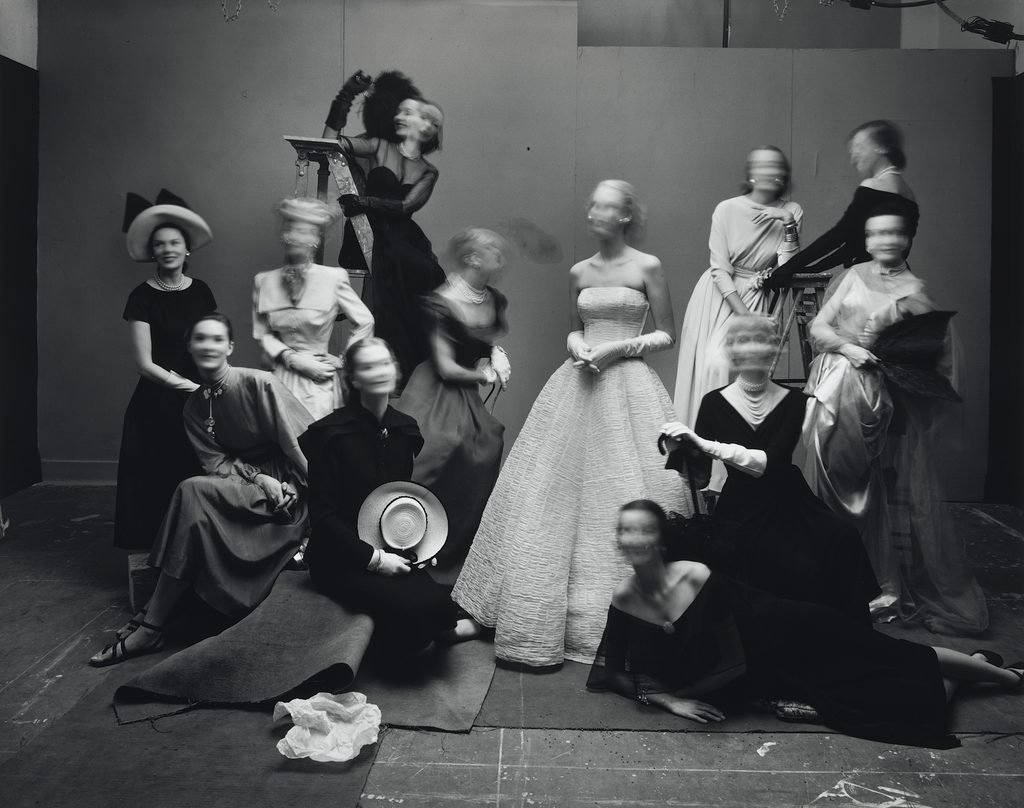
A Russian-American, Penn studied drawing, painting and graphics at the Pennsylvania Museum School of Industrial Arts from 1934 to 1938, where he trained under Alexey Brodovitch in his Design Laboratory. During these years, he also interned under Brodovitch at American Harper’s BAZAAR. Many of Penn’s drawings were published in the magazine, and with the money he earnt, he purchased his first Rolleiflex camera. In 1943, from the Vogue studio in the Graybar building on 420 Lexington Avenue, New York, Vogue’s new art director Alexander Liberman hired Penn to prepare layouts and suggest ideas for covers to the magazine’s photographers. Recognising in Penn “a mind, and an eye that knew what it wanted to see,” Liberman urged him to take the photographs himself. Penn was a quick study in still life and portraiture, which Liberman indulged. In the months before his post at Vogue, Penn travelled to Mexico to dedicate himself to painting and taking scenic photographs along his journey, although he destroyed all his paintings, unsatisfied, and continued with photography. This precipitated in October 1943, when Penn made Vogue history with his cover Parting Shot, which was the first still-life cover of a slouched brown bag, accessories and lemons for the magazine, as well as his first colour photograph. Acting as the entry point into Penn’s early decades of work in the exhibition, however, is The Twelve Most Photographed Models. Framed in conversation with the pages of the magazines set in vitrines, you immediately see that he had a pragmatic approach to beauty. Less interested in ornamentation or overly claustrophobic compositions, he treated the lines of the body and clothes, whether flowing or taut, as expression. It’s all torqued waists, chiaroscuro lighting and cigarettes for Penn.


“He could not tolerate mediocrity and was always striving for excellence. But this was not a sacrifice for him,” Pascal Hoël, the exhibition curator, tells me. “Throughout his career, he used a very minimalist setup that compelled him to focus on the person standing before him, without artifice or accessories.” In 1954, Penn opened his own studio on 80 West 40th Street, New York. The space boasted large windows, allowing him to utilise the natural light while shooting in the daytime. During this time, his camera rotation expanded to include a Deardorff V8 and Hasselblad. Hoël continues, “All that mattered was the quality of his eye. He could spend a great deal of time working on a composition until he achieved the result he wanted.” Penn’s discipline could also be projected onto his sitters, sometimes resulting in them enduring gruelling processes in order to achieve the ‘shot’. One image, Mascara Wars, captured in 2001, illustrates a model’s eye as she was made to tug at her lashes with mascara wands for hours on end. The final result is a close-up of the model’s eye, veined and red from exertion, on the verge of tears.

Penn’s truncated process of image making was a sort of purging. His pretensions, if they can be called that, were directed towards preserving the dignity of the black-and-white image. “Black-and-white photography has disappeared from the pages of magazines, which now predominantly publish colour images,” Hoël reflects. This shift came from the desire to capture images in a more accurate-to-life way as colourised capabilities became the norm in television and printing, alongside lowered costs for colour processing from the 1960s onwards. Undeterred, Penn would maintain his monochromatic slant to image-making. He eventually grew exasperated by the limitations of magazine reproduction and then turned to platinum-palladium printing in his Long Island darkroom. The process gave his images a more nuanced range of highlights, midtones and shadow, essentially acting as colour when there was none.
Penn remained “faithful to a demanding artistic vision” throughout his career, seemingly uninterested in the vagaries of taste so long as he remained engrossed by style. From 1967 to 1971, he built a portable studio for a series of roaming photo essays for Vogue. The endeavour took him all over the globe, from Nepal to Cameroon and Morocco. One series called The Quest for Beauty in Dahomey (now the Republic of Benin) sees Penn photograph locals in their traditional garb alongside images of religious altars dedicated to the voodoo god Legba. Despite the prevailing photography movement in West Africa that demanded carefully staged sitters, Penn’s images reflect a more relaxed society, with women draped languidly in group shots, necklaces off-centre and cool expressions that indicate rapport. This period also gives rise to some of Penn’s most memorable fashion photographs, including Balenciaga Roses Dress (1967), Mouche with Gold Neck Band (1960) and Naomi Sims in Scarf (1969).


Sean Grogan writes for The New York Times that “the history of fashion photography can be divided into before and after Irving Penn.” Hoël makes a similar argument. Looking at the 1965 Transparent Raincoat (Veruschka) and the 1987 Issey Miyake Seaweed Dress, he emphasises how Penn’s work often exceeds the confines of fashion photography, sublimating the image into something greater and more aspirational. His collaboration with Issey Miyake, which began mid-career and spanned thirty years, exemplifies this. After Miyake’s collections debuted, a proxy for Penn would receive Miyake’s clothes and bring them back to New York for Penn to photograph in his New York studio. Miyake would relinquish any control over the final image to Penn—the two were aesthetic paramours, bonded through a shared fascination with pure form. Miyake’s design language of pleating, movement and volume appealed to Penn’s sensibilities.
Drawing on Miyake’s involvement with ballet and theatre, Penn photographs his alien, playful garments against white backdrops. Miyake’s splashy designs are counterintuitive to Penn’s typical work: posed, dynamic, but odd. The resulting pictures are humorous, asking us to make sense of the geometrical riddles, swollen backs and staircase-silhouette pants that comprise the seasonal collection. Seen together, they radicalise the body, showing us how a garment’s two-dimensional form can be pushed to the furthest degree.

In the later years of his career, Penn began experimenting with different motifs for his commissions by Phillis Posnick for Vogue. These included masks in Beauty Treatment with Gauze Mask (1997) and Football Face (2002), where Penn used the obscured or distorted face to comment on the negative impacts of beauty treatments on women. “Penn’s photographs offer a view of the evolution of the fashion world over the 65 years during which he photographed it,” Hoël adds as we look at the pictures, hung in salon style.
Scattered throughout the exhibition are more portraits of industry legends: a slightly bewildered Picasso peers over a pulled-up sweatshirt akin to, in Penn’s words, “a high-school basketball coach”. Yves Saint Laurent scrutinises us with a single eye, the rest of his face hidden behind his hand. An insouciant Elsa Schiaparelli leans against a corner, hand on hip. Often working late into the night, Penn sought to develop a keen knowledge of the lighting, the framing and the subject. Some sitters, like Picasso, want to hide, while others enjoy being seen. We learn how he charges at his elements and how they defend in turn.


Penn’s images are gripped by two horns. He demonstrates his immunity from visual trends and his power of inimitability. The pictures on display demonstrate when time itself was less of a commodity and could be poured almost endlessly into planning a composition (it was noted that sometimes Penn sketched out his plans months in advance.) The process is one of intimacy before the fact.
Penn’s individualist approach gave him total control over the final image, imbuing them with a gravitas that elevated them beyond fashion photography and into something closer to art. Like Hoël affirms, “The exceptional quality of Penn’s photographs, with their strong graphic sensibility and his remarkable mastery, invites us to look at them as we would the paintings of the greatest masters.” Mastery, in this instance, is a command over time through image. Work that continues speaking to us, even from the other side.