Most organizations have a pretty good idea of whether their leader is liked, respected or trusted. Far fewer understand why people feel that way, what those feelings are built on, or how much goodwill their leader can draw on when things get difficult.
I think that’s a problem. And it’s one of the reasons we’re launching something new at Abacus Data.
The Abacus Data Executive Insight Series is a new series of research reports designed for senior executives, board members, association leaders and the people who advise them.
The idea is straightforward. We want to take the questions that matter to people running organizations, apply the research methods we’ve developed studying Canadians over almost two decades, and produce evidence and insights that help leaders make better decisions.
Because whether you’re running a company, a government, a university or a national association, your success depends on how people see you. Your employees, customers, members, investors and stakeholders all form impressions that shape what you can accomplish.
And those impressions are measurable.
Our first report introduces something we’ve been developing called the Abacus Leader Brand Model.
A leader brand is the collection of beliefs, impressions and feelings that people associate with an individual leader.
Our model measures that reputation through five lenses: how well someone is known, what audiences expect from them, how they are perceived, whether they understand the people they lead, and how much emotional loyalty they’ve earned.
At its core are three dimensions: competence, character and connection.
The result is a much richer picture than an approval rating or favourability score can provide.
And importantly, it’s designed to work for any leader, whether that’s a prime minister, CEO, union leader, university president or association executive.
We chose Prime Minister Mark Carney for our first case study because he’s arguably the most recognizable leader in Canada right now, and we’ve been tracking his public image since before he entered politics.
He’s also a fascinating test case.
Carney’s approval ratings have remained strong. In October, 56% of Canadians had a positive impression of him compared with 27% who viewed him negatively.
But what explains that support? And how durable is it?
We surveyed 1,500 Canadians in early November using our new model.
The results were remarkably consistent.
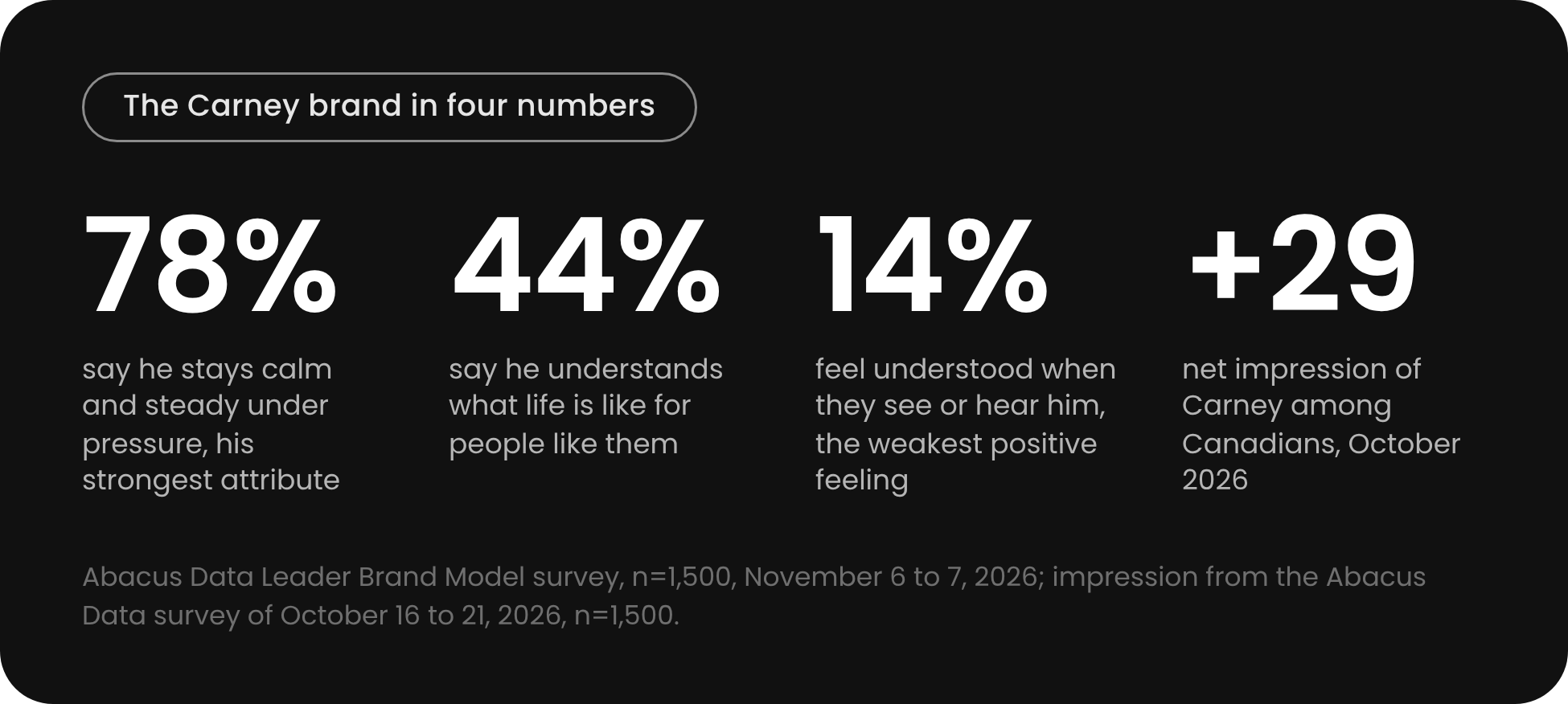
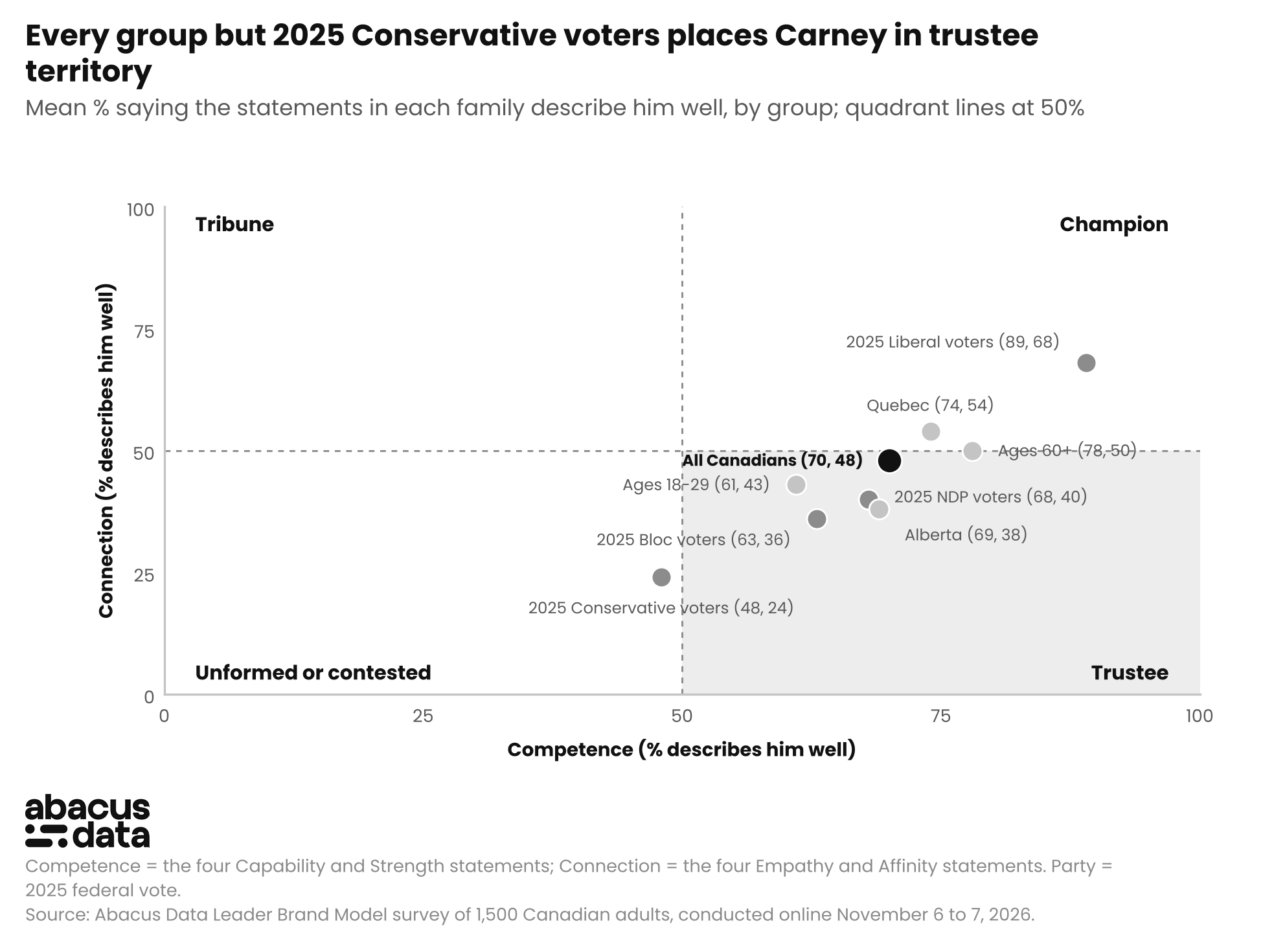
On average, 70% of Canadians say our competence measures describe Carney well. That drops to 62% on character and just 48% on connection.
That’s a 22-point gap between competence and connection.
And it isn’t simply partisan opposition. Even among people who voted Liberal in 2025, competence scores 89% while connection scores 68%.
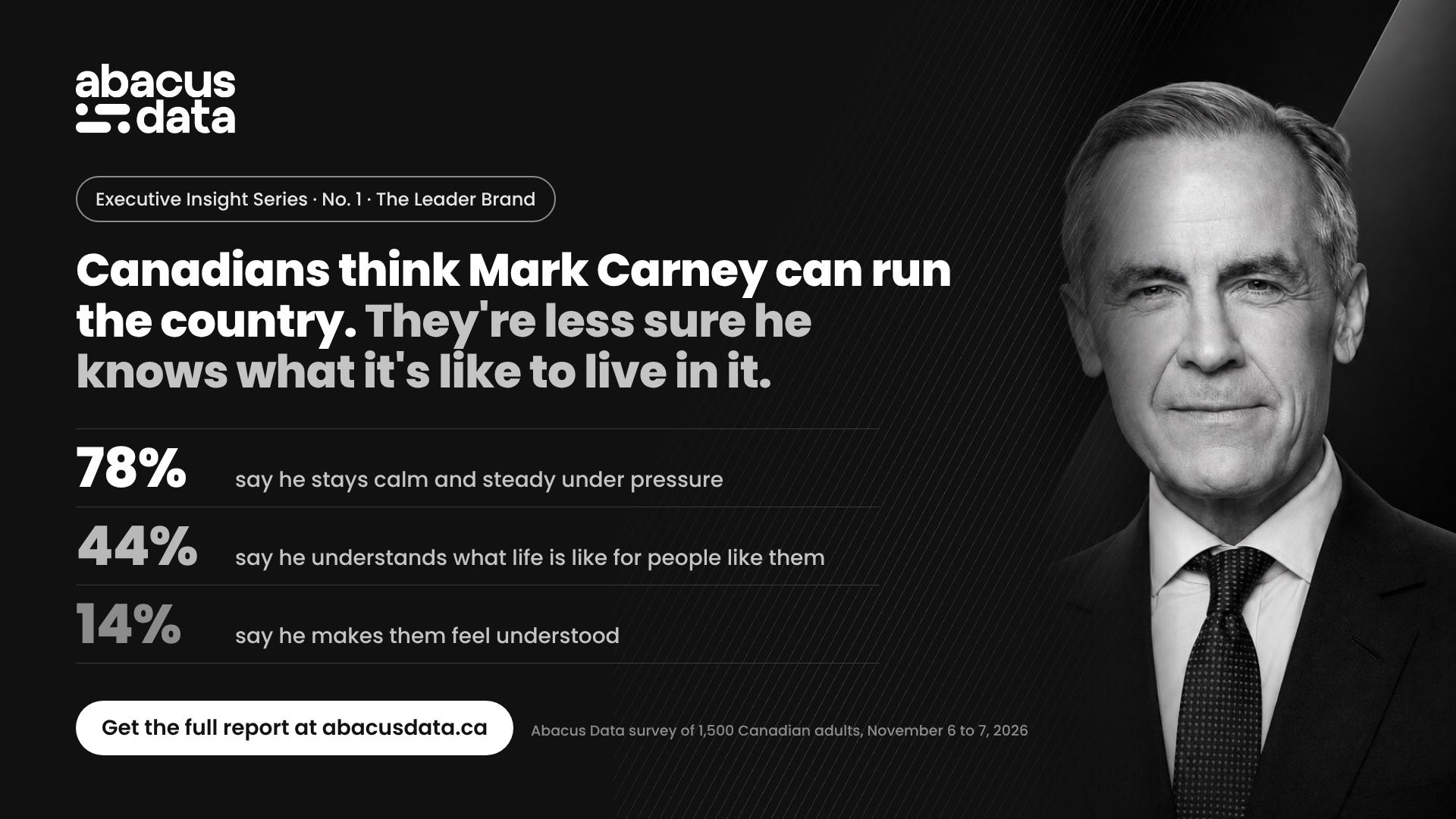
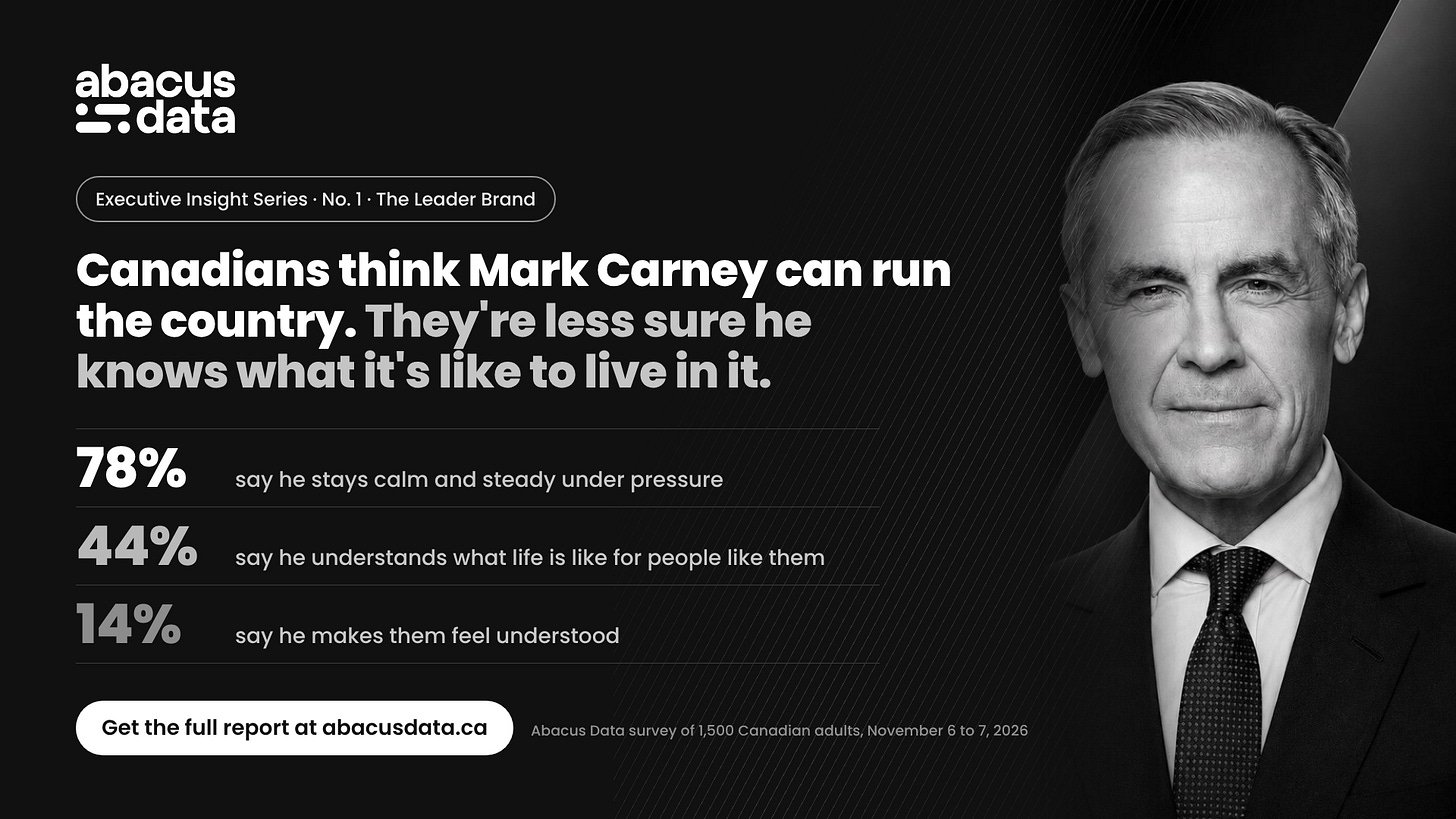
Canadians believe Carney knows how to run the country. They’re far less convinced he knows what it’s like to live in it.
Consider this. Seven in ten (71%) think he understands how the economy works. But only 45% believe he understands what it’s like to keep up with grocery bills, and 41% think he understands what it’s like to buy or rent a home.
Emotionally, 42% say Carney makes them hopeful and 30% feel reassured. Just 14% say he makes them feel understood.
Our model classifies Carney as a trustee: someone whose reputation rests heavily on competence, strength and stability.
That’s a valuable brand, especially in an uncertain world.
But it also comes with a risk.
When your reputation is built on competence, people expect results. And when results don’t come, you may have less emotional goodwill to fall back on.
That helps explain how Carney can enjoy strong overall approval while Canadians are much less satisfied with his government’s handling of affordability.
The encouraging news for Carney is that Canadians generally see him as human, humble and authentic. His connection gap appears to be about whether he understands their circumstances, rather than whether they like his personality.
I think the most important lesson from this research goes well beyond politics.
If you’re leading an organization, do you actually know what your brand is?
Do your employees see you the same way your customers do? Do your members believe you understand their challenges? Do people trust your judgment, your character, or both?
And perhaps most importantly, what would knowing those answers allow you to do differently?
You might discover strengths you didn’t know you had, gaps you need to close, or reservoirs of goodwill that could help you navigate difficult decisions.
My sense is that too many leaders are operating with an incomplete picture of how the people who matter most actually see them.
And that’s an avoidable risk.
The research we’ve developed makes it possible to measure that picture, compare it across audiences and track how it changes.
Learn more about our first report and the Leader Brand here: https://abacusdata.ca/executive-insight-series/leader-brand/
And if you think someone who really benefit from this work, please share it with them.