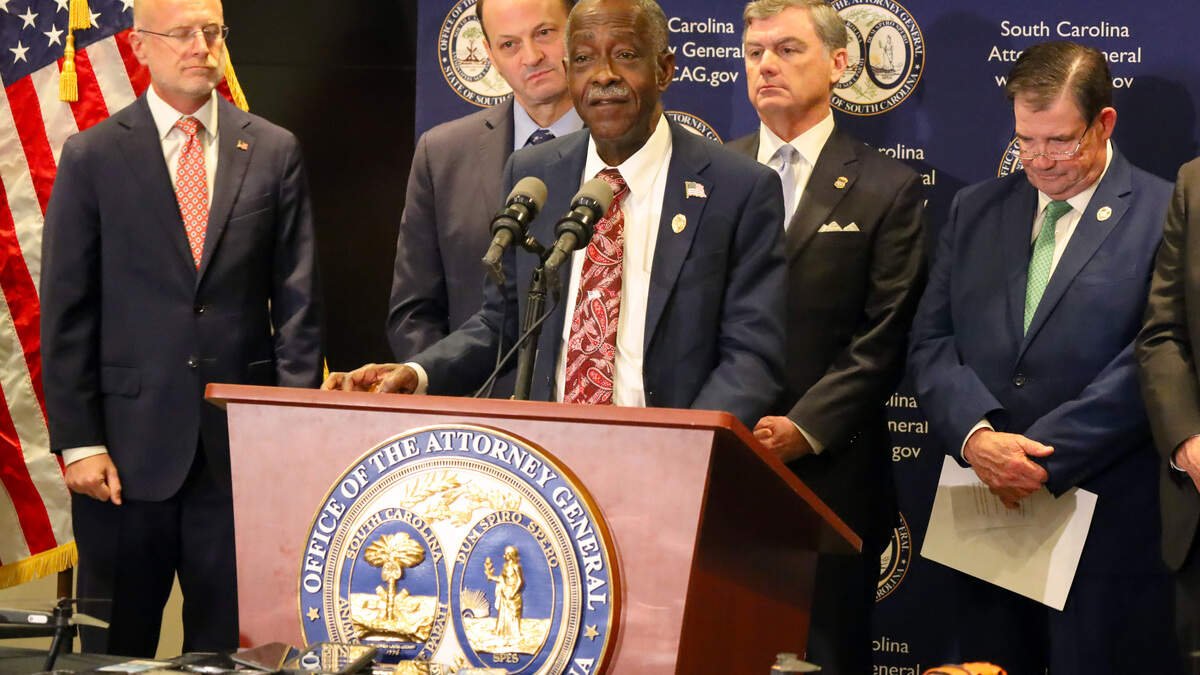
Retired S.C. Corrections officer Capt. Robert Johnson tells how inmates using illegal cell phones arranged a murder-for-hire plot against him
S.C. Department of Corrections
If you are an inmate in a South Carolina prison using an illegal cell phone to read this news story or commit criminal acts, your ability to do so may be soon coming to an end.
On Thursday, Nov. 19, the Federal Communications Commission will vote to allow state prisons around the country including those in South Carolina to begin testing, installing and using the technology to jam cell phone signals within prisons, said FCC chairman Brendan Carr at a Wednesday press conference in the Attorney General’s office on State House grounds.
Cell phones “are being used to do everything from ordering hits to run drug operations, to order kidnappings, to engage in the production and distribution of child sexual abuse material, to harass and threaten our veterans,” said Carr, standing with S.C. law enforcement officials who have fought for years to get a federal law in place that would allow prisons to jam cell phones.
Over the years, South Carolina officials took the lead in working with members of Congress and the FCC to allow jamming of illegal cell phones in prison, said Carr. Only recently has resistance to the idea faded, he said.
Resistance against jamming ended for two reasons: more people began to realize how much crime outside prison walls was caused by inmates using illegal cell phones, and also, there have been significant improvements in technology that allows pinpoint accuracy in jamming that prevents any bleedover that might affect civilian phones, Carr said.
On a table before officials at the event were dozens of seized contraband cell phones. On the floor were large drones — sizable enough to carry duffel bags containing dozens of cell phones.
“By voting tomorrow to authorize jamming, we’re going to put a new tool in the hands of law enforcement, and it’s going to make a dramatic difference,” said Carr, noting that some 25,000 cell phones are seized each year in the nation’s state and local prisons and jails.
The meeting will take place in Washington, DC. The FCC is a federal agency that regulates interstate and international communications by radio, television, wire, satellite and cable nationwide.
Capt. Johnson’s story
“They paid a guy $6,000 to kill me,” former S.C. Corrections officer Robert Johnson, 73, told the press conference.
In 2010, when he was a guard at Lee Correctional Institution in Lee County, his crackdown on cell phone usage at Lee angered some inmates to the point where they hired a hit man, according to evidence in the case. One defendant has been convicted on federal charges of murder-for-hire.
“No inmate should have been able to call from his cell to outside the prison, to put a hit on anyone,” Johnson said.
He was shot six times in the chest area and almost died. Over the years, he has had 32 surgeries.
“I call these cell phones ‘weapons of mass destruction’,” Johnson said. “No one should have to through what I went through…. I’m in pain 24/7 because of those six bullets hitting me in the abdomen and chest area from less than six feet away. Bullets ain’t no joke.”
After surviving the wounds and their aftereffects, Johnson became an activist, making speeches and working with Corrections officials to try to get the law changed. “The Lord just put good people in my way,” Johnson said.
Former Corrections’ director Bryan Stirling, now U.S. Attorney for South Carolina, praised Johnson’s efforts, saying, “If it’s not for him, we would not be standing here today.”
Inmate cell phone culture
Cell phones inside prison have caused all kinds of serious crimes to escalate, said Joel Anderson, current Corrections director. “It’s not just crimes for dealing cards or running a $10 dope ring. These crimes have become so sophisticated these days that we’re talking about millions of dollars.”
In prison, inmates charge other inmates from $5,000 to $8,000 for a contraband cell phone, depending on the type of phone, Anderson said.
“A cell phone in the hands of an inmate is probably the number one most dangerous weapon he can have. He extorts other inmates, family members. They call out hits on people in the streets,” Anderson said.
When drones first started being used to fly cell phones into prisons, they could only carry light payloads, about four pounds, or two cell phones. Now, bigger drones can carry up to 70 pounds and bring a duffle bag full of cell phones into a prison,” Anderson said.
Anderson said the prison system will employ the new technology one prison at a time, beginning with the Broad River Road complex outside Columbia. Officials will make sure the jamming is “mistake-free,” then move on to another facility.
State Attorney General and Gov.-elect Alan Wilson hosted the event, saying, “Capt. Johnson, you are a walking miracle. You are Exhibit A for this whole country on why we need to do what we are here to do today.”
Johnson predicted, “Pretty soon, the only thing those cell phones will be able to be used for is to hit each other with. I’m just glad we got this to the finish line.”