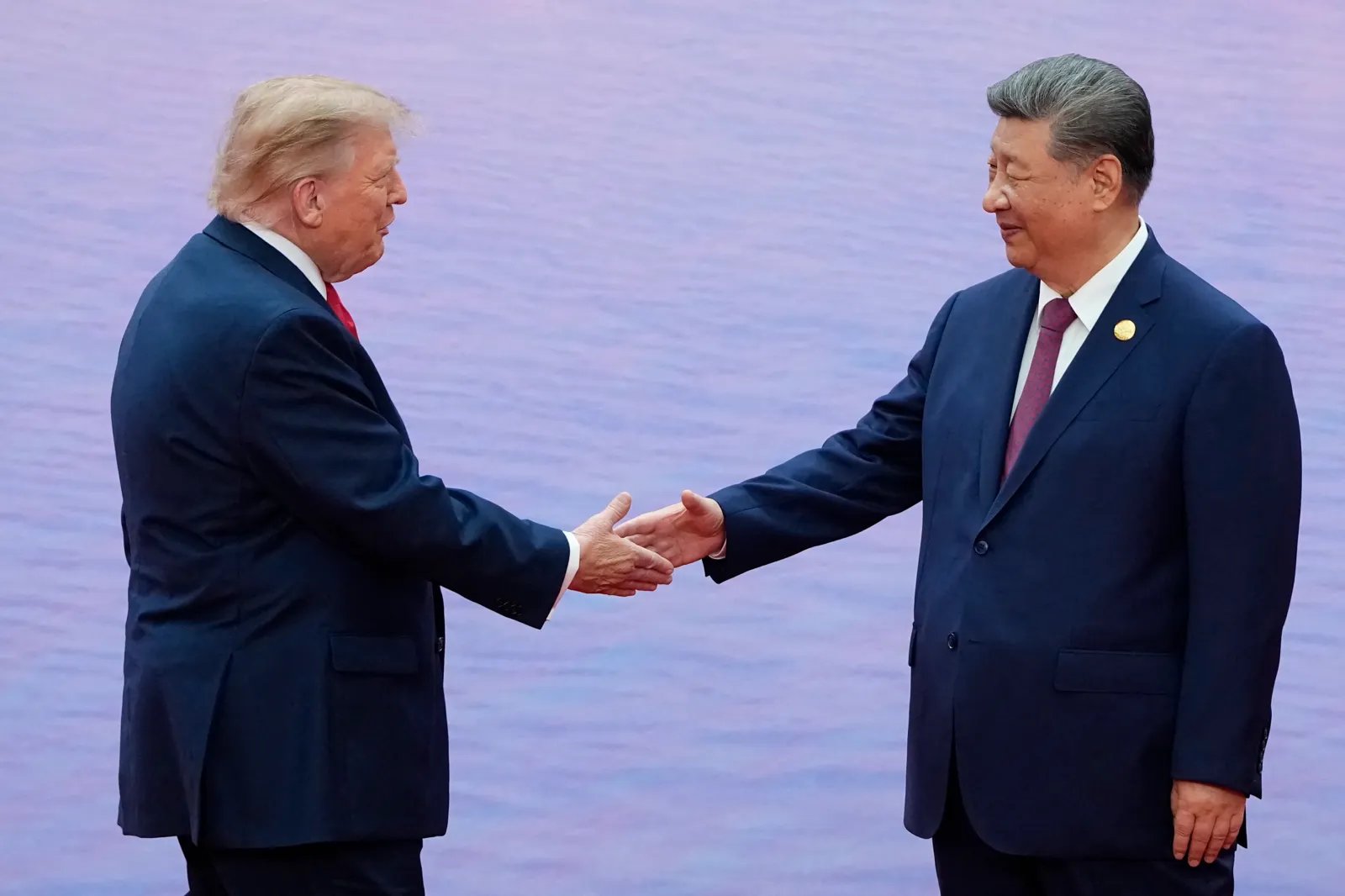
President Donald Trump landed in China on Wednesday for summit talks with Chinese President Xi Jinping as he seeks to hone in on regional trade agreements in Asia, but one of his administration’s biggest long-term challenges remains reducing reliance on Chinese mineral supplies and securing a homegrown supply of critical minerals to counter Beijing’s dominance.
A new U.S. Geological Survey (USGS) report released last week found Beijing remains the dominant producer of several critical minerals essential to national defense systems, semiconductor manufacturing, artificial intelligence infrastructure and advanced batteries.
The agency’s latest World Minerals Outlook (WMO) projects homegrown production capacity of eight critical minerals through 2030: antimony, copper, graphite, niobium, potash, silicon, silver and tungsten. While the report forecasts growth and rising U.S. capacity for select minerals such as antimony, graphite and tungsten, China remains the world’s leading supplier of several strategically important commodities.
Read More on News

Why It Matters
The eight materials examined by USGS are used across industries that have become increasingly important to both economic and national security. Currently, the U.S. depends on imports for more than 50 percent of annual consumption of each of the eight commodities.
The agency noted that seven of the eight are used in defense production and advanced technologies, including semiconductors, energy storage systems and electronics.
According to the report, China accounts for about 70 percent of global natural graphite production capacity, about 70 percent of tungsten capacity and roughly 80 percent of silicon metal capacity. China is also a major exporter of antimony, graphite and tungsten.
“In the 21st century, mineral security is national security,” Assistant Secretary of the Interior Andrea Travnicek said.
In recent years, Xi has used China’s position as the world’s top rare earths miner and exporter as leverage. Last year, Beijing’s export restrictions caused a chain reaction of disruption which affected U.S. manufacturers such as Ford Motor.
Speaking during a press briefing, Braden Harker, director of the USGS National Minerals Information Center, warned that concentrated supply chains can create vulnerabilities.
“When one supplier holds most of a market, a strike or a flood or a policy change in one country can affect supply for the whole world,” he said.
The WMO emphasized how dependent modern life is on these strategic materials, noting the need for copper in electronics and infrastructure–especially as the surge in data centers is expected to play a large part in the demand for the metal–and silver which is in nearly every electronic device.
Trump Meeting Xi
The USGS findings come as Trump is expected to meet his Chinese counterpart amid continuing competition between Washington and Beijing over trade, technology and supply chains.
China has already imposed export licensing requirements on antimony and graphite and added export controls on tungsten in 2025, according to USGS. The agency also noted that tungsten prices outside China more than doubled during 2025.
Asked by Newsweek whether U.S. defense and technology supply chains are vulnerable should China impose additional restrictions on exports of antimony, graphite and tungsten, Harker said all three commodities were identified in the agency’s 2025 critical minerals supply-chain risk analysis.
The meeting between Trump and Xi, widely expected to take place on Thursday, where the leaders could discuss extending an existing trade truce–due to expire in January–that includes provisions affecting critical-mineral exports.

Can the U.S. Reduce Its Dependence on China?
The report projects increased U.S. production capacity for antimony, graphite and tungsten through 2030, three commodities in which the United States has had limited recent domestic production.
Asked what it would take for the United States to reduce its import dependence on critical minerals, Harker believes supply expansion ultimately depends on economics.
“We don’t opine on the efficacy of policies,” he said. “But if economics were the driver, then it would have to be an intersection of producers and consumers … at a mutually beneficial price and a mutually beneficial specification.”
Colin Williams, coordinator of the USGS Mineral Resources Program, said the U.S. has domestic resources for all eight critical commodities and pointed to mapping efforts to identify where new mineral deposits could eventually support domestic production.
Responding to a separate minerals report by the USGS earlier this year, Rich Nolan, CEO of the National Mining Association said “it still takes an average of 29 years to bring a mine online in the U.S. That’s far too long.”
Nolan added: “China will not relinquish its chokehold on U.S. mineral supply chains easily. We must fully recognize the scale of the challenge before us and commit to doubling down on our efforts to tackle it.”

What Happens Now?
The World Minerals Outlook projects that natural graphite production capacity will grow by 20 percent globally through 2030, the largest increase among the eight minerals studied.
Potash is projected to increase by 18 percent, while antimony, copper, niobium, silicon, silver and tungsten are all expected to record smaller gains.
“If there’s one lesson in this report, it’s time,” Harker warned. “Mines take years,” he said, adding that most of the production capacity projected for 2030 “was set in motion before 2025.”
“The World Minerals Outlook gives us a clearer picture of where global critical mineral production is headed over the next five years,” Andrew Stewart, lead author of the second World Minerals Outlook explained. “By identifying anticipated changes in production capacity, we can help policymakers and industry better understand potential supply risks and make informed decisions about future investments.”
Contact Newsweek editors on this story: Ben Kelly and Cristina Diciu.