Prime Minister Mark Carney has brokered another trade deal with China that will deliver meaningful relief to Canadian sectors long stymied by tariffs and red tape.
But Ottawa is also making concessions of its own, which has some China hawks feeling squeamish.
China imprisoned Canadians amid the Meng Wanzhou affair — the Huawei executive was placed on house arrest at the Americans’ request due to fraud charges — and the 2024 foreign interference inquiry singled out China as “the most active perpetrator of foreign interference” in Canada.
Carney himself said last year during a leaders’ debate that China is the “biggest security threat” to Canada. His government created a new foreign influence registry to try to tamp down meddling by China and others.
But, with the U.S. relationship on shaky ground as the Trump administration pummels Canadian products with potentially industry-destroying tariffs, Carney has taken what he describes as a more “pragmatic” and “constructive” approach to China while maintaining “guardrails” that prevent the two countries from becoming too intertwined.
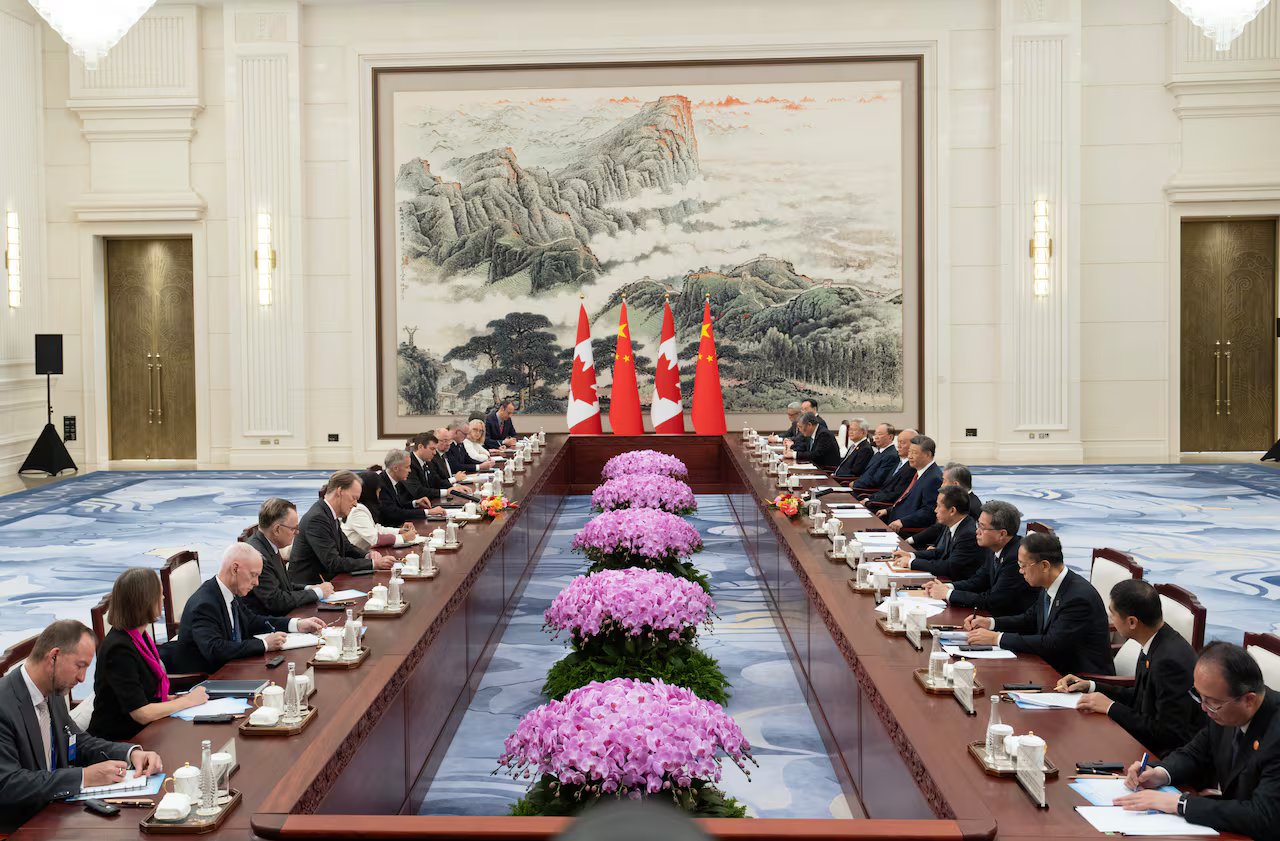
After meeting Chinese President Xi Jinping on Tuesday, the Prime Minister’s Office said in a readout that Carney agreed to “further elevate this partnership” with China.
“The leaders agreed that the peoples of both countries are benefiting from these renewed ties between Canada and China,” according to the PMO.

The Carney-Xi meeting took place on the sidelines of the APEC summit in Shenzhen, China. (Adrian Wyld/The Canadian Press)
Michael Kovrig, a former diplomat who was one of the two men taken into custody in China after Meng’s arrest, said he is watching the improving relations with “a great deal of concern” and is urging Carney to tread carefully.
In an interview with CBC News, Kovrig said relations with China have undoubtedly thawed but “they’re not back to normal and they shouldn’t be.”
“There are definitely some potential benefits. The challenge is to make sure that the benefits don’t come with bigger and more problematic downsides,” he said.
Kovrig noted that China has weaponized tariffs in the past to punish Canadian farmers and can do so again.
“The readout doesn’t say anything about national security or transnational repression or human rights issues or about Canadian detainees in China. They should also be a priority along with market access,” he said.
Kovrig said drawing closer to the Chinese, and allowing new imports like EVs and steel products, also has the potential to anger the Americans, jeopardizing what he describes as Canada’s single most important economic relationship.
“You have to put Washington first. I know that’s not a popular idea in Canada right now,” he said.

The trade relationship between Canada and China, while important, needs to be carefully managed, says Michael Kovrig, a former diplomat who was held captive in China on spying allegations for more than 1,000 days. He says the gains in Prime Minister Mark Carney’s new trade deal are asymmetrical and benefit China far more than Canada.
Trump himself has brokered trade deals with China — he praised Xi as a “great leader” — and his administration is currently embroiled in the fallout from the former Nvidia CEO’s affair with an alleged Chinese spy.
Trump’s commerce secretary, Howard Lutnick, has also been accused of pushing to weaken U.S. chip export rules to benefit Asian AI data centres that do business with China.
Despite that baggage, Peter Navarro, a Trump trade adviser and frequent Canada critic, said Carney’s dealings with China are “offensive in the extreme.”
“China is going to eat Canada alive,” he said.
Still, the early results suggest that looking past bad Chinese behaviour is paying dividends for Canadian businesses and the people they employ.
Xi agreed to drop his country’s “anti-discriminatory tariffs,” worth up to 25 per cent on some $400 million worth of Canadian pork and seafood products — a manoeuvre that delivers immediate benefits to those sectors by unlocking access to China’s vast market for foodstuffs.
In addition to a commitment to take more lentils, fava beans, “wild aquatic products” and pet food, among other agri-food items, Xi is extending the tariff pause Carney secured in January for Canadian canola meal, peas, lobster and crab, which has been an economic boon.
Indeed, since Carney’s first meeting with Xi, and what the government says is 35 other ministerial visits and engagements to smooth over bilateral irritants, Canadian exports to China have surged.
Statistics Canada data and figures from the University of Alberta’s China Institute show that Canadian trade with China hit a record $12.7 billion last quarter.
The dollar value of Canadian products sent to the Asian economic powerhouse has increased by 60 per cent over the last two years, a byproduct of Carney’s move to restore relations with Beijing.
Kyle Larkin, president and CEO of the Canadian Meat Council, said pork producers have suffered under the Chinese restrictions and Carney’s deal to eliminate many of them is “a great step in the right direction.”
“We’re very happy,” he told reporters in China.
Vina Nadjibulla, the co-founder and CEO of the Centre for Strategic Statecraft, said U.S. trade actions necessitate Canada looking elsewhere for business — even if there are lingering concerns about cozying up to a country like China.
“China’s behaviour hasn’t changed, but Canada’s strategic circumstance has,” Nadjibulla said in an interview.
“We are now living in a world in which we do have to diversify and we do have to economically engage with China in certain areas. But I hope that we remain smart and strategic and do not forget the lessons of the past.”
In return for all this new access, Carney is opening the door wider to Chinese steel and aluminum imports by extending and expanding remission measures for products that cannot be found in sufficient quantities in this country.
There’s also a vague commitment to “deepen co-operation” in “finance.”
And Carney will continue to allow tens of thousands of Chinese electric vehicles to enter Canada annually at a reduced tariff rate — although the number imported so far is significantly below this year’s quota of 49,000.
A backgrounder on the Carney-Xi deal distributed to reporters states that, after past BYD approvals, a second, unnamed Chinese company has just secured the necessary Transport Canada permissions to import its foreign-made cars.
A government spokesperson confirmed that Geely, an automotive conglomerate with stakes in brands like Zeekr, Polestar and Lotus, now has the green light.
Much of Canada’s auto industry has fiercely opposed giving Chinese firms access, fearing a flood of cheaply made, state-subsidized vehicles will sink remaining Canadian auto and parts production.
While the Carney government previously expected significant manufacturing investment from Chinese EV makers in Canada, nothing has materialized — and the backgrounder released to reporters suggests none is coming soon.
Flavio Volpe, the president of the Automotive Parts Manufacturers’ Association (APMA), told CBC News that Ottawa must resist any temptation to allow Chinese firms to ship “knock-down” car kits into Canada for assembly.
Volpe said Chinese firms have promised other countries like Brazil that these kits are just a first step until they can build local manufacturing capacity, only to renege on those commitments.
He said these kits use no Canadian parts, would imperil the homegrown sector and frustrate the U.S., which sends many parts to Canadian assembly plants.
“Does that scuttle any prospect of a trade deal with the Americans? Well, it certainly tweaks the Americans’ attention,” he said of the prospect of more Chinese-made vehicles in Canada.
While there’s industry anxiety, Carney is showing an openness to working with these Chinese firms while the U.S. relationship is strained.
“We have the best auto workers in the world, and we want them fully deployed, full opportunity, in an integrated North American market,” Carney told reporters travelling with him on his nine-day trade mission.
“That market has become less integrated because of U.S. trade actions.”