Elon Musk has spent years building some of the world’s most valuable businesses. But what happens to them if he is suddenly no longer at the helm?
Mark Zuckerberg’s Meta faces the same conundrum. Who takes over if he is out of the picture?
Investors have begun asking this question about several S&P 500 companies amid Jensen Huang’s departure from Nvidia. Huang’s exit has shone a spotlight on a problem facing companies built around powerful founders: succession planning.
Also Read | Layoffs Are Rising In Tech, But These Skills Are Helping People Unlock Better Pay
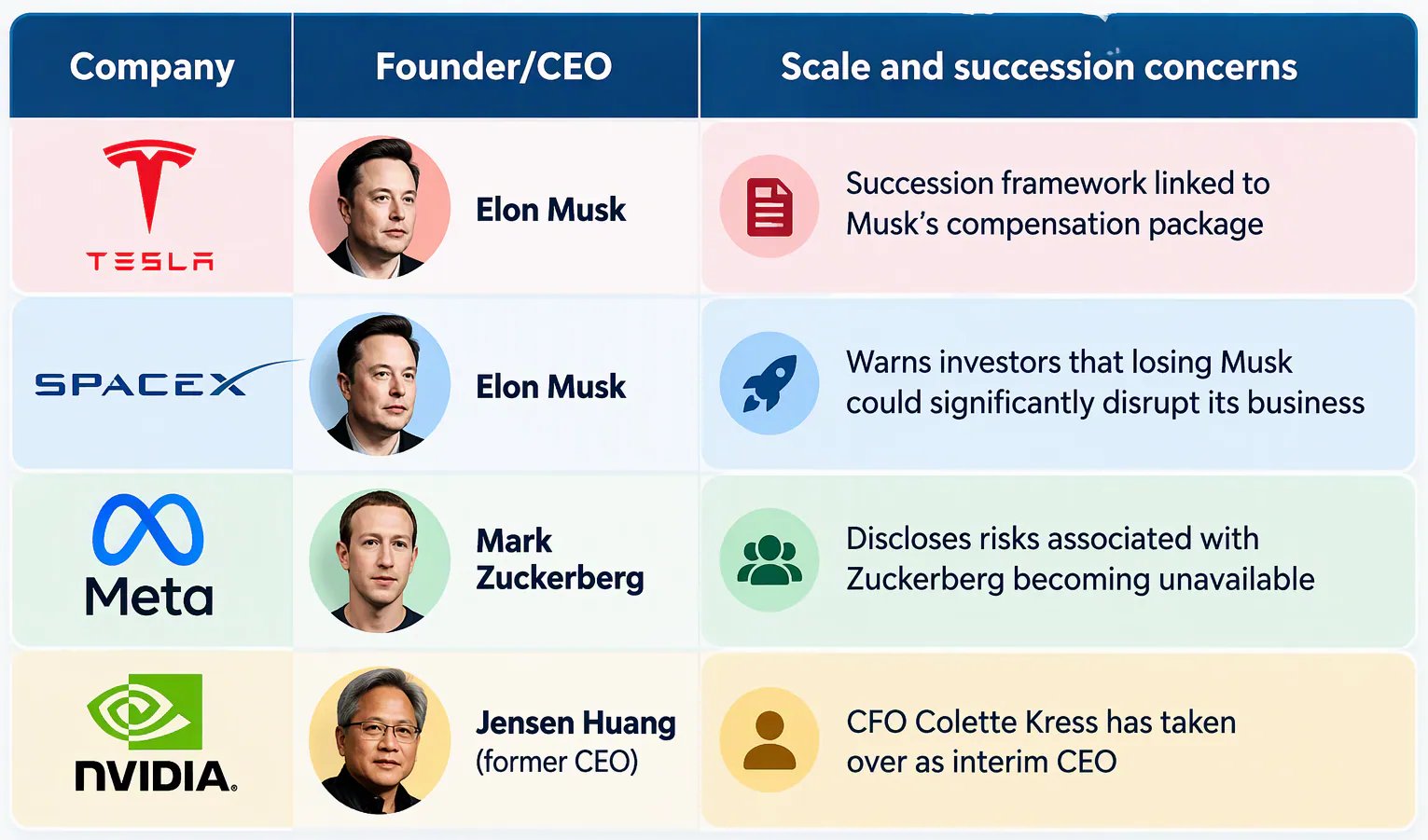
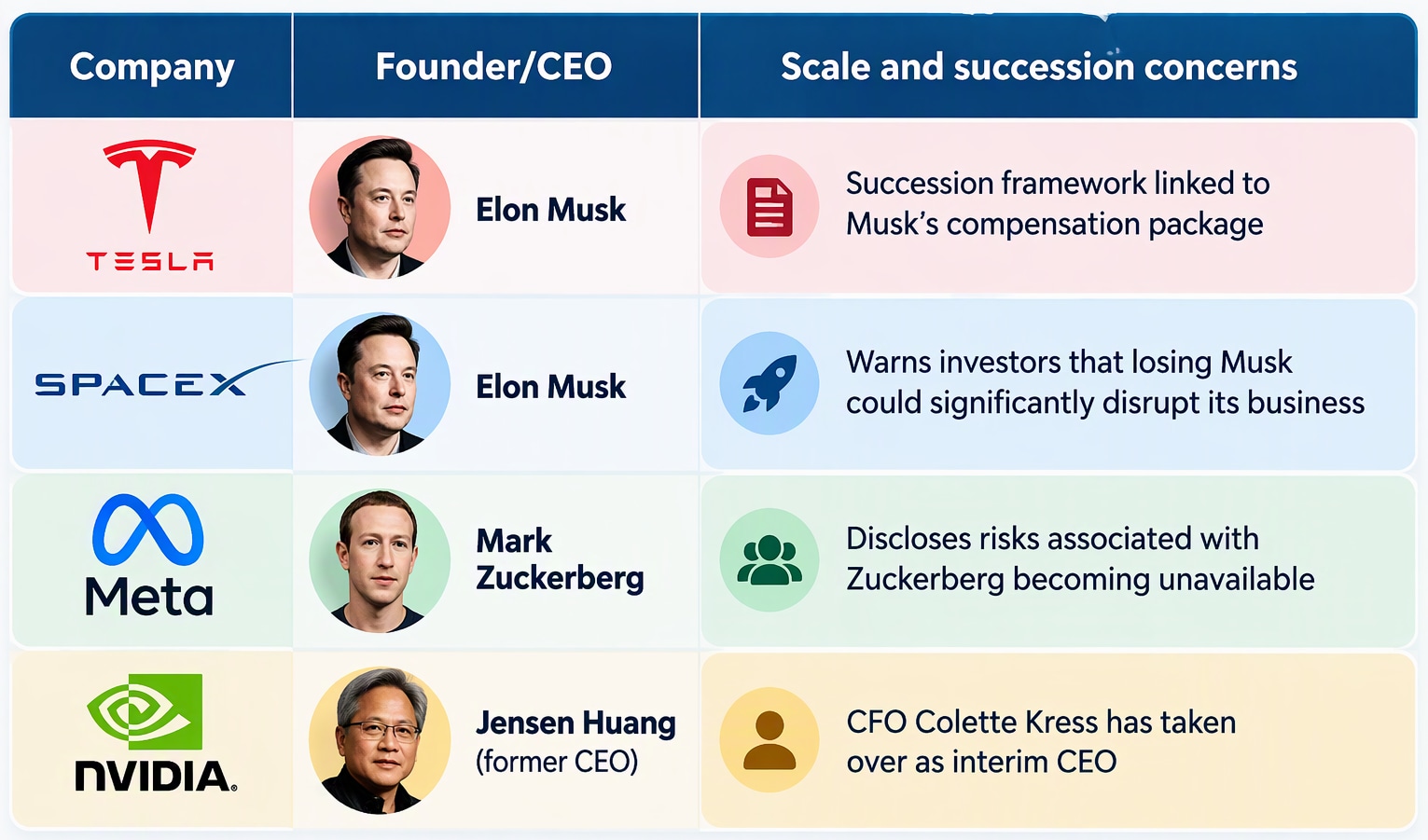
Tech giants such as Tesla, SpaceX and Meta remain heavily dependent on their founders. Their financial disclosures acknowledge the risks of losing these leaders, but there is little clarity on who could take over if they step aside.
For Musk and Zuckerberg, Huang’s exit could be an uncomfortable reminder of that vulnerability. According to The Washington Post, Ross Gerber, an investor in SpaceX who has previously raised concerns about Tesla’s succession planning, believes the Nvidia episode could be particularly unsettling for Musk. “This Jensen thing is probably the biggest fear that Elon has,” said Gerber.
Why Elon Musk’s Companies Depend So Much On Him
Musk is not just the chief executive of Tesla and SpaceX. He is also closely associated with their long-term technological ambitions and business strategies.
Tesla’s electric vehicle business, its autonomous driving plans, and its humanoid robot ambitions are closely linked to Musk’s vision. SpaceX, meanwhile, is pursuing reusable rockets, satellite internet through Starlink, and plans to take humans to Mars.
This creates a difficult question for shareholders. Can these businesses maintain their momentum if Musk is no longer involved in day-to-day operations?
The concern is not merely theoretical. In its filing ahead of its public listing, SpaceX explicitly warned investors about its dependence on Musk. The company said losing him, whether through death, disability or another circumstance, could disrupt its management structure and affect its ability to execute its business strategy.
It also cautioned that finding a replacement with Musk’s combination of skills and experience could be a lengthy and uncertain process. The company added that there was no assurance it would be able to find a suitable successor in time, or at all.
Tesla has also referred to succession planning in its financial disclosures. However, The Washington Post report points out that the company has not publicly demonstrated a clear succession framework.
Elon Musk’s $1 Trillion Pay Package Has A Succession Clause
There is another interesting dimension to the issue. Tesla’s massive compensation package for Musk includes a requirement that he develop a succession planning framework to qualify for its final two award tranches. The package, potentially worth $1 trillion, was designed to keep Musk involved with Tesla through the middle of the next decade.
However, the succession requirement does not necessarily mean Tesla has a ready replacement or a publicly established transition plan. A company can acknowledge that succession planning is important without having a clear candidate prepared to take over. For investors, the absence of a publicly outlined plan leaves questions about leadership continuity.
Mark Zuckerberg And Meta Face A Similar Problem
Musk is not the only technology billionaire whose company faces questions about what happens in his absence. Meta, led by Mark Zuckerberg, has also warned investors about its dependence on key executives.
In its financial disclosures, the company has highlighted the possibility that Zuckerberg becoming unavailable could have a materially adverse impact on its operations.
Meta has also pointed out that Zuckerberg holds a majority of the company’s voting power. This gives him considerable influence over shareholder decisions, including the appointment of directors.
Its filings do not disclose a succession plan for the chief executive position. The situation highlights a broader corporate governance concern. When a founder exercises significant control over a company, transferring leadership can become more complicated than simply appointing another executive.
How Big Are These Companies?
The scale of the businesses involved explains why succession planning matters beyond their founders and senior management.
Tesla, Meta and Nvidia collectively employ at least 200,000 people and account for almost 10 per cent of the S&P 500’s market value. SpaceX, which is privately held, is valued at nearly $1.9 trillion.
Is A Company Really Indispensable Without Its Founder?
There is another side to this debate. A founder’s departure does not automatically mean a company’s business model or growth prospects will collapse.
Apple is an important example. The company continued to expand after Steve Jobs died in 2011. Tim Cook took over as CEO and led Apple through a period of substantial growth.
Other technology giants, including Microsoft, Amazon and Alphabet, have also moved beyond their founders as chief executives. This suggests that strong businesses can develop institutional leadership and continue operating without the person who originally built them.
“Technology companies are often driven by the vision of their founders. For long-term success, this inspiration must be sustainable. If the business is highly driven by the identity of individuals and therefore its valuation is heavily dependent, succession must be carefully thought about,” Dipal Dutta, CEO at RedoQ, told NDTV.
Dutta added, “Having depth in your leadership will allow you to spread decisions across your company and create structures that will allow innovation to continue despite changes in leadership. Whilst having a strong founder can lead to a successful company, having a strong business allows you to sustain that success.”