
Quick overview
- Spot gold is currently trading near $4,144, with a potential drop to $4,112 if it falls below near-term moving averages.
- China has extended its gold buying streak to 23 months, increasing its reserves to 77.47 million troy ounces as part of a strategy to diversify foreign reserves.
- Market odds for an October FOMC rate hike have decreased to 19-21%, but the U.S. 10-year Treasury yield remains high at around 5.30%, impacting gold’s attractiveness.
- Despite high yields, structural demand for gold from central banks remains strong, supported by geopolitical uncertainties and the role of gold as a safe haven.
Spot gold is trading near $4,144, and a move below the near-term moving averages puts $4,112 in focus. China has extended its gold buying streak to 23 months in a row. Meanwhile, odds for an October FOMC hike have tumbled to 19-21%. However, the U.S. 10-year Treasury yield has settled at around 5.30%, supporting the opportunity cost of holding non-yielding bullion.
Given the technicals and fundamentals, my bias is skewed to the downside. However, given the strength of China’s gold buying as well as other central bank buying and geopolitical uncertainties, I am structurally bullish on gold.
China Extends Gold Buying to 23 Straight Months
An increase in Chinese gold reserves was one of the more bullish structural changes for gold. The People’s Bank of China increased its gold reserves for the 23rd month in a row in September. Reserves increased to 77.47 million troy ounces from 76.73 million troy ounces in August.
I want to mention, that China’s buying of gold, particularly over the last 23 months has been during great volatility in the gold market. This buying has not been tactical. It’s more so as part of China’s broader strategy to add more gold to its reserves to further diversify its foreign reserves, decreasing China’s reliance on U.S. Treasuries and other traditional sovereign debt.
October Fed Hike Risk Has Fallen Sharply
The recent U.S. employment and inflation reports have improved the monetary policy outlook since the latter part of September. Market odds for another FOMC hike in October have dropped to 19% to 21% from approximately 50% a week earlier.
Though this was gold-bullish because the immediate risk of Fed hiking rates was diminished, the outlook for a more restrictive Fed policy in October remains. A majority of 85% still expects a hike in December and, until the outlook changes, the Fed is still viewed as not done with its policy tightening.
Fed Minutes Could Reset Expectations Again
In the absence of new macro data or FOMC officials’ speeches, expectations have been centered on the minutes from the September 15-16 FOMC meeting, due for release later Wednesday.
The minutes could offer some insights into the degree of support for the latest rate increase and how many members see policy tightening going beyond December 2026. The Minutes could offer more color into the Fed’s outlook and make traders less patient.
Treasury Yields Remain Gold’s Biggest Headwind
The most important macro issue is the bond market. The 10-year U.S. Treasury yield has moved up to around 5.3%, and longer-term yields have recently been at their highest levels in around 24 years. Market concerns about inflation have only increased amid high energy prices and extraordinarily high levels of government borrowing and spending.
For gold, this means yields are looking more attractive than the zero income that bullion provides. While the immediate expectation of a Fed rate hike in October has lessened, gold has still struggled to post a meaningful bounce.
Structural Demand Is Holding Up Despite High Yields
What I find interesting is that, despite the tighter financial conditions, gold-related business with the central banks and official sector is strong. At the LBMA conference this week, some of the central bank speakers again emphasized the role of gold as a diversifier of other riskier assets and a reserve asset during periods of geopolitical stress and high debt-related credit risk.
The explanation provided helps to show why, during this cycle, gold has shown less correlation to changes in real interest rates compared to previous cycles. While short-term traders may be selling gold, other longer-term central bank traders are buying gold. This provides a bottom to the gold market.
Geopolitical Risk Adds Another Layer of Support
Middle East uncertainty remains another source of demand. U.S.-Iran tensions continue, while escalating Houthi attacks on Saudi Arabia have raised concerns on energy infrastructure and supply.
For gold, this remains a two-sided catalyst. On the one hand, geopolitical uncertainty increases demand for safe havens. On the other hand, higher oil prices increase inflation expectations and increase the case for more Fed rate hikes. Thus, the current situation in the gold market fits with the trade description in which inflows occur without a clear break out higher.
Gold Technical Analysis: $4,112 Is the Key Support
In the 1-hour chart of Gold, the price has dropped below the short-term moving averages after failing to take out the descending trend line again. Gold is in a longer-term downtrend with lower highs and lower lows and the shorter-term structure is the same, as price continues to make lower highs and is trading below 4,161-4,179.
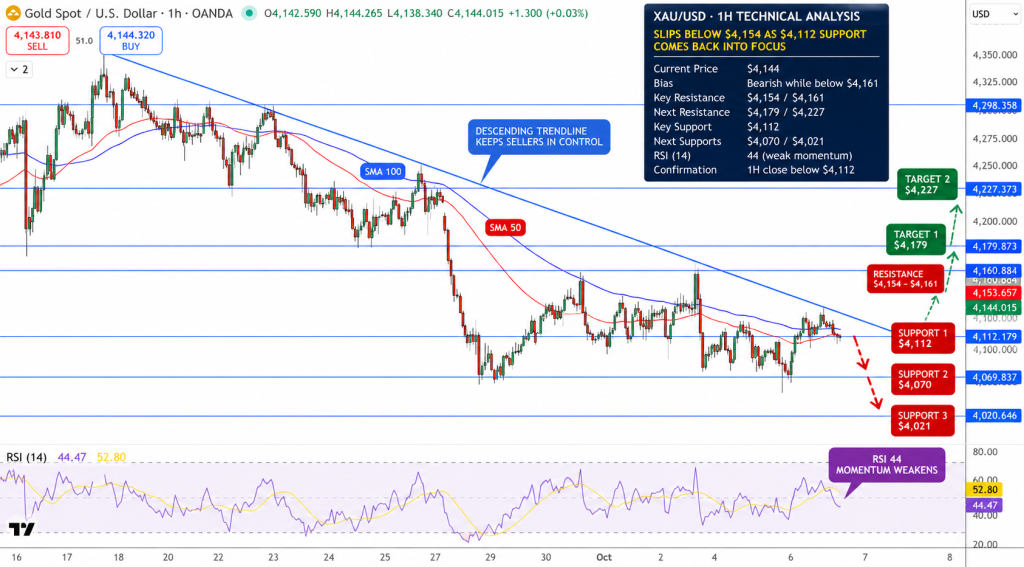
Looking at the hourly chart, the first support to watch is at 4,112. If price drops below that level, supports come in at 4,070 and 4,021. If price recovers, the first resistance is at 4,154-4,161 and if price continues to rise, important resistance comes in at 4,179 and 4,227.
As of now, RSI is around 44, with the signal line closer to 53, suggesting that the previous upwards momentum has slowed again. While I am leaning more towards the bear case as long as gold is under 4161-4179 and the descending trendline, a move above 4179 would help the case for a countertrend rally. A move below 4112 would suggest 4070 is next in line.
Resistance: 4154, 4161, 4179, 4227
Support: 4112, 4070, 4021
Frequently Asked Questions
Why is China still buying gold?
China has continued adding gold as part of a broader reserve-diversification strategy. September marked the 23rd straight month of reported PBoC buying, with reserves rising to 77.47 million fine troy ounces.
What is the biggest catalyst for gold today?
The Federal Reserve meeting minutes are the key event because they could reshape expectations for additional tightening in October or December.
What is the key XAU/USD support?
200 hour EMA or 4112 is the key support for the moment. A clean break below it opens the door for 4070 and 4021.

Arslan Ali Butt
Lead Markets Analyst – Multi-Asset (FX, Commodities, Crypto)
Arslan Ali Butt serves as the Lead Commodities and Indices Analyst, bringing a wealth of expertise to the field. With an MBA in Behavioral Finance and active progress towards a Ph.D., Arslan possesses a deep understanding of market dynamics.
His professional journey includes a significant role as a senior analyst at a leading brokerage firm, complementing his extensive experience as a market analyst and day trader. Adept in educating others, Arslan has a commendable track record as an instructor and public speaker.
His incisive analyses, particularly within the realms of cryptocurrency and forex markets, are showcased across esteemed financial publications such as ForexCrunch, InsideBitcoins, and EconomyWatch, solidifying his reputation in the financial community.