President Donald Trump’s remarks about the possibility that Iran could “take out” Los Angeles and San Diego have sparked a firestorm of criticism, with Democrats claiming the president was either calling for a foreign adversary to attack the U.S. or portraying the destruction of two major cities as acceptable collateral damage.
But given the full context — as well as Trump’s numerous past comments on this issue and the White House’s later clarification — that’s not our reading of the president’s comments. While his wording is confusing, a more plausible interpretation is that he meant the war would prevent Iran from posing a threat to U.S. cities, and higher gas prices are a small sacrifice to make. He’s made versions of those points before, using similar language.
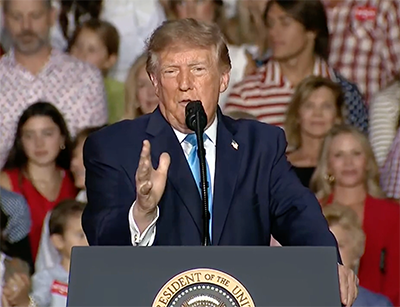
Trump’s remarks came during an Oct. 5 rally in Nebraska.
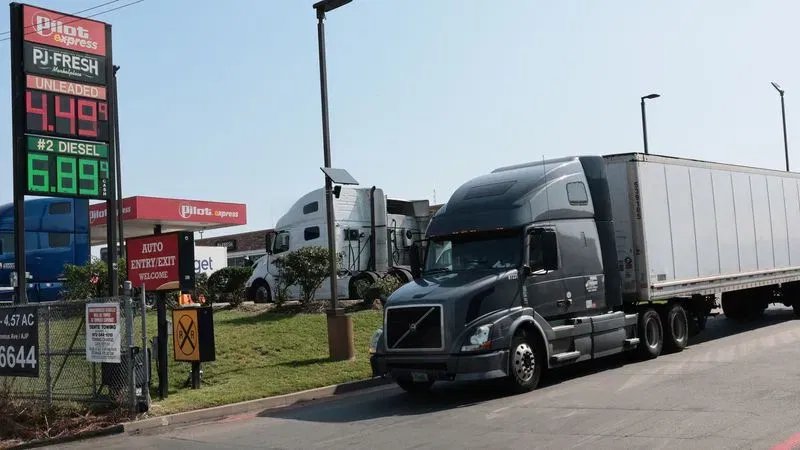
“Remember, with the war, it’s just artificial. It’s a little bit high,” he said, apparently referencing gas prices. “It’s a small price to pay for keeping the world safe, keeping our country safe. They could take out a city. Let them take — let it — let them take out Los Angeles. Let them take out San Diego.
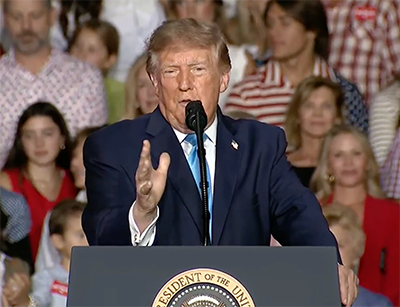
“That’s — this is a very small price to pay, and it’s going to be over with very soon,” he continued. “It’s essentially almost over with.”
The speech quickly drew outraged responses from Democrats in California and nationally.
“After sending the National Guard and Marines to occupy California, Donald Trump is now saying our foreign enemies should ‘take out’ Los Angeles and San Diego,” California Gov. Gavin Newsom wrote on X. “He is deranged and dangerous.”
Newsom’s press office subsequently posted, “Let’s be clear: The President is advocating for an attack on 10+ million U.S. residents in two of America’s largest cities.”
Newsom posted again the following day, calling Trump’s remarks “dangerous — if not treasonous” and saying that he was directing the state “to actively monitor the situation in the event that foreign actors interpret the President’s remarks as an invitation to target California.”
“The President says the Iran war will end ‘very soon,’” Democratic Sen. Adam Schiff of California posted. “How many times have we heard that promise? And if it means attacks on two major American cities in the process, he is not troubled by the cost.”
“I can’t believe we have to say this, but the annihilation of two major American cities — more than 5 million people — is not a ‘small price to pay’ for Trump’s illegal war,” Sen. Bernie Sanders of Vermont, an independent who caucuses with Democrats, wrote on X.
Trump’s remarks were admittedly confusing, in keeping with his characteristically roundabout style of speaking. His speeches at rallies frequently veer off on tangents before circling back to an earlier point. It doesn’t help that some in the crowd in Nebraska began cheering as he said, “Let them take out Los Angeles. Let them take out San Diego,” though Trump himself didn’t seem to react to or encourage the crowd’s response.
But taken in context, his remarks don’t appear to be “advocating” an attack on U.S. cities or suggesting their destruction would be an acceptable cost.
Trump first referenced the war in Iran a few minutes into his Nebraska speech. “We’re saving the world from what could be one of the worst tragedies ever,” he said, adding that the war would end soon and, when it does, the price of oil “will come tumbling down.”
After riffing on other topics, he eventually came back to the subject of the war, which is when he made his controversial comments about Los Angeles and San Diego. What immediately preceded those statements, however, suggests that Trump wasn’t calling for the destruction of those cities, but rather saying that protecting them is worth paying a bit more at the pump: “It’s a little bit high. It’s a small price to pay for keeping the world safe, keeping our country safe. They could take out a city.”
He was likely making the same point about paying more for gasoline when, after referencing the California cities, he said, “This is a very small price to pay, and it’s going to be over with very soon.”
Trump has used similar language before to argue that higher gas prices are worth it if the war prevents Iran from posing a threat to the U.S.
“The one thing already has happened is, Iran will never have a nuclear weapon,” he said in Iowa on Sept. 28. “That’s a very big thing, because if you want to see turmoil and a travesty, let them take out a city with a nuclear weapon. I’m not only talking about Israel and big parts of the Middle East, but let them hit us with a nuclear weapon.”
Speaking to reporters in the Oval Office in March, he said rising oil prices were “a very small thing compared to allowing them to have — you want to see the stock market go down? Start letting them hit you with nukes, OK? I said it this morning, I think it’s a very small price to pay.”
“We’re going to get [the cost of fuel] down,” he told a Nebraska news network on the day of his rally there. “But it’s all going to come pouring down as soon as the war’s over, which will be very soon. And we will not have Iran having a nuclear weapon. And that’s going to be — and I say it and I say it proudly — a relatively small price to pay for keeping nuclear weapons out of the hands of a lunatic nation.”
Reached for comment, a White House spokesperson directed us to an X post from Communications Director Steven Cheung.
“The media freakout over President Trump’s comments is not rooted in reality,” Cheung said. “He was clearly stating U.S. cities would have been threatened if a nuclear Iran hadn’t been stopped.”
In his Feb. 24 State of the Union address, days before the U.S. and Israel launched airstrikes on Iran, Trump said Iran was “working to build missiles that will soon reach the United States of America.” But experts told us the threat of Iran developing an intercontinental ballistic missile capable of reaching the mainland of the United States was not particularly imminent.
Editor’s note: FactCheck.org does not accept advertising. We rely on grants and individual donations from people like you. Please consider a donation. Credit card donations may be made through our “Donate” page. If you prefer to give by check, send to: FactCheck.org, Annenberg Public Policy Center, P.O. Box 58100, Philadelphia, PA 19102.