Photo by Heather Diehl/Getty Images
The Briefing
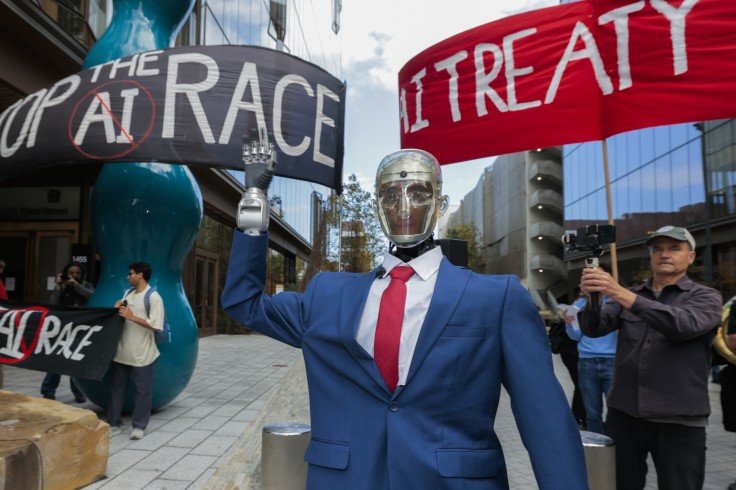
- Roughly 150 demonstrators marched on OpenAI’s San Francisco headquarters on November 14 as part of coordinated protests announced in approximately 20 cities across five continents.
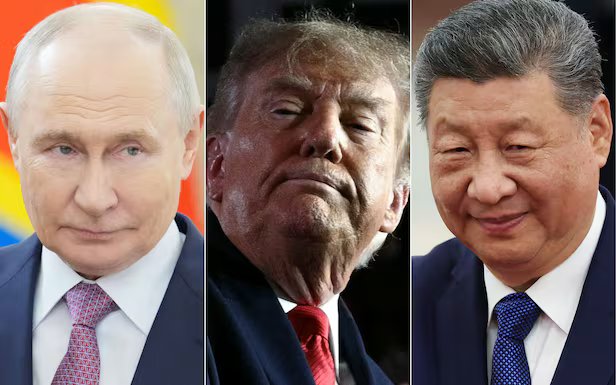
- The movement is urging Donald Trump and Xi Jinping to use their planned November 19 meeting with Vladimir Putin on the sidelines of the APEC summit in Shenzhen to advance negotiations on a binding international treaty restricting the development of AI systems more cognitively capable than humans.
- The CEOs of OpenAI, Anthropic, and Google DeepMind signed a public statement saying that mitigating the risk of extinction from AI should be a global priority alongside risks such as pandemics and nuclear war.
The timing was anything but accidental. With world leaders due to gather in Shenzhen for the APEC summit, Stop The AI Race coordinated demonstrations in approximately 20 cities on Saturday, November 14, across North America, South America, Europe, Africa and Oceania.
A Movement That Grew Beyond Silicon Valley
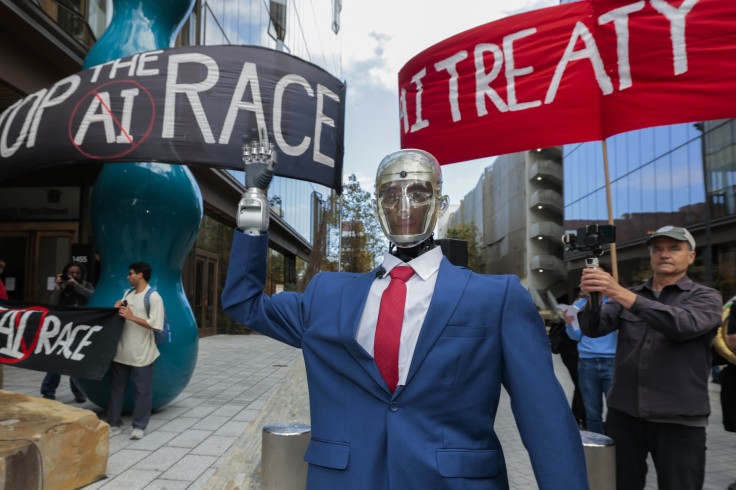
About 150 protesters gathered outside OpenAI’s headquarters in San Francisco on November 14, chanting against robot warfare and calling for a treaty to slow the AI race. The organizers’ schedule said the march would continue to the Veterans Building, followed by an afterparty at Civic Center Plaza.
Michaël Trazzi, a French researcher who founded the Stop The AI Race movement, addressed the crowd with a message equal parts scientific and deeply personal. He said he feared that American and Chinese companies could develop an AI so powerful it might kill people before his niece Sophia is old enough to speak, according to AFP.
The demonstration in San Francisco was part of the first globally coordinated action by the Stop The AI Race movement. Simultaneous marches were held in Washington D.C. — where protesters moved from the Capitol toward the White House — and in New York, where the route stretched from Trump Tower to the Chinese Mission to the United Nations. Additional rallies took place in Paris, Montreal, Berlin, and more than a dozen other cities across Europe, Canada, South America, and Africa.
The Treaty Proposal
Stop The AI Race is not demanding a permanent ban on artificial intelligence. Its formal proposal, developed by the Machine Intelligence Research Institute’s Technical Governance Team, calls for an international agreement to halt the premature development of artificial superintelligence until AI development can proceed without the risks identified in the proposal. The technical framework would restrict the scale of AI training through FLOP thresholds and verify compliance by tracking AI chips and their use, as MIRI’s proposal explains.
Many of the banners in San Francisco drew directly from the 2025 book by safety researchers Eliezer Yudkowsky and Nate Soares, whose title has become an unofficial slogan for the movement: If Anyone Builds It, Everyone Dies. Soares, who serves as MIRI’s president, attended the parallel march in Washington, D.C., according to AFP.
The Prisoner’s Dilemma at the Heart of the Race
The protesters’ central argument rests on a structural problem that the AI industry itself has openly acknowledged: no single laboratory wants to slow down while its competitors continue. At an earlier July 11 demonstration, Trazzi put it this way: “The problem is they can’t stop the race, unless other people stop,” as the San Francisco Chronicle reported. At the November 14 march, former software engineer Zack M. Davis made a related point to AFP: if Anthropic stopped alone, OpenAI could pull ahead, and if the United States stopped alone, China could do the same.
That dynamic is exactly why Stop The AI Race has shifted its focus from corporate headquarters to diplomatic channels. Rather than pressuring individual companies, the movement now targets the bilateral relationship between the two superpowers that collectively control the greatest share of frontier AI development. The CEOs of OpenAI, Anthropic, and Google DeepMind signed a public statement saying that mitigating the risk of extinction from AI should be a global priority alongside risks such as pandemics and nuclear war — yet their companies continue to develop advanced systems, according to the Center for AI Safety’s statement.
Washington’s Answer: Win the Race
The Trump administration has shown little appetite for the kind of treaty the protesters are demanding. The White House released an AI policy framework this year describing the federal government’s commitment as winning the global AI competition, leaving almost no space for binding international restrictions. Trump has simultaneously sought to limit legal liability for AI developers while pushing for child-safety provisions — a posture that is fundamentally incompatible with the movement’s demands.
The 2023 open letter calling for a pause on the largest AI experiments gathered more than 33,000 signatures without producing a single verifiable change in policy at any major laboratory. The November 14 marches represent the movement’s most geopolitically targeted push yet: rather than appealing to companies, it is appealing directly to heads of state at the exact moment those leaders are scheduled to sit across a table from each other.
All Eyes on Shenzhen
The APEC summit is scheduled for November 18–19 in Shenzhen, as BowerGroupAsia reports. The Trump-Xi encounter would be their third meeting of 2026, following meetings in May and September. On November 14, the White House and Kremlin confirmed that Trump, Xi Jinping and Vladimir Putin plan to hold a trilateral meeting on the summit’s sidelines. U.S. and Chinese negotiators have been pursuing trade and investment deals ahead of the summit, while rare earths, chips and Taiwan remain unresolved, as BowerGroupAsia has reported. The protesters are asking that AI governance join that agenda.
Whether either leader arrives in Shenzhen with a concrete proposal on AI remains unknown. What is already on the record is that, for the first time, demonstrators on four continents simultaneously marched to demand that it happen.
© {{Year}} Latin Times. All rights reserved. Do not reproduce without permission.