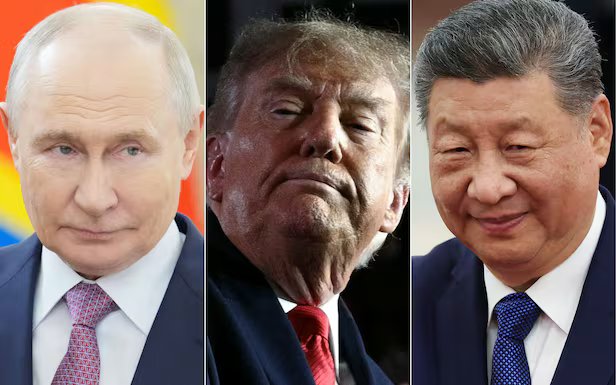
U.S. President Donald Trump, Chinese President Xi Jinping, and Russian President Vladimir Putin will hold the first-ever three-way summit on the 19th in Shenzhen, China. It will be the first time in history that leaders of the three countries with the world’s largest nuclear arsenals gather to discuss nonproliferation. With the U.S.-led democratic alliance system that has underpinned global security since World War II wobbling, concern is rising that a so-called ‘new Yalta order’ could emerge, in which great powers redraw the global security map while excluding the parties directly involved.

Summing up major foreign media reports on the 15th (local time), the three leaders will meet separately on the 19th on the sidelines of the Asia-Pacific Economic Cooperation (APEC) summit to be held in Shenzhen, China, for two days starting on the 18th. White House Spokesperson Olivia Wales said at a briefing, “President Trump made clear that he will discuss global nuclear arms reductions, which he sees as very dangerous if they proliferate, along with other agenda items,” adding, “President Trump will wrap up his China visit with a three-way meeting among the U.S., Chinese, and Russian leaders.” After attending the ASEAN summit in the Philippines on the 17th, Trump is scheduled to arrive in Shenzhen late on the 18th and hold a bilateral meeting with Xi Jinping on the 19th.
New START, the last nuclear arms reduction treaty between the United States and Russia, expired in February, leaving no legal mechanism to cap the three countries’ strategic arsenals. The United States and Russia each hold around 5,000 nuclear warheads, while China has about 600 and has long refused to join nonproliferation talks. A senior U.S. administration official, speaking to Politico on condition of anonymity, said, “We hope this meeting will be a starting point that leads to productive dialogue,” while drawing a line that no concrete reduction deal will emerge. The official said, “China’s extreme opacity around its nuclear stockpile affects the human security of everyone around the world.”
The meeting came together as Putin’s proposal to discuss terms for ending the war without Ukraine at the table aligned with Trump’s interests in finding a diplomatic breakthrough after midterm election losses and in ending the war in Iran. A White House official said discussions on the Ukraine conflict are proceeding through a separate channel that does not include China, adding, “The president said he does not intend to raise Ukraine at that meeting.”
Even so, there is unease that once the three leaders meet, core issues such as Ukraine’s territorial integrity, the Taiwan Strait, and North Korea’s nuclear program could become subjects of off-the-cuff deals. The Korean government conveyed to the United States and China that the summit must not turn into a second Yalta conference that harms the national interest on the Korean Peninsula. Japanese Prime Minister Sanae Takaichi is also seeking a separate meeting with Trump, and a Japanese government source told Kyodo News, “We will ask the United States to exercise caution so the security order we have built together is not undermined.”
Experts said China and Russia stand to reap major strategic gains simply from holding the summit, even without substantive agreements. Hal Brands, a Johns Hopkins University professor, wrote in the U.S. foreign affairs magazine Foreign Policy that “it is likely because China has received ample assurances that there will be no substantive outcomes from the meeting.” Ian Brzezinski, a senior fellow at the Atlantic Council, told Politico, “The optics are terrible,” adding, “The notion that they would sit down with Trump to try to solve problems—without our allies and partners deeply engaged—and effectively be prioritized over allies will generate significant unease among allies in Europe and the Indo-Pacific.” Zack Cooper, a senior fellow at the American Enterprise Institute (AEI), also told the Asahi Shimbun, “The mere fact the summit is happening is a major victory for China and Russia.”