(TNND) — President Donald Trump’s move to lower diesel fuel costs for truckers and farmers was met with skepticism Tuesday from both a truckers’ trade group and an energy economist.
Trump signed an executive order at Monday night’s Nebraska rally, intended to temporarily let drivers fill up with tax-free red-dyed diesel that’s normally allowed only for off-road use, including on farms.
Trump told supporters the order will waive the off-road requirement and let anyone buy red-dyed diesel for any reason.
Trump called it an “unprecedented step to bring down costs,” saying it will save the typical trucker over $100 every time they fill up.
“And farmers will also save millions and millions of dollars,” Trump said.
The executive order does not provide an outright tax waiver. It directs Treasury to determine whether it can defer certain federal diesel-tax payments through the end of the year and suspends specified penalties for highway use of normally tax-exempt dyed diesel.
Trump framed his order as something that’ll eventually make life easier for all inflation-weary Americans.
“And this order will also drive down the cost of all goods, including grocery prices, very substantially,” Trump said. “And it’s an honor to do it. And we’re not going to need it long. I hope we’re not going to need it long, because your prices are plummeting.”
A gallon of diesel cost on average $3.56 at the start of the year, but prices have been on the rise since the conflict with Iran began.
Diesel prices have been over $6 a gallon on average for close to a month now, according to AAA.
The average on Tuesday was $6.32.
The federal diesel tax is 24.4 cents per gallon, according to the White House.
“It’s going to be a small break, a marginal break, in the retail cost of diesel for truckers, but it’s not going to change much,” University of Houston energy economist Ed Hirs said of Trump’s executive order.
And Hirs said he doesn’t see the fuel tax savings reducing transportation costs enough for meaningful price relief to ripple through businesses to consumers.

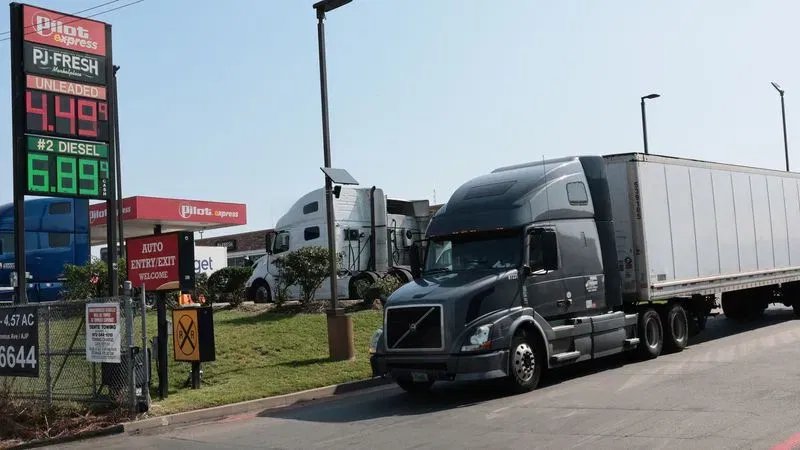
FILE – Gas prices are displayed at a Pilot gas station on September 17, 2026, in Newark, New Jersey. (Photo by Michael M. Santiago/Getty Images)
Todd Spencer, the president and CEO of the Owner-Operator Independent Drivers Association, said America’s truckers are “feeling the pain at the pump.”
“Every $1 increase per gallon in fuel costs our members around $400 more per week, and sustained high prices will put many truck drivers out of business,” Spencer said in a statement.
But Spencer, too, didn’t see Trump’s order as moving the needle much on transportation costs.
“OOIDA believes allowing the wider use of red-dyed diesel will provide minimal relief,” Spencer said. “Market stability is essential to bring down costs for the long haul.”
Hirs said diesel costs more now primarily because of the Iran war, even though the White House blamed a “restricted global diesel supply” on the Russia-Ukraine war, a lack of refining capacity around the world, and Democrat-led states that “chose to shut down their refineries in the name of ‘Green Energy’ policies.”
“The world runs on diesel,” Hirs said. “So, as soon as the blockade of the Strait of Hormuz occurred, diesel prices, fuel oil prices, across the globe jumped – partly due to the cutoff in the refined products that had been coming out through the strait and partly due to Qatar’s 20% of the global (liquefied natural gas) market going offline.”
The interruption to LNG customers forced some to switch to diesel, putting added price pressure on that fuel type, Hirs said.
Hirs questioned why Trump didn’t seek to defer federal taxes on all diesel – including the fuel truckers already buy at the pump – rather than limit the relief to dyed diesel.
He said the diesel available at any truck stop and red-dyed diesel are chemically identical. The dye is just added for enforcement purposes.
“Why not just tell everybody not to collect federal taxes on diesel, period?” Hirs said.
And Hirs said the “irony” of the order is that it could actually disadvantage farmers – a group the order is intended to help – if it causes demand, and thus prices, of red-dyed diesel to jump.
Hirs said refineries and distributors can expand the availability of red-dyed diesel to meet demand, but that can take some time.
“Yeah, suddenly now the American farmer is looking at Amazon and UPS and FedEx and Coca-Cola and Pepsi and Frito-Lay going to his pump to get red diesel,” Hirs said. “So, I would expect that we’re going to see shortages in red diesel, at least initially.”