In 2004, SpaceShipOne flew to space for the second time in less than two weeks and won the $10 million Ansari XPRIZE. I’d spent a decade trying to prove that a privately funded team could do something most people believed only a government could or should do. My first instinct immediately was to ask what else we could do in space.
What I couldn’t have told you was what any of it meant beyond space. For that, I needed other people.
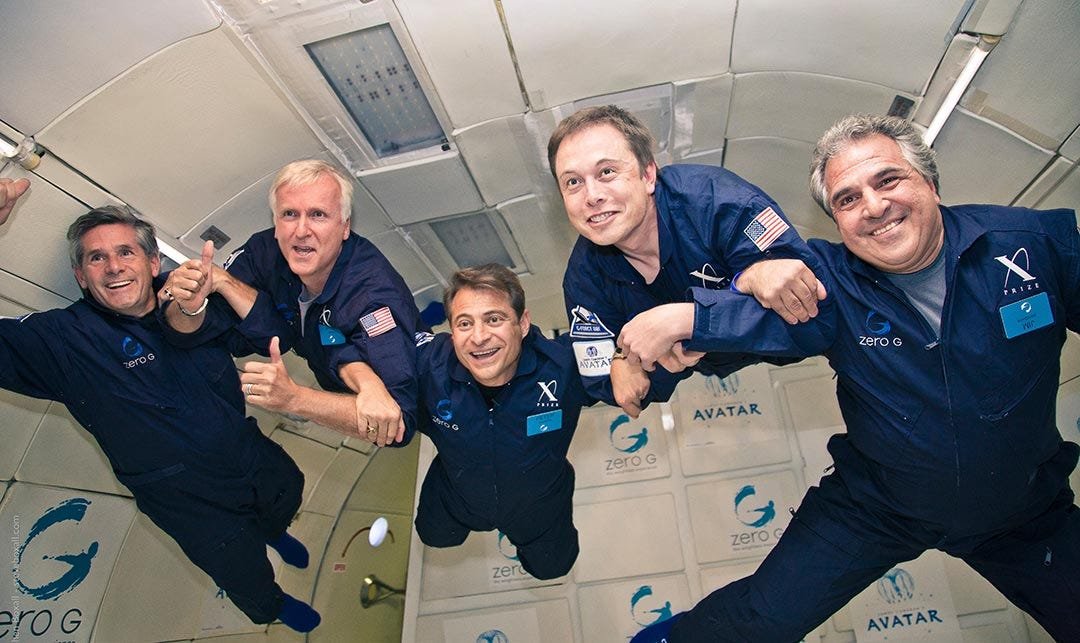
Over the years, Larry Page, James Cameron, Elon Musk, and Anousheh Ansari all served on the XPRIZE board. At one point I’d assembled thirty trustees. It was a wonderful group to invite to dinner and a surprisingly, remarkably difficult group to assemble when we needed a vote. That one was on me. Over the years I learned three important lessons from having such incredible people near me, and today, I’m sharing them with you.
I’d wanted to go to space since I was a kid. By the time SpaceShipOne won, we knew engineers, pilots, and entrepreneurs who’d spent years trying to open up spaceflight. There was plenty left for us to do together; space, in all honesty, is an infinite place of opportunities.
Larry Page joined one of our meetings as a guest while we were debating what to take on next. He listened for most of the meeting and toward the end, he pointed out something pretty obvious: we’d found a way to get people to solve a very big problem with a relatively small amount of prize money.
If we put it into perspective, who had done that? We’d put up one prize and spelled out what a spacecraft had to do to win and let the world decide who chimed in. The teams raised their own money, recruited engineers, and built spacecraft of their own design. Larry saw how much more we could do if we gave people in other fields that same opportunity, and he wasn’t wrong.
A few years later, we challenged automotive engineers to build a production-ready car that could travel the energy equivalent of more than 100 miles on a gallon of gasoline while meeting safety and performance requirements. We could tell the teams exactly what the car had to do and leave it to them to figure out how to build it. That was the possibility Larry had seen in the space prize.
I think about that meeting whenever a founder tells me their first product worked and they’re already building the next version. Before you get too far, bring in someone who understands your business but didn’t spend the last three years building that product with you. Ask them, “What other problem could we solve with what we’ve learned?”
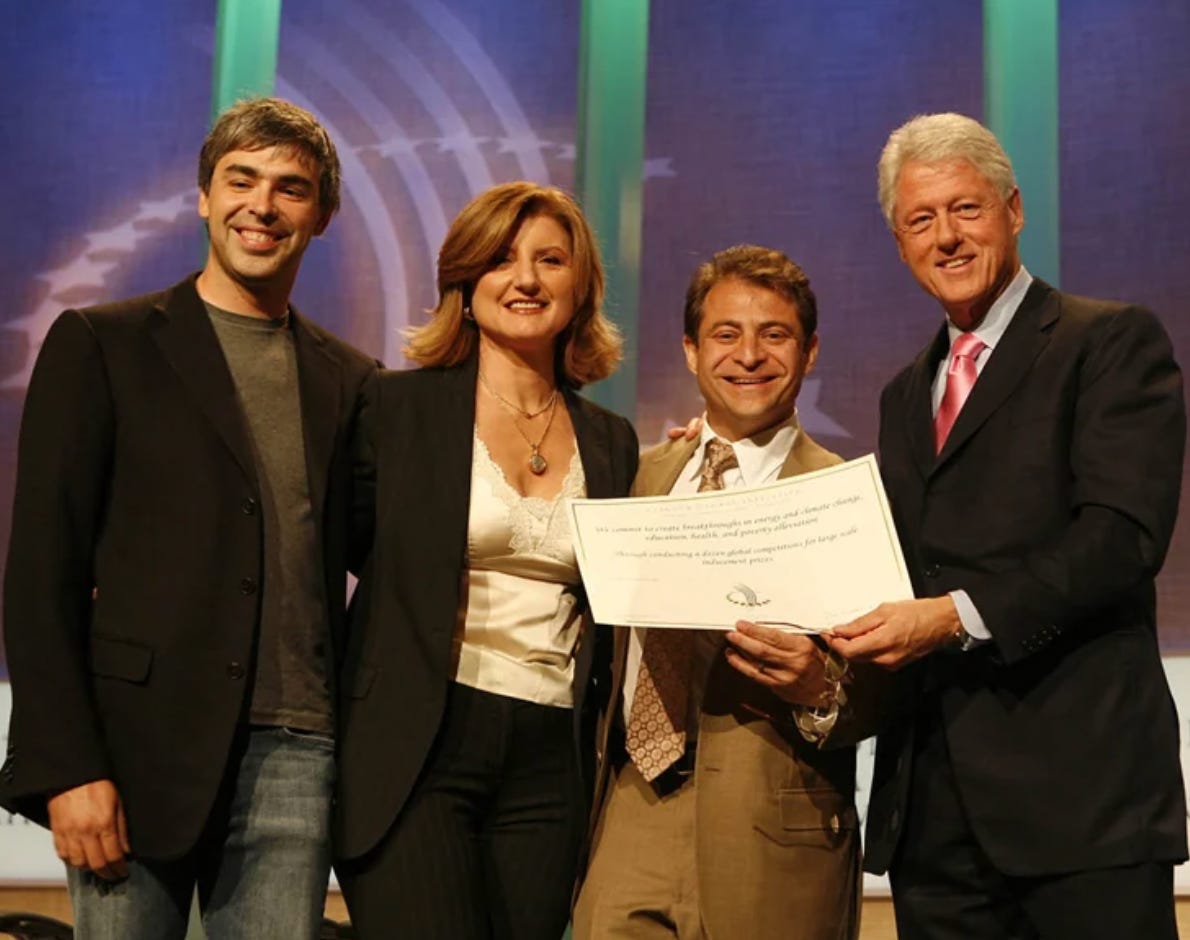
In 2010, oil was pouring into the Gulf of Mexico after the Deepwater Horizon disaster. Jim Cameron, who was on our board, sent me a message. He wanted us to launch an emergency XPRIZE. Without thinking twice, I reached out to our community. Eric Schmidt responded, and Wendy Schmidt funded a competition to improve the speed at which oil could be recovered from the water’s surface.
One of the ten finalists was a team called Vor-Tek. As Steven Kotler and I recounted in BOLD, a tattoo artist and a customer got talking about the problem and tested a scale model in a Jacuzzi. That idea took them all the way to a national oil-spill testing facility in New Jersey, where they could put their equipment through the same trials as industry veterans. Elastec/American Marine won the competition, more than tripling the industry’s previous best oil recovery rate in controlled tests.
I just keep thinking, to this day, about how far apart those people were. Jim could pick up his phone and reach me. I could get a message to the Schmidts. But if Wendy had asked me that afternoon for a list of ten people she should fund, what are the odds I would have put a tattoo artist on it? How would I even have known to call him?
I’d spent years thinking about whom to invite onto our board. One of the most valuable things a trustee ever did was give someone none of us knew a chance to show us what he COULD do. Once those machines were in the water, everyone could see how well they worked; surprise and optimism were the best ways to describe it. He didn’t hesitate when he saw the problem and immediately made the call to get it solved. Just like the Vor-tek team answered the call for this prize. It’s a practice I keep alive to this day.
When I announced our first $10 million prize in St. Louis in 1996, I didn’t have the $10 million. I thought the $10 million would be easy to raise. After all, a sponsor would only have to pay if a team won, so I pitched more than 150 CEOs, billionaires, and philanthropists. Every one of them said no.
Anousheh understood what it meant to be on the other side of that pitch. She was a technology entrepreneur who’d grown up in Iran dreaming of going to space. She’d given considerable thought to why civilians still had so few ways to get there, and she believed competition could change that. Her family sponsored the prize. She joined the board, flew to the International Space Station in 2006, and in 2018 the board asked her to lead XPRIZE as CEO. By then, we knew which problem she kept coming back to, even when it was still entirely somebody else’s responsibility.
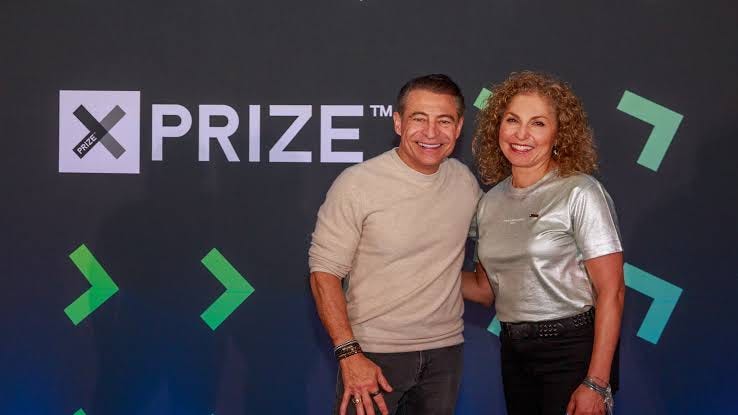
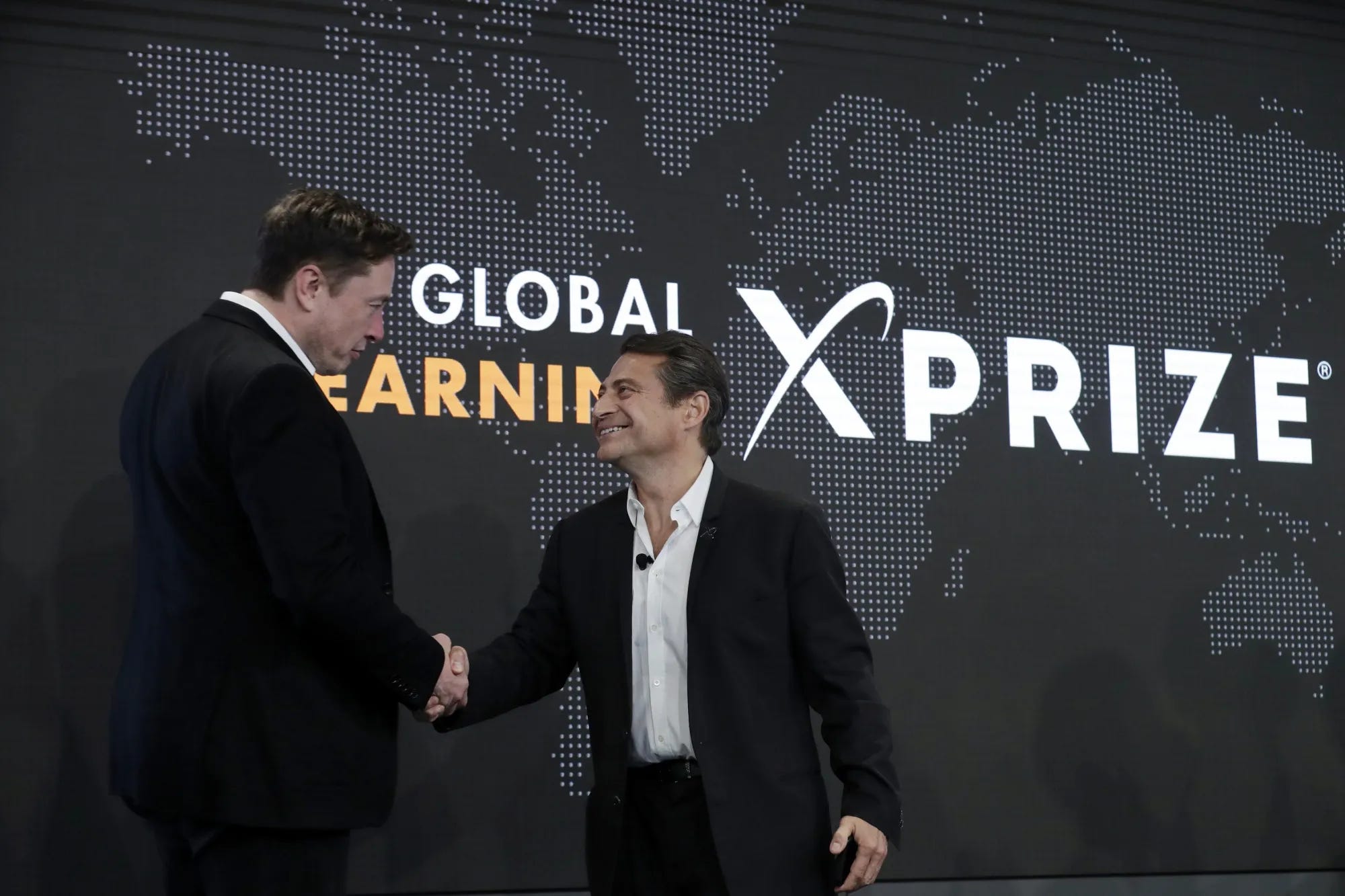
After those 150-plus pitches for our first prize, I had a particular appreciation for what happened years later with Elon. The $100 million XPRIZE for Carbon Removal came together in 31 days. The teams would have four years to prove what they could do. What impressed me enough to write about it at the time was how quickly Elon was willing to give them that chance.
What I learned from Elon was that you can know a problem is worth $100 million before you know who can solve it. He could commit that quickly because the question was clear: how much carbon could each team actually remove? The teams had four years to answer. In the final year, the winner and the runners-up each removed more than 1,000 net tonnes of CO₂. I think about that when someone brings me an idea I’m unsure about. If I can tell them what result would earn my backing, then I ought to ask myself whether I’m willing to fund the work it takes to get there.