
TL;DR: Last week’s hawkish Fed repricing, not a flight from risk, drove yields and the Dollar higher and hit non-yielding gold and Bitcoin, while equities rose and volatility fell. Markets have now priced far more tightening than any Fed official has endorsed, so the 5% test in the two-year yield and whether the Fed validates that path are the next questions.
Why Did Hawkish Fed Repricing Hit Gold and Bitcoin While Stocks Rose?
Financial markets underwent a substantial hawkish reassessment of Federal Reserve policy last week, driving US Treasury yields sharply higher and pushing Dollar Index to a new 2026 high. Gold and Bitcoin suffered heavy losses as tighter financial conditions increased pressure on assets that offer no conventional interest income. Yet US equities advanced and market volatility declined, suggesting that the dominant force was a repricing of interest rate expectations rather than a broad flight from risk.
The scale of the adjustment was striking. Markets entered the week pricing roughly two additional quarter-point Fed hikes through 2027, but ended it anticipating nearly four. The shift was triggered by Fed Governor Christopher Waller’s warning that larger increases might be necessary, followed by an October CPI report that met his threshold for considering a 50bps move. Other policymakers reinforced the need for further tightening, although they differed over its pace and offered no clear endorsement of the full path markets had priced.
The key question for the coming week is whether the Fed can justify the additional tightening already embedded in market prices. The technical picture adds urgency: US two-year yields are approaching 5%, Dollar Index has broken above significant resistance, gold is threatening a decisive breakdown below 3,870, and Bitcoin has already breached a major retracement level.
Follow the Fed repricing and its impact on gold, Bitcoin and the Dollar on the ActionForex Telegram channel.
Fed Expectations Shift From Two Hikes to Nearly Four
The most consequential change was not the expectation of another December rate increase. Markets had already assigned a 76.3% probability to a hike before the week began, with further tightening anticipated during 2027.
What changed was the expected scale and timing of those increases.
At the November 6 close of the previous trading week, Fed funds pricing implied approximately 47bps of additional tightening through September 2027, equivalent to just under two quarter-point hikes. By Friday, November 13, that expectation had climbed to around 90bps, or approximately 3.6 hikes.
Markets had almost doubled the amount of additional tightening they expected the Fed to deliver.
The December 8–9 meeting moved from a 76.3% probability of a hike to a fully priced increase, with CME FedWatch assigning 88.5% to a 25bps move and 11.5% to 50bps. More significantly, the probability of at least 50bps of cumulative tightening by January jumped from 15.8% to 76.6%.
The repricing extended progressively further along the policy horizon. Expected cumulative tightening for December increased by approximately 9bps, while the September 2027 expectation rose by 43bps.
- Cumulative tightening through September 2027: about 47bps (Nov 6) to about 90bps (Nov 13)
- December hike: 76.3% probability to fully priced (88.5% for 25bps, 11.5% for 50bps)
- At least 50bps of cumulative tightening by January: 15.8% to 76.6%
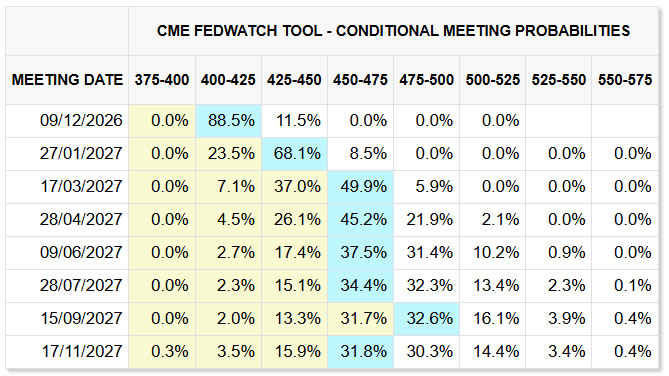
That distinction is critical. The market was not simply betting on a larger December hike. It was pricing a more sustained tightening cycle and a higher eventual policy rate.
The adjustment was largely completed by early Thursday. Subsequent changes through Friday were relatively modest, indicating that the strongest phase of repricing had already occurred before the week’s final inflation release.
Friday’s expected tightening path also raises a question about market positioning. With almost 90bps of additional increases priced through September 2027, further hawkish surprises would need to justify either a faster sequence of hikes or a higher eventual policy peak.
Waller’s Warning and October CPI Triggered the Repricing
The turning point came on Tuesday, November 10, when Fed Governor Christopher Waller raised the possibility of accelerating monetary tightening.
Speaking at the Bank of England Watchers Conference in London ahead of the US inflation release, Waller supported a 25bps December increase even if inflation improved from September. However, he argued that a 50bps move should be considered if monthly core CPI reached approximately 0.3% or higher.
“Hiking only 25 basis points would put our credibility at risk,” Waller warned.
The concern was not confined to the immediate inflation figures. Waller argued that expected future rate increases had already tightened financial conditions. If the Fed failed to deliver the tightening markets anticipated, interest rates could fall and financial conditions could loosen, undermining efforts to restore price stability.
His argument introduced a feedback mechanism between Fed policy and market expectations: financial markets were already delivering restraint that policymakers might need to preserve.
October CPI subsequently reinforced that concern.
Core consumer prices increased 0.3% mom for a third consecutive month, exceeding expectations of 0.2% and meeting the threshold Waller had identified. Headline CPI rose 0.4%, also above the 0.3% forecast, although it slowed from September’s 0.6% increase.
The internal details were mixed. Shelter inflation moderated, and core goods inflation eased slightly. However, services excluding rent of shelter accelerated from 0.3% to 0.5% mom, suggesting persistent price pressure beyond the most volatile components.
The combination of Waller’s conditional warning and the subsequent inflation surprise gave investors a concrete reason to reassess the Fed’s policy trajectory.
The Treasury market responded immediately, with the two-year yield rising sharply on Tuesday. Additional pressure developed later in the week as investors absorbed the implications of persistent inflation and further Fed commentary.
Friday’s PPI release provided a modest counterweight. Headline producer prices increased 0.3% against expectations of 0.4%, prompting some retreat in yields and the Dollar. Yet underlying PPI excluding food, energy and trade services held at 0.5% for a second month, while annual headline producer inflation reached 6.5%.
The PPI downside surprise interrupted the advance but did not materially challenge the broader inflation concerns that had driven the week’s repricing.
Fed Officials Support More Tightening, but Differ Over Pace
Waller’s comments were the clearest catalyst for a more aggressive interpretation of Fed policy, but the wider message from policymakers was more nuanced.
Dallas Fed President Lorie Logan supported at least two additional quarter-point increases, stating that the FOMC needed to implement “at least two more 25-basis-point rate increases.” She also suggested that faster action might become appropriate.
Kansas City Fed President Jeff Schmid described policy as “fairly accommodative,” reinforcing the argument that interest rates had not yet reached a sufficiently restrictive setting.
Others shared concerns about inflation without endorsing larger immediate increases.
Cleveland Fed President Beth Hammack favored smaller, more frequent hikes, arguing that gradual tightening would allow households and businesses to adjust more smoothly. Despite acknowledging that inflation was moving in the wrong direction, she rejected the idea that the Fed had fallen sufficiently behind to require more aggressive action.
“I don’t think we’re behind the curve today,” Hammack said.
San Francisco Fed President Mary Daly also expected further tightening but emphasized that rising Treasury yields were already contributing to tighter financial conditions. She described higher yields as “most welcome,” arguing that market-driven restraint gave the Fed additional time to make calibrated decisions.
Chicago Fed President Austan Goolsbee warned that inflation was at a “precarious moment,” particularly as services price pressures persisted beyond tariffs and energy. New York Fed President John Williams similarly supported further tightening without specifying its timing or magnitude.
Comments from Philadelphia Fed President Anna Paulson and Boston Fed President Susan Collins also favored measured increases, while leaving room for faster action if inflation developments warranted it.
The emerging consensus is that rates need to rise further. The disagreement concerns how quickly the Fed must act, and how much additional tightening will ultimately be necessary.
This distinction leaves a potentially important gap between market expectations and policymakers’ expressed intentions.
Investors have priced approximately 90bps of further tightening through September 2027, but no official has explicitly endorsed that cumulative increase or identified a corresponding terminal rate.
That does not mean the market is necessarily overpricing the cycle. Persistent inflation could eventually validate the projected path. However, the current level of market expectations requires stronger confirmation than a general agreement among policymakers that further hikes are necessary.
Treasury Yields Lead Dollar Higher While Equities Resist Risk-Off Pressure
The Treasury market delivered the clearest expression of the policy adjustment.
The US two-year yield surged 34bps during the week, from 4.512% to 4.852%. The ten-year yield increased 28bps to 5.139%, while the thirty-year yield rose approximately 21bps.
The larger increase at the front end narrowed the spread between two-year and ten-year yields from approximately 34.7bps to 28.7bps.
- US two-year yield: +34bps, 4.512% to 4.852%
- US ten-year yield: +28bps to 5.139%
- US thirty-year yield: about +21bps
- Two-year/ten-year spread: about 34.7bps to 28.7bps
That flattening is consistent with a repricing driven primarily by expected Fed policy rather than a rise in longer-term borrowing costs alone.
Bond yields also increased in Germany, Britain, Canada and Japan, but the US moves were larger. The resulting widening in yield differentials provided a fundamental basis for the Dollar’s advance.
Dollar Index climbed 1.11% over the week to close at 103.410, breaking above its previous 2026 high around 102.945. The weekly FX heat map showed broad Dollar strength against all seven major counterparts, although the Yen and New Zealand Dollar held up relatively well while Swiss Franc was particularly weak.
The nature of the Dollar rally is important.
The evidence points more strongly toward a yield-differential advance than a conventional safe-haven bid. Swiss Franc weakness and falling equity-market volatility contrast with what would normally accompany broad defensive positioning.
Indeed, US stocks recovered despite the sharp rise in yields.
S&P 500 gained approximately 2.5% for the week, Nasdaq advanced 2.3%, and Dow Jones rose 2.1%. VIX declined by about 25%, reflecting a substantial reduction in the market stress seen during the preceding week.
- Dollar Index: +1.11% to 103.410 (previous 2026 high around 102.945)
- S&P 500: about +2.5%; Nasdaq: +2.3%; Dow Jones: +2.1%
- VIX: down about 25%
Part of the equity recovery therefore reflected relief from earlier selling. Higher yields nevertheless continued to challenge valuations, particularly in longer-duration technology shares. Nasdaq finished Friday lower even as the major indices retained positive weekly performances.
The result was a differentiated market response rather than a uniform withdrawal from risk.
Gold and Bitcoin Bear the Brunt of Tighter Financial Conditions
The impact of higher yields and Dollar strength was considerably more pronounced in gold and Bitcoin.
Gold fell 4.56% during the week to close at 3,883.94, while Bitcoin declined approximately 9.93% on its weekly chart, trading around 67,300 during Saturday’s snapshot. Silver also suffered substantial losses.
For gold, the monetary transmission mechanism is relatively direct. Higher real yields increase the opportunity cost of holding a non-interest-bearing asset, while a stronger Dollar creates an additional headwind.
Bitcoin does not operate through precisely the same mechanism. Its valuation is also sensitive to market liquidity, leverage, positioning and cryptocurrency-specific developments. Nevertheless, higher interest rates and tighter financial conditions can reduce the attractiveness of holding an asset that offers no conventional income stream.
The common pressure was the repricing of the return available from interest-bearing assets and the financial conditions surrounding alternative stores of value.
The distinction matters because equities rose during the same period. The declines in gold and Bitcoin cannot simply be explained as a general collapse in investor risk appetite.
Nor does the week’s correlation establish that monetary policy expectations caused every movement in either asset.
Still, the simultaneous surge in yields and the Dollar, alongside heavy losses in gold and Bitcoin, provides a coherent picture of where the tightening adjustment exerted its greatest pressure.
The technical developments now suggest that both assets could face further downside if the current monetary backdrop persists.
Two-Year Yield Approaches 5%, Dollar Targets Further Gains
US Two-Year Yield: 5% Is the Immediate Test, 5.259% the Larger Hurdle
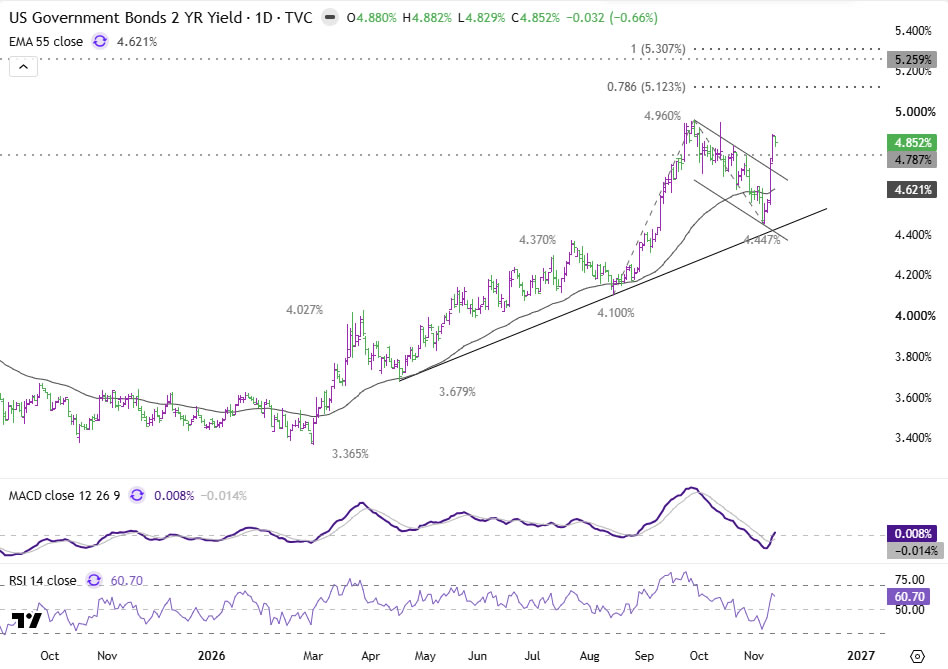
The two-year yield’s strong advance and break above 4.787% resistance reinforce the case that the corrective retreat from 4.960% completed at 4.447%.
Immediate focus is now on the 4.960–5.000% resistance zone.
Some consolidation could develop as yields approach this area. However, the near-term outlook will stay bullish as long as the 55-day EMA, currently around 4.621%, holds.
A firm break through 4.960–5.000% would confirm resumption of the broader uptrend from the 2026 low at 3.365%. The next target would be the 78.6% projection of 4.100% to 4.960%, measured from 4.447%, at 5.123%.
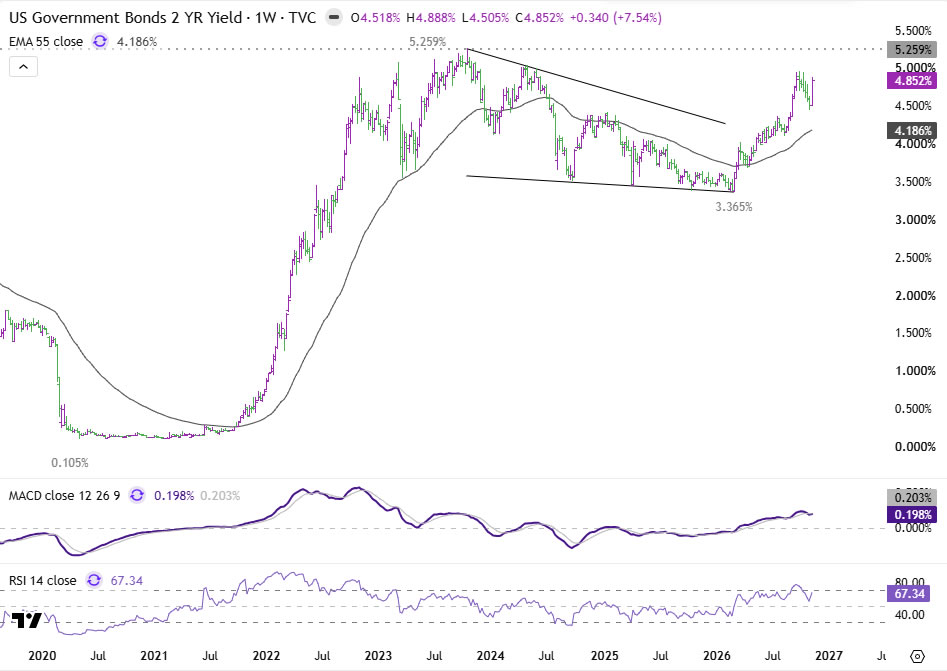
The weekly chart presents an even more consequential possibility.
The consolidation from the 2023 high at 5.259% appears to have completed as a triangle at 3.365%. This raises the prospect that the long-term uptrend from the 2020 low at 0.105% is resuming.
Nevertheless, 5.259% represents the critical longer-term hurdle. A sustained break above that level would provide stronger confirmation of a major bullish continuation in yields.
The distinction is between overcoming 5% in the near term and establishing a broader breakout above the 2023 peak.
Dollar Index: Breakout Signals Upside Acceleration
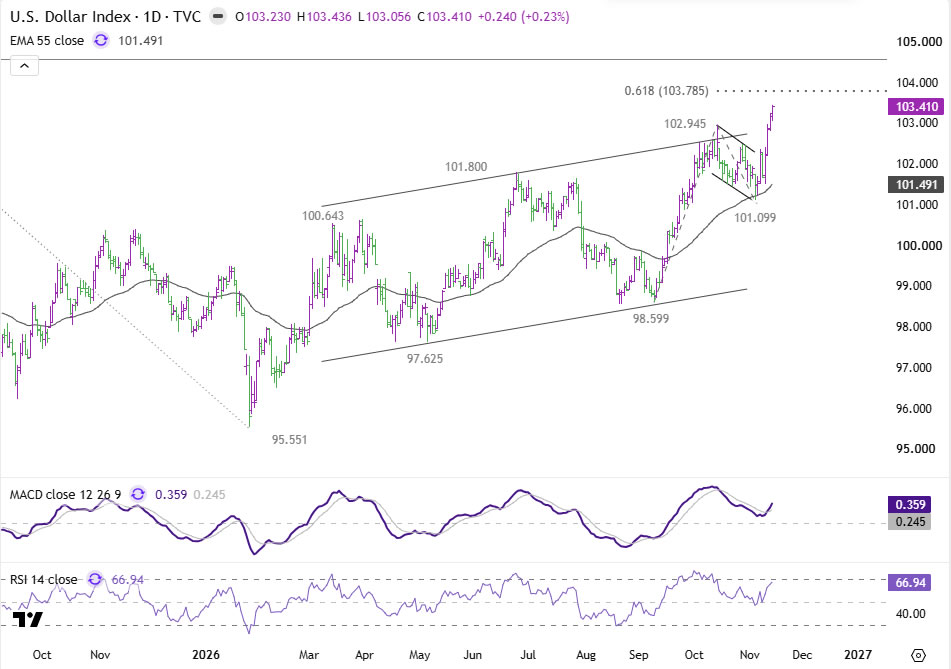
Dollar Index’s firm break above 102.94 resistance confirms resumption of the advance from the 2026 low at 95.55.
The move also carried the index above the upper boundary of its medium-term rising channel, indicating upside acceleration.
Further gains are favored toward the 61.8% projection of 98.59 to 102.94 from 101.09, at approximately 103.78.
In the event of a pullback, the near-term bullish outlook will remain intact while the 55-day EMA, currently around 101.49, holds.
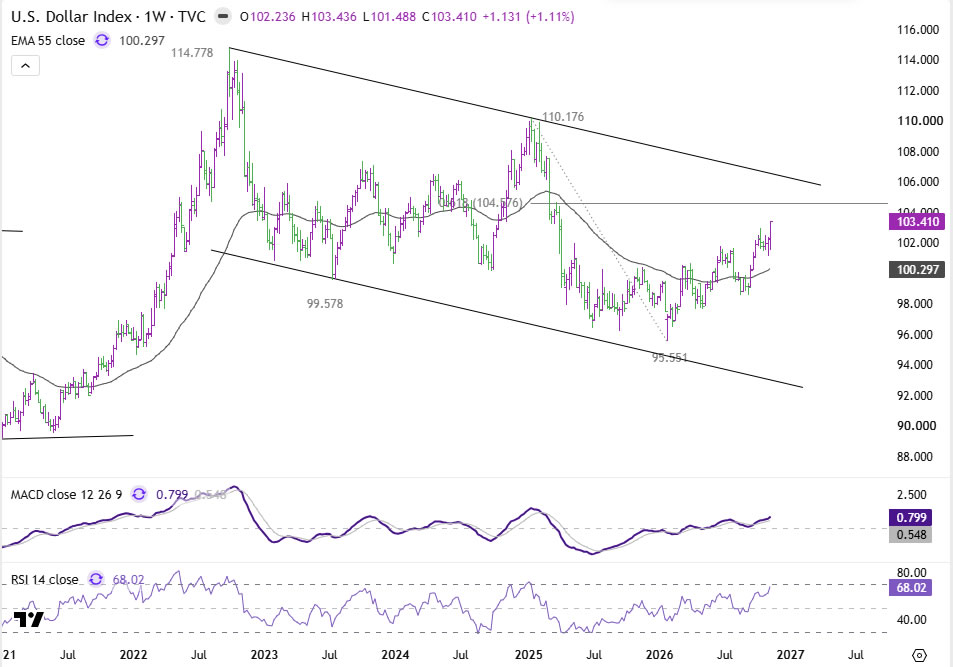
In the broader picture, the rise from 95.55 is seen as reversing the decline from the 2025 high at 110.17.
The next important target is the 61.8% retracement at approximately 104.57. A firm break would bring the long-term falling channel resistance, currently around 106.50, into focus.
The larger decline from the 2022 high at 114.77 could have completed as a three-wave correction at 95.55. Sustained trading above the long-term channel resistance would add weight to that bullish interpretation.
For now, both the daily breakout and weekly recovery structure support further Dollar strength, consistent with the widening US yield advantage.
Gold, Bearish Pressure Builds Around 3,870 Support
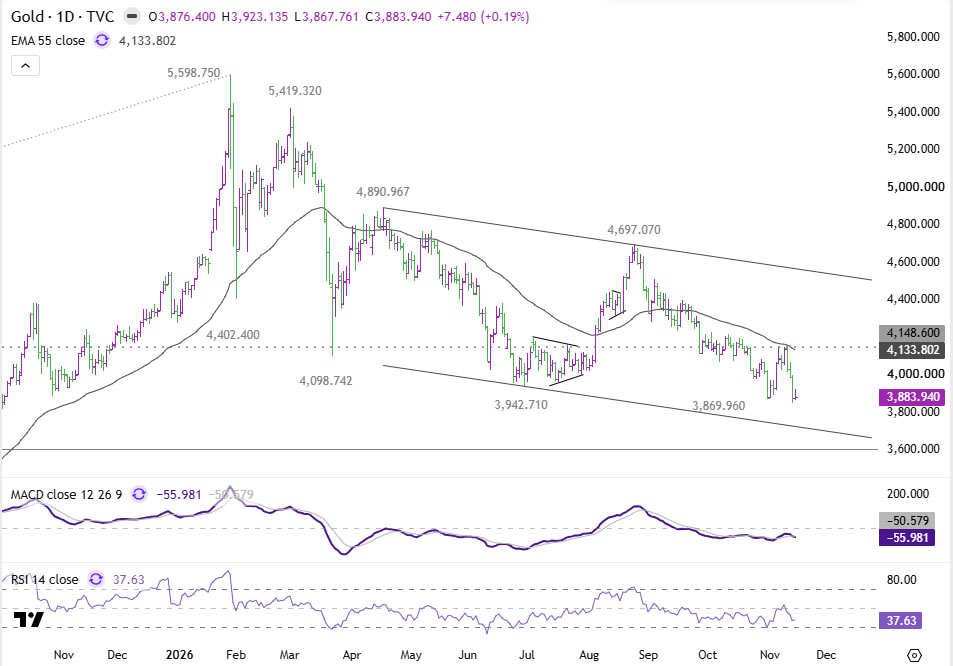
Gold briefly breached the 3,869.96 support level last week, reaching 3,852.62, but failed to establish a clean breakdown.
The recovery to a Friday close of 3,883.94 leaves room for further consolidation before the next decisive move.
Nevertheless, the near-term outlook remains bearish while 4,148.60 resistance holds.
Sustained trading below 3,869.96 would confirm resumption of the larger decline from the record high at 5,598.75.
The weekly chart highlights the potential scale of that correction.
Gold’s advance from the 2022 low at 1,614.92 to the 2026 peak at 5,598.75 has left significant room for decline.
A confirmed break below 3,869.96 would target the 50% retracement at 3,606.83.
A firm break beneath 3,606.83 would then expose the 61.8% retracement at 3,136.74.
The weekly close below the 55-week EMA, now around 4,184.30, reinforces the bearish medium-term structure.
The critical distinction is that gold has tested support without confirming a sustained breakdown. The technical outlook favors further weakness, but confirmation of the next downward leg is still required.
Bitcoin, Breakdown Below 69,050 Opens Retest of 57,736
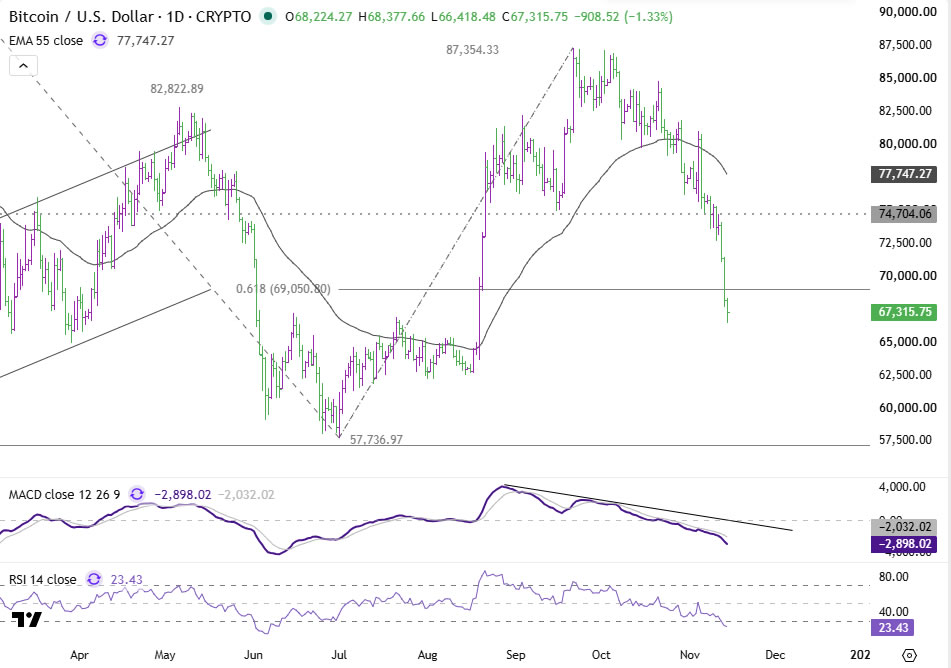
Bitcoin’s decline from 87,354 accelerated sharply last week, breaking below the 61.8% retracement of the 57,736–87,354 rebound at approximately 69,050.
The development, with its downward acceleration, is raising the chance that the long-term downtrend is resuming.
Whether this is the case or not, the near-term outlook will stay bearish as long as 74,704 resistance holds. The next target is a retest of the 57,736 low.
Daily RSI has fallen into oversold territory, raising the possibility of temporary rebounds. However, an oversold condition alone does not establish that the decline has ended.
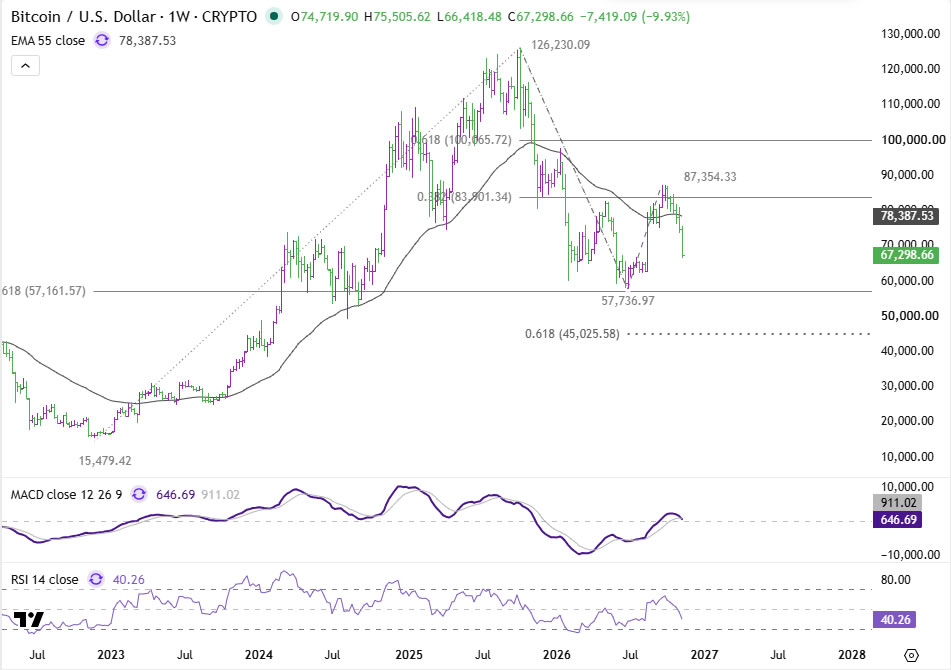
The weekly structure raises the risk that Bitcoin’s longer-term downtrend from the 2025 peak at 126,230 is resuming.
The rebound from 57,736 to 87,354 has failed to sustain its recovery, while the latest decline has carried price back below the 55-week EMA, currently around 78,388.
A firm break below 57,736 would strengthen the case for long-term bearish continuation, targeting the 61.8% projection of 126,230 to 57,736 from 87,354, at approximately 45,025.
Bitcoin’s breakdown is technically more advanced than gold’s, where the critical 3,870 support has not yet been decisively breached.
Can Markets Sustain the Tightening Already Priced?
Last week’s developments created an important distinction between the Fed’s stated intentions and the expectations now embedded in financial markets.
Policymakers broadly agree that further tightening is necessary, but markets have already priced nearly four additional quarter-point hikes without an explicit endorsement of that cumulative path.
That gap could become a source of volatility as investors assess incoming inflation, employment and policy signals.
The technical picture currently favors continued upward pressure on Treasury yields and the Dollar, while gold and Bitcoin remain vulnerable to further declines.
Yet the next phase is not predetermined. A failure of the two-year yield to break through 5%, or evidence that the Fed is unwilling to validate the additional tightening priced, could interrupt the adjustment.
Conversely, renewed inflation pressure or stronger hawkish guidance could reinforce the market’s expectations and extend the moves.
The defining issue for next week is whether economic evidence can catch up with market pricing. The Fed has not yet delivered the tightening investors now anticipate, but Treasury yields and the Dollar have already transmitted a substantial part of that restraint to financial markets.
Key Takeaways
- Markets nearly doubled their expected Fed tightening, from about 47bps to about 90bps through September 2027, after Waller’s warning and a hot October CPI.
- The US two-year yield rose 34bps to 4.852% and Dollar Index gained 1.11% to a new 2026 high of 103.410, a yield-differential move rather than a safe-haven bid.
- Equities rose and VIX fell about 25%, so gold’s 4.56% loss and Bitcoin’s roughly 9.93% decline reflect pressure on non-yielders rather than broad risk-off.
- The two-year yield faces 4.960–5.000% resistance, with 5.259% the larger hurdle, while Dollar Index targets 103.78 and 104.57.
- Gold tested 3,869.96 without a confirmed breakdown (3,606.83 below), while Bitcoin has broken 69,050 and its next target is the 57,736 low.
Stay ahead of the Fed repricing, the 5% yield test and the next move in gold and Bitcoin—join the ActionForex Telegram channel for regular market updates and analysis.
