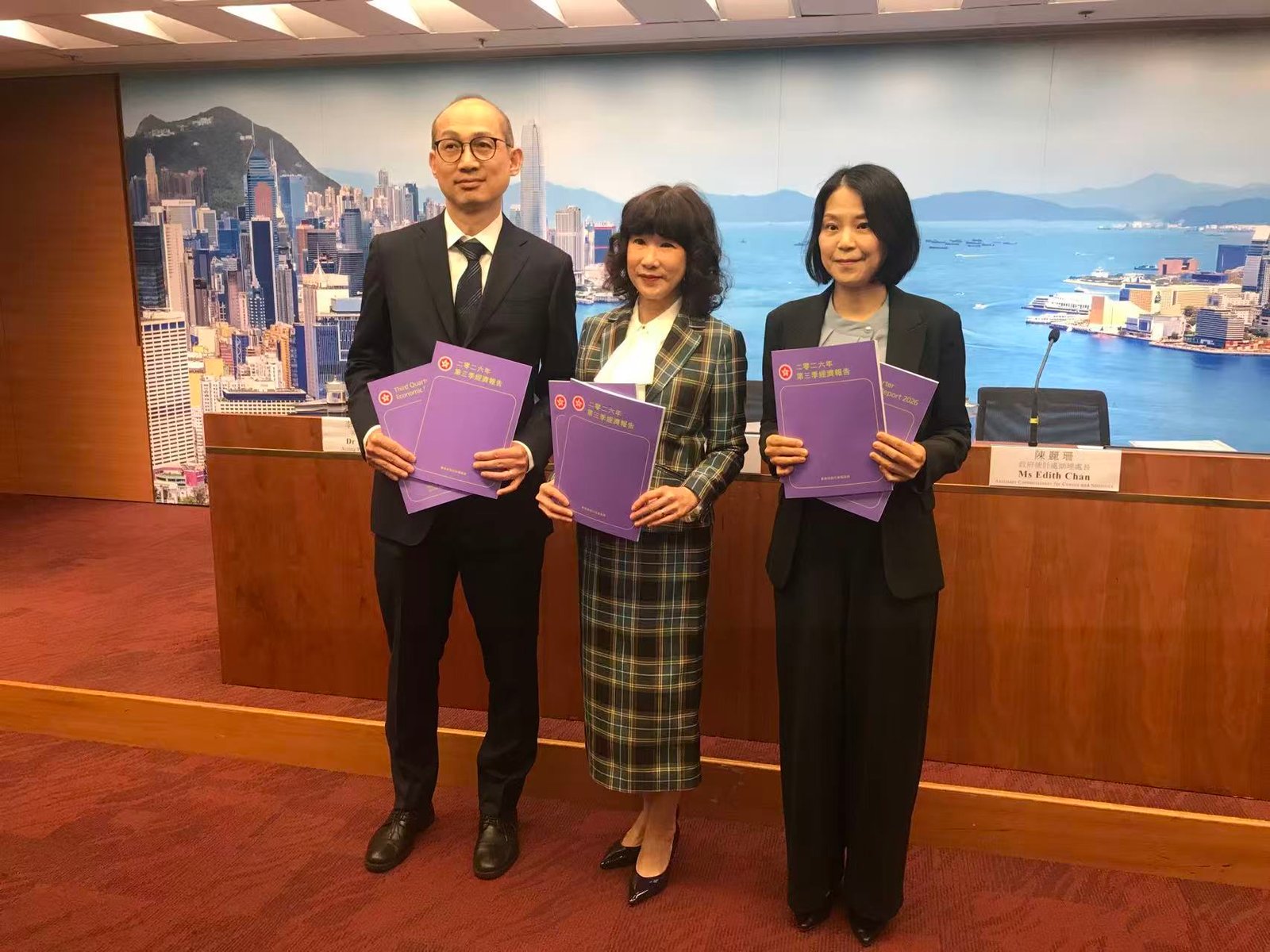
The Hong Kong Special Administrative Region has raised the full-year economic growth forecast to 4.8 percent for 2026, from the previous projection of 3.5 percent to 4.5 percent, citing stronger-than-expected growth in the first three quarters and expected further solid growth in the fourth quarter.
Hong Kong’s economy expanded 5.2 percent year-on-year in the third quarter, up 1 percentage point from the previous quarter. For the first three quarters of this year, the economy grew at an annual rate of 5.1 percent, the fastest pace in five years.
Economic growth was boosted by the total export of goods (30.3 percent), export of services (4.3 percent), private consumption expenditure (2.9 percent), government consumption expenditure (1.7 percent), and overall investment expenditure in terms of gross domestic fixed capital formation (7.5 percent).
ALSO READ: HK GDP rises 5.2% on exports surge, solid domestic demand
The SAR government slashed this year’s forecast for underlying inflation from the previous forecast of 2.5 percent to 1.9 percent, citing slower-than-expected pass-through of higher international prices to fuel-related components, and the alleviation effect of government measures including fuel subsidies.
“Looking ahead, we expect the outlook for Hong Kong’s economy to remain positive. This is because of strong export data from neighboring major semiconductor manufacturing countries and regions last month, and the fact that artificial intelligence-related electronic products account for 75 percent of Hong Kong’s exports,” government economist Irina Fan Yuen-yee said at a Friday press conference.
Fan added that while recent market volatility regarding AI-related investments represents a risk factor, it has not actually impacted Hong Kong’s real economy, and the government is closely monitoring the situation.
She cited the business data of the Semiconductor Industry Association in the United States that high double-digit semiconductor product sales growth is expected next year which should support Hong Kong’s strong export performance.
READ MORE: Chan: HK’s Q3 GDP forecast may be revised upwards
When asked about the impact of potential interest rate hikes by the US Federal Reserve, Fan said: “It depends on whether there is a rapid rate hike cycle or a gradual rate hike. The market is currently expecting a 25 basis points rate hike this year and another rate increase by the middle of next year. As the market does not expect a rapid rate hike, the rate hike impact on Hong Kong’s economy should be moderate.”
Tommy Wu, Greater China and North Asia senior economist at Standard Chartered, projected Hong Kong’s economy will grow 4.3 percent this year, while the fourth quarter growth rate will moderate to 3.2 percent.
“We look for a continued recovery of the domestic sectors, while exports strength likely remains robust as global AI-driven demand stays strong,” Wu said.
According to government figures, Hong Kong residents’ expenditure in the domestic consumption market surpassed pre-pandemic levels, spending HK$497 billion ($63.7 billion) during 2024 to the third quarter of this year. However, non-residents’ spending in the special administrative region remained notably below the pre-pandemic level.
Hang Seng Bank raised the city’s GDP forecast to 4.4 percent in 2026, with AI-driven exports continuing to underpin strong growth momentum.
“To broaden its nascent domestic recovery, Hong Kong needs to attract more visitors, expand its labor force and crowd in private investment — all among the many priorities highlighted in the new five-year plan,” Hang Seng Bank Chief Economist Kelvin Lau said.
The government said the seasonally adjusted unemployment rate edged up to 3.9 percent in the third quarter, as the labor force grew faster than total employment amid the entry of graduates and school leavers. The unemployment rate among young people aged 15-24 rose to 14.6 percent, significantly higher than other age groups.
READ MORE: HK jobless rate dips for second straight quarter
According to government figure, the SAR has hosted over 130 mega-events in the first half of this year, attracting 1.75 million visitors that generates HK$5.8 billion in spending and contributing HK$3.3 billion value-added to the economy.
Citi Research said it expects Hong Kong’s economic recovery will continue to be uneven, with strong AI-related merchandise trading activities, rising public and private investments, but consumption growth likely stayed moderate despite high tourist arrivals during the summer holiday.
Fan admitted that the pace of growth varies across different sectors of Hong Kong’s economy. “The cumulative salary growth since the COVID-19 pandemic has also diverged across industries, with finance and telecommunications sectors showing the best cumulative increase at 28 percent, while the retail sector has seen the lowest at 14.5 percent which is below the average level of 26 percent.”