A LinkedIn post about a new type of luxury home led a Bonita Springs-based construction company on an AI-fueled, exponential growth journey, mass-producing what looks like the love child of a Yeti cooler and a shipping container.
Northstar Technologies, an offshoot of a 26-year-old construction company, originated in Naples in 2020. During the early days of the COVID-19 pandemic, it had makeshift offices at Naples Smoke Shop in Neapolitan Way Shopping Center, then in the hallways of Naples Bay Resort and later on a yacht anchored there.
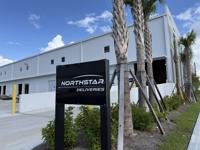
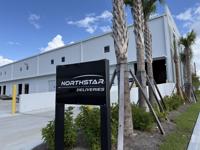
Northstar Technologies manufactures modular data centers inside this warehouse off Oriole Road in Lee County. The buildings made are used to support artificial intelligence infrastructure.
Photo by David Dorsey
Now, it’s headquartered in a Bonita Springs warehouse. Northstar’s on track for its annual revenue to grow more than 100 times over three years. It started at $4.3 million in 2024, grew to $11.5 million in 2025 and leaped to a projected $450 million this year, CEO Paul Inglese said, with about $1.3 billion in committed sales this year.
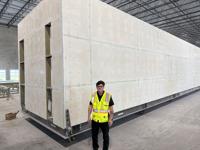
Most of Northstar’s modular buildings measure about 12 feet wide, 12 feet tall and 60 feet long. They are about 720 square feet — roughly the size of two steel shipping containers.
They are being built inside a 153,000-square-foot warehouse off Oriole Road, near where Alico Road and Interstate 75 intersect in Lee County.
Multiply one Northstar modular data center by about 700, and you get a hyperscale data center — a massive building eclipsing half a million square feet. Those have been facing opposition from communities, voters and elected officials.
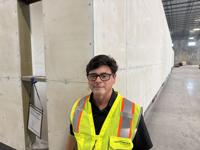
Northstar Technologies CEO Paul Inglese stands in front of a modular data center nearing completion.
Photo by David Dorsey
Some of Northstar’s modular buildings end up in large, hyperscale data centers, Inglese said, but others are deployed as standalone buildings, allowing them to face less scrutiny from neighboring property owners.
By building a data center miniature in scale, Northstar has positioned itself to pioneer a nascent industry, said Jason Hick, director of modular data centers at Alliance Technology Group, which also builds the hyperscale data centers for its clients.
Alliance surveyed 25 modular data center builders, and Hick said Northstar rose to the top. Alliance is one of Northstar’s biggest clients, and the two are intertwined in growth. Alliance has projected its own modular data center revenue this year at about $100 million, Hick said.
“When you have a building and a site selection and construction starting, it’s a very dirty environment,” Hick said of hyperscale data centers. “There are tools flying everywhere, and it’s not an environment for a computer. Computers need filtered air and liquid cooling and a lot of power. House power — to run a few light bulbs or an office trailer — that’s not something you can run a computer off of.”
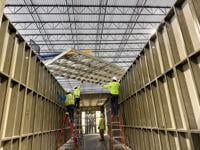
Workers put the roof on a modular data center under construction. The assembly line process takes about two days to build one. Photo Photo by David Dorsey
Photo by David Dorsey
Alliance’s clients are trying to monetize their buildings before they get completed, which isn’t easily feasible in a cavernous building.
“Enter Northstar,” Hick said.
It’s not just the disparity in size that is making Northstar’s products a hot commodity in the AI industry, Hick and Inglese each said. It’s the materials. Instead of using concrete and steel, Northstar assembles the buildings out of fiber-reinforced polymer, made out of high-strength fibers such as glass, set in a polymer resin matrix. They are similar in insulation capability, Inglese said, to a Yeti cooler, which is made from polyethylene with polyurethane foam insulation.
“As everybody knows, the claim is ice lasts for three days or more in a Yeti cooler,” Inglese said. “The same concept goes for the data center. It’s not taking on heat from the outside. So, it’s only dealing with what’s inside of it. It’s easier to cool it. Small and compartmentalized. Highly energy efficient and not taking heat gain from the environment.”
The composite material serves two additional purposes: It’s lightweight and durable. The modular data centers have passed tests, certified as Category 5 hurricane- and EF5 tornado-resistant, Inglese said.
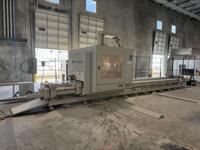
Northstar’s factory uses a combination of humans and machines, such as this saw, during the milling process of building a modular data center. Photos by David Dorsey
Photo by David Dorsey
“We are 80% lighter than steel,” Inglese said. “But we’re stronger than steel on a weight-to-strength ratio. Meaning the strength of it compared to its lightness allows it to be used in applications that need high strength and low weight. That leads to transporting a 60-foot module across the country or shipping it globally. It’s more transportable.”
That aspect has led to clients such as the U.S. government, including the Department of Defense.
The government contracts, exponential growth and the billion-plus dollars in sales, none of that would have been set in motion had Inglese not witnessed the days after Aug. 13, 2004, when Hurricane Charley devastated Charlotte County.
“When Hurricane Charley and Wilma hit, we were doing just small residential buildings, conventional block and such, up in Port Charlotte and Punta Gorda,” Inglese said. “When that storm hit, I had never seen devastation like that in my life. We got a call from this one guy, an older gentleman in Port Charlotte.”
The gentleman had a hole in his garage wall that needed fixing. Inglese went out to look at it. A concrete block panel had blown through the side of the garage, through the car inside and onto the car seat.
“Everyone thinks that concrete block homes are strong, and it’s in the building code,” Inglese said. “People don’t understand — the building code is the minimum that you can build to. The heartache I saw, I thought to myself, ‘There has to be a better way.’”
Inglese spent almost the next 20 years in construction while doing research and development and trial and error, leading him to building a three-story, 3,100-square-foot, $1.7 million luxury home in Naples Park on 111th Avenue North. It’s Collier County’s first home made out of fiber-reinforced polymer. Nicknamed the “Lotus home,” the then-windowless shell of it was completed in time to endure Hurricane Ian’s devastating winds in 2022.
Northstar posted about the home’s resiliency on LinkedIn thereafter, which was when an executive at Owens Corning, a Toledo, Ohio-based shingles, glass, fiberglass and insulation manufacturer, saw it.
“I got a communication through LinkedIn from Dan Smith,” Inglese said. Smith was executive vice president and chief growth officer of Owens Corning. “He said, ‘If you have what I think you have, we’ve got to talk. We’re flying down.’”
Owens Corning dispatched about 10 employees to Naples to meet with Inglese and look at the Lotus home. One of them told him: “I’ve been in composites all my life. I didn’t think I would live long enough to see a 100% composite-built home.”
Northstar Technologies CEO Paul Inglese stands in front of a modular data center nearing completion.
Photo by David Dorsey
“We had our engineering department run the calculations,” Inglese said. “We had 87,000 pounds of glass, just in the structure of that home.”
A few weeks after the Naples visit, Owens Corning invested about $5 million into Northstar, Inglese said.
Because there weren’t any large-scale homebuilders looking to mass-produce luxury homes out of fiber-reinforced polymer, Inglese went to work looking for other applications, just as AI began entering the consciousness of America.
“With the deal with Owens Corning, what it gave us was access to their science and technology lab,” Inglese said. “We had a complete lab. We were able to develop Northstar materials at material science level. Instead of going and buying off the shelf, we were able to develop the glass mats that we use.
“We did a lot of new product development through that lab. That’s where the explosion of growth came from.”
The first product the company began selling was a storage compartment for EV batteries. Porsche North America began ordering and deploying them to dealerships across the country.
“The EV battery in a Porsche is the whole length of the car,” Inglese said. “They’re about $80,000, and they’re about 1,400 pounds. When these batteries are damaged, fire code does not allow them to store the batteries in the service bays. Northstar developed an EV battery enclosed building.
“That was our first modular build,” Inglese said. “We went from residential, which we called panelized. We’d erect them like tilt-wall. With Porsche, the building was built like a modular building in-house, then we’d ship them to the site.”
Canadian-backed owners bought Dallas-based Compass Datacenters in late 2023. It was building modular data centers for the U.S. military, and foreign-owned companies face restrictions on military contracts. This led to Northstar’s next big break.
Northstar bought Quantum — also known as Compass Edgepoint Systems — from Compass in April 2025. Northstar then folded that into Northstar Enterprise + Defense and Northstar Federal.
Since May, when the modular data center assembly line began operations in Lee County, Northstar has decreased the time needed to make one from six days to two . The factory has capacity to build a little more than 300 per year.
Every department in Northstar since 2024 has been developed and operated with AI tools, such as Anthropic’s Claude, all while the company has grown from fewer than 20 employees to about 100, including subcontractors, Inglese said. Northstar spends between $7,000 and $10,000 per month on AI tools, he said.
Up next for Northstar: continued expansion. Inglese said he is looking to lease the identical warehouse next door at Oriole Logistics Center, and a third warehouse that just broke ground could be in play in the future, as well.
Born out of the wreckage of Florida hurricanes, Northstar’s modular data centers have yet to be deployed in the Sunshine State, Inglese said, partly because AI infrastructure originated elsewhere and partly because Florida communities are resisting them.
“The misconceptions of data centers are they consume a ton of resources,” Inglese said. “And that has been true in the past. I think we need to do a better job as an industry to educate people and communities on how these can coexist.
“A modular can be put into more rural, discreet areas so they’re not interfering with people’s standard lifestyles. We try to bring the edge to closer to the use of purpose so it reduces latency. We only use closed loop systems, so we’re not using water in our systems. Again, the misconception is data centers consume a lot of water. These are so energy efficient, the Yeti cooler analogy. Just like a phone. They keep getting smaller but they keep getting stronger. That’s our whole concept.”