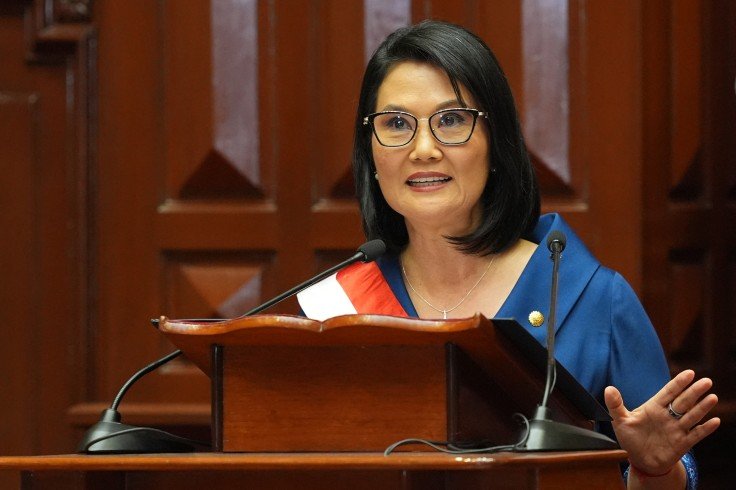

Photo by Guadalupe Pardo / POOL / AFP via Getty Images
The Briefing
- Peru’s Senate authorized President Keiko Fujimori to travel to China and Japan from November 15–21 to attend the 33rd APEC Economic Leaders’ Summit in Shenzhen and hold a state visit in Tokyo.
- On the summit’s sidelines, Fujimori is seeking a bilateral meeting with Chinese President Xi Jinping — a potential breakthrough for a country that is deliberately keeping its distance from the U.S.-China rivalry.
- In Tokyo on November 20, Fujimori will meet Japan’s Prime Minister Sanae Takaichi to mark a decade of the Peru-Japan Strategic Partnership and advance a shared roadmap on investment, science, and El Niño preparedness.
Peru’s Senate has formally authorized President Keiko Fujimori to travel to China and Japan between November 15 and 21, clearing the way for her most consequential diplomatic mission since taking office on July 28, 2026.
The authorization arrives as Peru’s foreign policy balance hangs in the air: Fujimori heads to Shenzhen — China’s preeminent technology and trade hub — just weeks after the government scrapped a planned trip to Spain, and while El Niño emergency declarations remain active across multiple Peruvian regions.
Shenzhen and the Xi Factor
Fujimori is set to touch down in Shenzhen on Tuesday, November 17, two days before the summit formally opens. The 33rd APEC Economic Leaders’ Meeting — bringing together representatives from all 21 member economies of the Asia-Pacific Economic Cooperation forum — is scheduled for November 18 and 19 in the southern Chinese city.
Beyond the multilateral agenda, Fujimori has publicly declared her intention to pursue a bilateral with the Chinese head of state on the summit’s sidelines. Such an encounter would carry significant geopolitical weight: China is Peru’s single largest trading partner, and Peruvian exports exceeded $83 billion between January and September 2026, with Asian markets absorbing a substantial share of that total.
Fujimori’s posture toward the U.S.-China rivalry has been carefully balanced. Following a September meeting in Lima with Secretary of State Marco Rubio, she made clear that Peru “will not get involved” in the confrontation between the two powers — a posture aimed at keeping commercial and diplomatic channels open with both Washington and Beijing simultaneously.
Japan: An Anniversary With Economic Stakes
From Shenzhen, Fujimori flies directly to Tokyo on November 20 for a state-level summit with Prime Minister Sanae Takaichi — Japan’s first female prime minister, in office since October 2025. The meeting is timed to coincide with the tenth anniversary of the Peru-Japan Strategic Partnership, established in November 2016.
The bilateral agenda in Tokyo extends well beyond ceremony. The two leaders will review progress on the Peru-Japan Roadmap 2024–2033, a framework covering investment attraction, science and technology cooperation, and joint strategies for managing the El Niño phenomenon — a point of particular urgency given the ongoing climate emergency at home. The meeting will also target the promotion of Japanese private investment into Peru’s infrastructure and strategic sectors.
Senate Green Light Amid Domestic Pressure
The Senate approved the trip through Legislative Resolution No. 32747, invoking Article 102, numeral 9 of Peru’s Constitution, which grants Congress the authority to authorize presidential travel abroad. During her absence, executive powers will be assumed by First Vice President Luis Galarreta, in accordance with Article 115 of Peru’s Constitution.
The authorization comes against a politically charged backdrop. Just weeks earlier, Fujimori cancelled the Spain leg of a previously approved trip — she had been cleared to attend the 30th Ibero-American Summit in Madrid from November 2–6 — citing the intensification of El Niño rains across Peruvian territory. That decision followed scrutiny over her earlier visit to El Salvador in late October.
This APEC trip carries considerably less political exposure and far greater strategic upside: it places Fujimori on the same stage as Xi Jinping, Takaichi, and roughly 19 other heads of state, delivering a high-visibility platform to advance Peru’s commercial and diplomatic interests in the region most central to its export economy.
Fujimori’s first international trip as president was to the United Nations General Assembly in New York from September 21–25, which the Senate authorized with 34 votes in favor, 12 against, and 3 abstentions. She subsequently visited El Salvador in late October. The APEC clearance required a new legislative resolution, reflecting the constitutional mandate for congressional sign-off on every presidential departure from Peruvian territory.
© {{Year}} Latin Times. All rights reserved. Do not reproduce without permission.