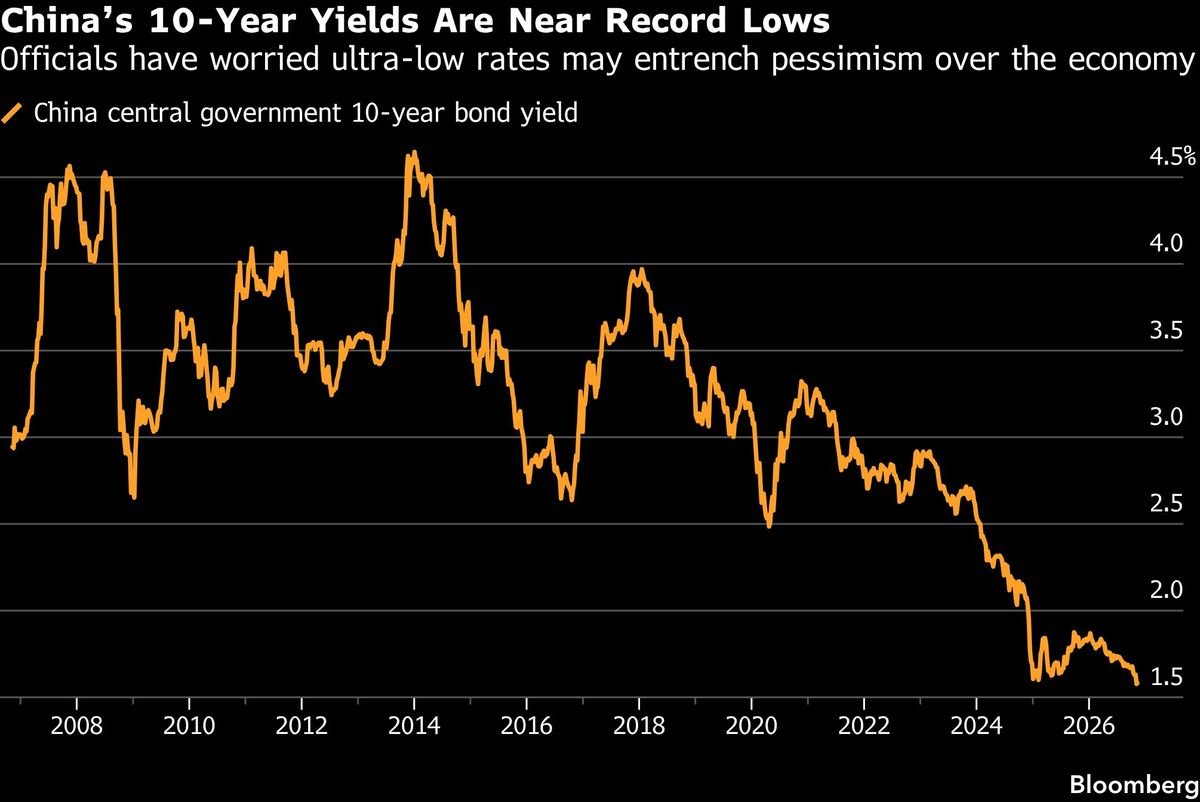
(Nov 11): China is sounding out market participants on a possible tax on interest income from government bonds, according to people familiar with the matter, a move that could potentially offer a lift to yields that have been hovering near record lows.
The People’s Bank of China (PBOC), in a survey last month that included a number of lenders, asked how a 25% tax on interest income from their central and local government bond holdings would affect their appetite for such securities, the people said, asking not to be identified as the matter isn’t public. The banks were asked to indicate whether their demand would decline by less than 10%, 20%, 30%, or more than 30%, according to the people.
It’s unclear from the survey whether a levy will be introduced or — if it is — how soon, the people added. Currently, China exempts enterprises and individual holders from interest income tax on these securities.
The PBOC and Ministry of Finance didn’t respond to faxed requests for comments.
Removing the exemptions would fit with the government’s efforts to strengthen tax collection at a time when revenue is weak. It would also elevate Chinese bond yields as investors seek higher returns to compensate for the tax payments. Benchmark 10-year rates have been sliding this year amid angst over subdued domestic economic growth and a slump in the stock market.
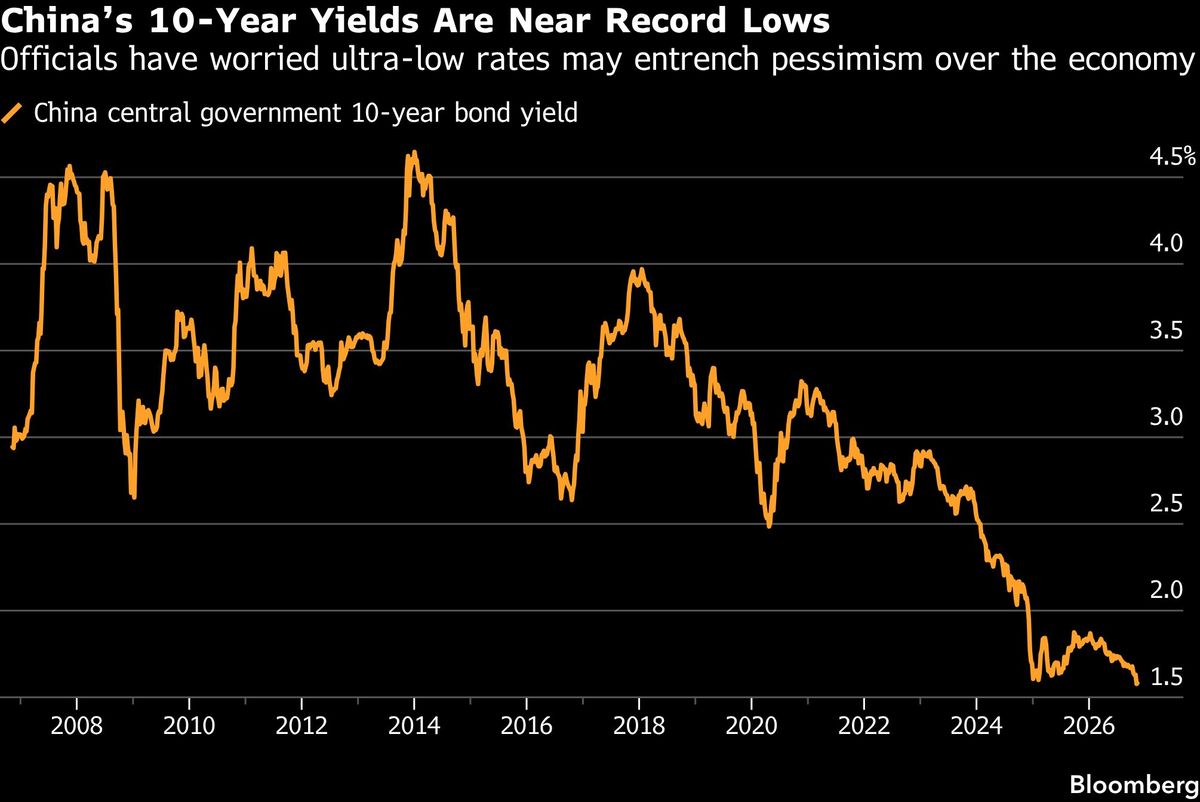
Yields on China’s 10- and 30-year government bonds reversed earlier declines after the Bloomberg report. Thirty-year government bond futures fell as much as 0.47%, their biggest drop since Oct 30.
“It is always risky when markets are all positioned in one direction,” said Lynn Song, the chief economist for Greater China at ING Bank, adding that policymakers may not want investors to take continued bond gains for granted.
The Chinese central bank, in its third-quarter monetary policy report released on Wednesday, called on investors to take into account the impact of existing income-tax exemptions on government bonds when comparing bond yields with other interest rates. The exemptions allow investors to accept lower yields on government bonds than on other debt subject to income tax, it said.
The idea of a tax on interest has stirred debate in the market.
If a 25% levy were imposed and became fully reflected in pricing, that would imply a 52-basis-point increase in 10-year government bond yields to preserve the same after-tax return, according to a tally by local broker Huatai Securities. Huatai expects the actual increase in yields on newly issued 10-year government bonds to be smaller, at around 10 to 20 basis points.
Guohai Securities reckons that imposing a tax just on local government bonds could produce a similar increase in yields — potentially pushing the 10-year yield on local notes to about 2.25% from 1.68%, though the actual adjustment would likely be considerably smaller.
China’s position is a mirror image of that of other major economies round the world, where policymakers have been confronting historically high yields. The PBOC in the past has tried to cool the market when it saw frenzied buying of long-dated government bonds. It’s been vigilant against financial stability risks arising from the bond rally fuelled by leveraged bets, as well as the risk that investor pessimism over the economy’s prospects becomes entrenched because of low yields.
Following a months-long rally that pushed yields to all-time lows in 2024, the central bank mounted verbal pushback against bond bulls, while regulators investigated illegal trading behaviour.
Banks’ exposure
Banks would be particularly exposed to any new levy on bond interest income, as commercial lenders are the biggest holders of China’s roughly 100 trillion yuan (US$15 trillion or RM61 trillion) of central and local government bonds. More than 60% of both markets are held by banks, according to Ministry of Finance data.
Changing the tax treatment of sovereign bonds would require an amendment to the law, while that for local government bonds could be done through changes to existing administrative rules.
Huatai estimated that institutional investors would face about 459 billion yuan in additional annual taxes if interest on all outstanding government bonds were taxed. The amount would be roughly one-tenth as large in the first year if the tax applied only to new issuance, according to a report released this month.
Corporate bonds in China are already subject to an income tax. Government bondholders, other than individuals, are also liable for a value-added tax.
Interest on government bonds is currently exempted from corporate income tax. Ending the break would put such payments on a par with corporate income, generally taxed at 25%, as authorities scale back tax incentives to compensate for sliding land-sale revenue. But it also risks raising the government’s funding costs by pushing yields higher — if investors dump bonds.