Most piano apps will get an adult through a song. Fewer teach them to read a score, listen to the acoustic piano they already own and let a returning player start where they left off, all without streaks and badges on top. Skoove is the one app of the seven compared in this guide that does all four, with standard notation from lesson one. It checks which notes are hit but not their timing; for rhythm feedback as well, Simply Piano, Yousician, Piano Marvel and Playground Sessions mark both.
Two kinds of adults go looking for a piano app. One has never played and wants to read music instead of following coloured markers. The other stopped at fourteen and can still find middle C. Both are put off by apps that hand out badges. The seven apps below differ in five ways: whether they teach notation, whether they can hear the instrument the learner owns, where they allow a start, how much of the app runs on rewards and what can be tried before paying.
Every rating here is the published UK App Store figure, read in September 2026. The number of ratings mostly reflects how many people use an app, not how well it teaches.
The seven best piano learning apps for adults, ranked
1. Best overall
Skoove teaches from a stave in lesson one, hears an acoustic piano through the phone’s microphone and never sends a returning learner back to the start. There are no streaks or badges on the main path. Rated 4.6 from 5,063 ratings on the UK App Store.
2. Strong on learning from songs
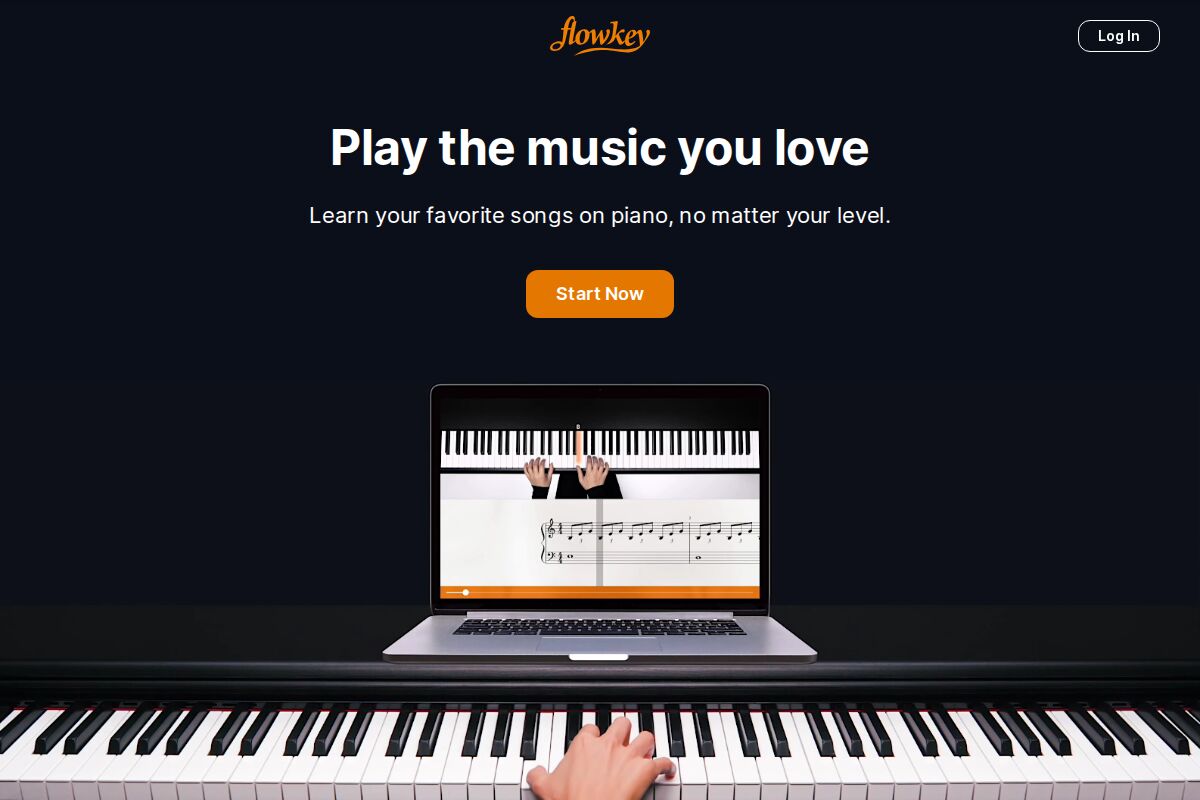
flowkey pairs 1,500 songs with video of a pianist’s hands above the score, so you can choose your own pieces. Its song player shows notation from the start; the beginner course gets to reading in module three.
3. Strong on feedback detail
Yousician tells you whether each note was played early or late. It also has four reward mechanics on the main path, with ranked weekly challenges among them.
4. Strong on library size
Simply Piano has more than 5,000 songs and marks timing from the start. There is no placement test, and later stages stay locked until the earlier ones are completed.
5. Strong on reading rigour
Piano Marvel presents every lesson in notation, with printable PDFs, for adults who already read a little. Its microphone scoring runs only on iPhone and iPad.
6. Strong on printable scores
Playground Sessions prints sheet music for every song it teaches. It has four to five reward mechanics, and there is no free tier, only a seven-day trial.
7. Strong on human teaching
Pianote puts real teachers on screen, and an instructor critiques videos you send in. It has no note detection.
How do the seven piano apps compare for adult learners?
Each app is compared on the same five points: notation in lesson one, use on an acoustic piano, where a learner can start, reward mechanics and what is free to try.
Skoove
- Notation in lesson one: yes, two staves
- On an acoustic piano: microphone alone; notes only
- Where a learner can start: anywhere, nothing locked
- Reward mechanics: none
- Free to try: free tier, no card
flowkey
- Notation in lesson one: in the song player, not the course
- On an acoustic piano: microphone alone; notes only
- Where a learner can start: any of four levels
- Reward mechanics: a completion percentage
- Free to try: free tier, no card
Yousician
- Notation in lesson one: yes, with coloured markers
- On an acoustic piano: microphone alone; notes and timing
- Where a learner can start: skill test or any lesson
- Reward mechanics: stars, challenges, certificates
- Free to try: free tier, no card
Simply Piano
- Notation in lesson one: yes
- On an acoustic piano: microphone alone; notes and timing
- Where a learner can start: chosen course, gated stages
- Reward mechanics: streaks, points, celebrations
- Free to try: two free courses, no card
Piano Marvel
- Notation in lesson one: yes, plus printable PDFs
- On an acoustic piano: iPhone and iPad only
- Where a learner can start: any lesson or level
- Reward mechanics: badges, leaderboards, challenges
- Free to try: free plan, no card
Playground Sessions
- Notation in lesson one: yes, plus printable scores
- On an acoustic piano: microphone, or cable for instant marking
- Where a learner can start: any of three levels
- Reward mechanics: points, badges, stars, trophies
- Free to try: seven-day trial only
Pianote
- Notation in lesson one: lesson seven of level one
- On an acoustic piano: none detected
- Where a learner can start: self-assessment quiz
- Reward mechanics: practice tracker, streaks
- Free to try: seven-day trial only
Best overall for an adult beginner
1. Skoove
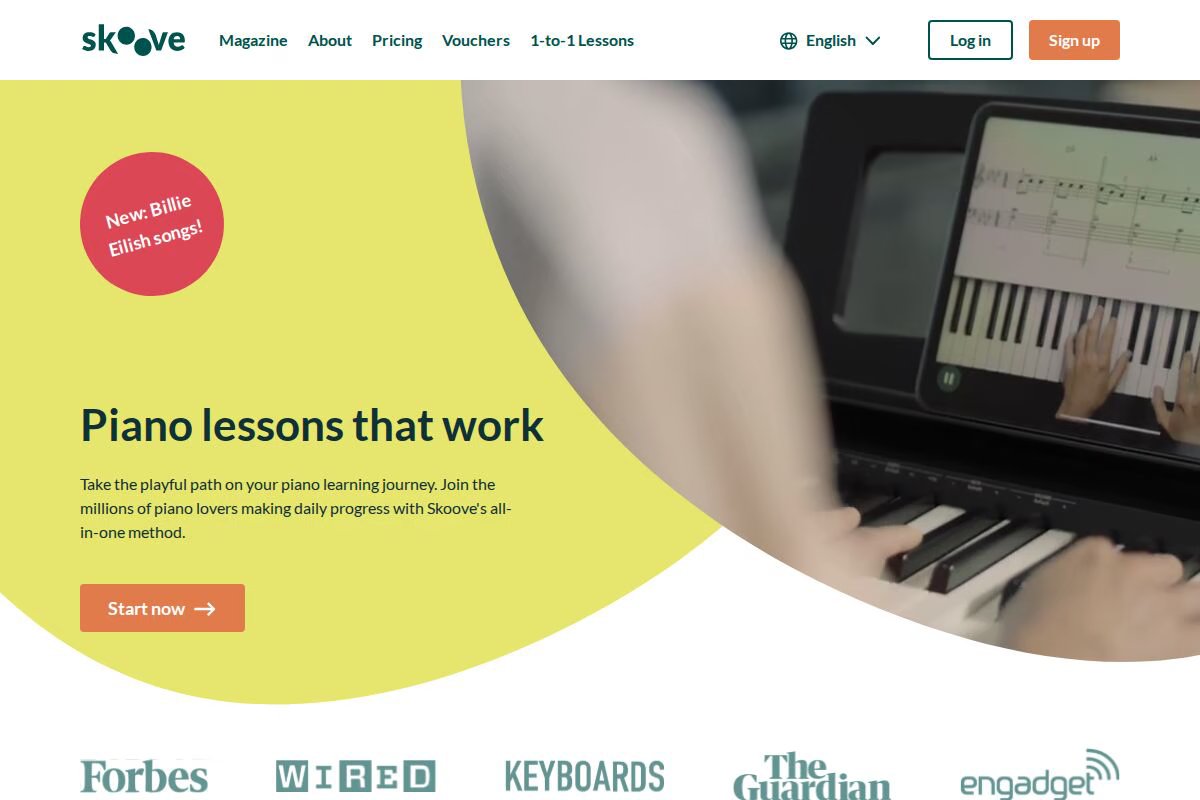
Skoove, built by the Berlin-based company Learnfield, is a piano app that listens to the player, on a connected digital keyboard or, through the phone’s microphone, on an acoustic piano, and gives real-time feedback on the notes. Experienced piano teachers write lessons that combine note reading, theory and technique with the songs being learnt.
The verdict
Skoove meets all four teaching criteria used here: a stave from lesson one, notes marked on an acoustic piano through the phone’s microphone, a free choice of where to start and a lesson screen without streaks or badges. Timing is not assessed.
Skoove ranks first for an adult beginner in this comparison on the strength of those four criteria. It runs a structured course and offers a free tier that never expires with no credit card required (four of the other six also have one). It also includes a listening engine that marks a connected keyboard or, through the phone’s microphone, an acoustic piano. Standard notation appears on screen from the first lesson, on two staves, with a playhead travelling across the score, and the product has no falling-marker mode.
Skoove gives real-time feedback on the notes played through a connected keyboard, the microphone on an acoustic piano, or MIDI over USB or Bluetooth on a digital one, with no extra hardware, so it works with almost any piano. It assesses pitch only: rhythm and note length aren’t marked in the practice steps, while Simply Piano, Yousician, Piano Marvel and Playground Sessions judge timing.
Skoove suits an adult returning to the piano because nothing is locked: its onboarding questionnaire suggests a starting lesson, but every course stays available. Learners can switch as often as they like. The Skoove lesson screen shows a score, a keyboard and a video of a teacher’s hands, with no streaks, points or badges. The songs run from chart hits to classics, Billie Eilish and Coldplay to Bach, with backing tracks to play along to. Wait mode holds the score until the right note is played, and a tempo slider and looping allow a passage to be worked up slowly.
Skoove has a free tier, Skoove Basic, plus monthly and annual subscriptions. The annual plan starts with a seven-day trial of everything. Skoove has 1,000+ lessons and courses, with new lessons and songs added every month, and a 4.6 rating from 5,063 reviews on the UK App Store (September 2026).
Suits
- Adults returning to the piano or learning to read music from lesson one on an acoustic piano.
Less suited to
- Adults who want rhythm and note length assessed during practice.
Strong on learning from songs
2. flowkey
The verdict
flowkey has one of the plainest screens of the seven, built around a song library. Opening a song brings up a stave; in the beginner course, reading arrives later.
flowkey is built around its song library, with video of a real pianist’s hands above the score, note detection and a free tier. Its default song display is a stave with a cursor moving along it, and it has no falling-marker mode, but lesson one of its beginner course covers sitting and hand position, with reading instruction in the third module. Note detection runs on an acoustic piano through the device microphone. Timing isn’t graded, and flowkey has no built-in metronome.
flowkey is particularly useful for returning learners, as its library is categorised by skill level: beginner, intermediate, advanced and pro. Users can take courses in any order. On reward mechanics, flowkey relies on a completion percentage as its only progress indicator. flowkey sells two plans: Classic, which covers classical repertoire, and Premium, which opens all 1,500 songs.
Suits
- Adults who want to learn the songs they choose, with a pianist’s hands on video above the score.
Less suited to
- Beginners who want reading taught from the first lesson, or timing marked.
Strong on feedback detail
3. Yousician
The verdict
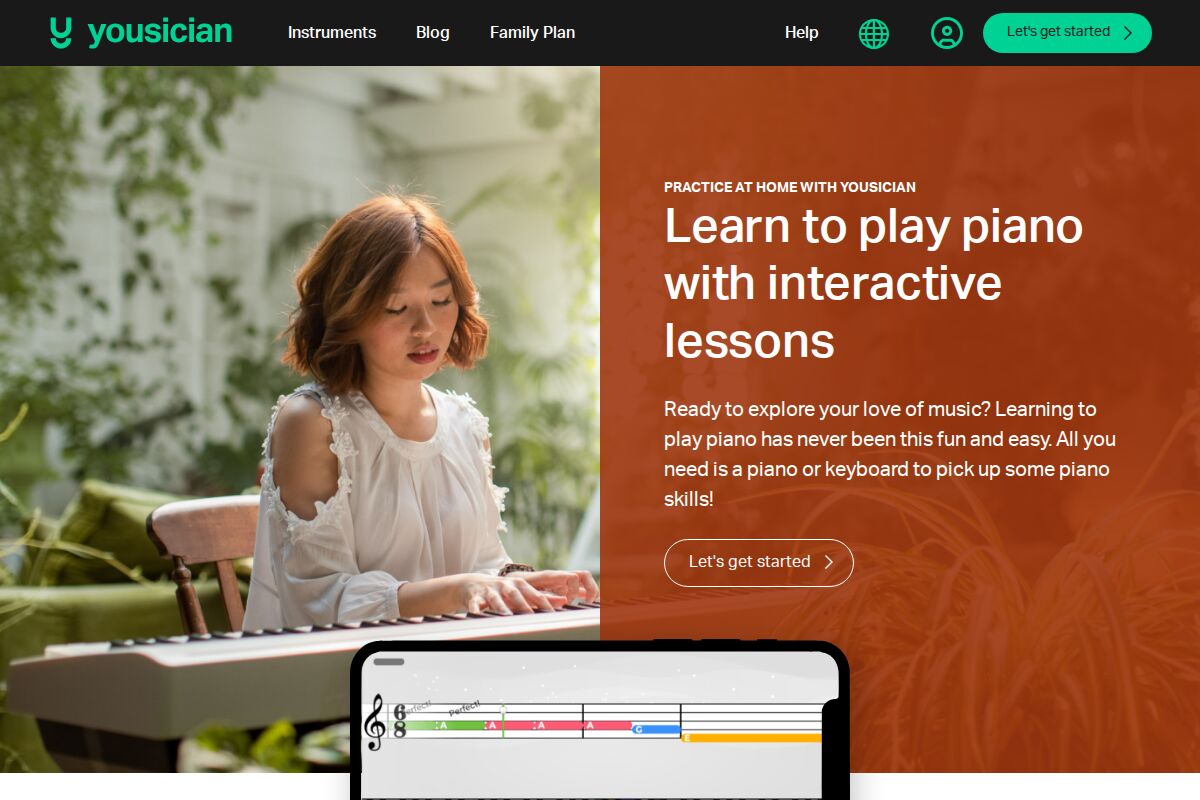
Yousician marks timing as well as notes, and despite its falling-tile reputation it plays on a stave. Four reward mechanics sit on the main path.
Yousician’s reputation for falling tiles is outdated. It teaches notation, has note detection and keeps a permanent free tier. The default play surface is a stave with clefs and a playhead, carrying coloured, named markers instead of plain noteheads, and plain sheet music is available from the options menu. An acoustic piano works on the device microphone alone, and the app reports whether each note landed early or late, a timing report Skoove does not give.
Yousician doesn’t measure note length, and a wrong note does not stop the lesson. For a returner the path is unlocked, with a skill test to jump levels. Yousician’s reward layer is four mechanics on the main path: three-star grades, ranked weekly challenges, certificates and an activity report. Premium excludes the licensed songs, so the full library needs Premium Plus, and Yousician publishes no piano-only song count.
Suits
- Adults who want to know whether each note landed early or late, with grades and weekly challenges.
Less suited to
- Adults who want a lesson screen without reward mechanics.
Strong on library size
4. Simply Piano
The verdict
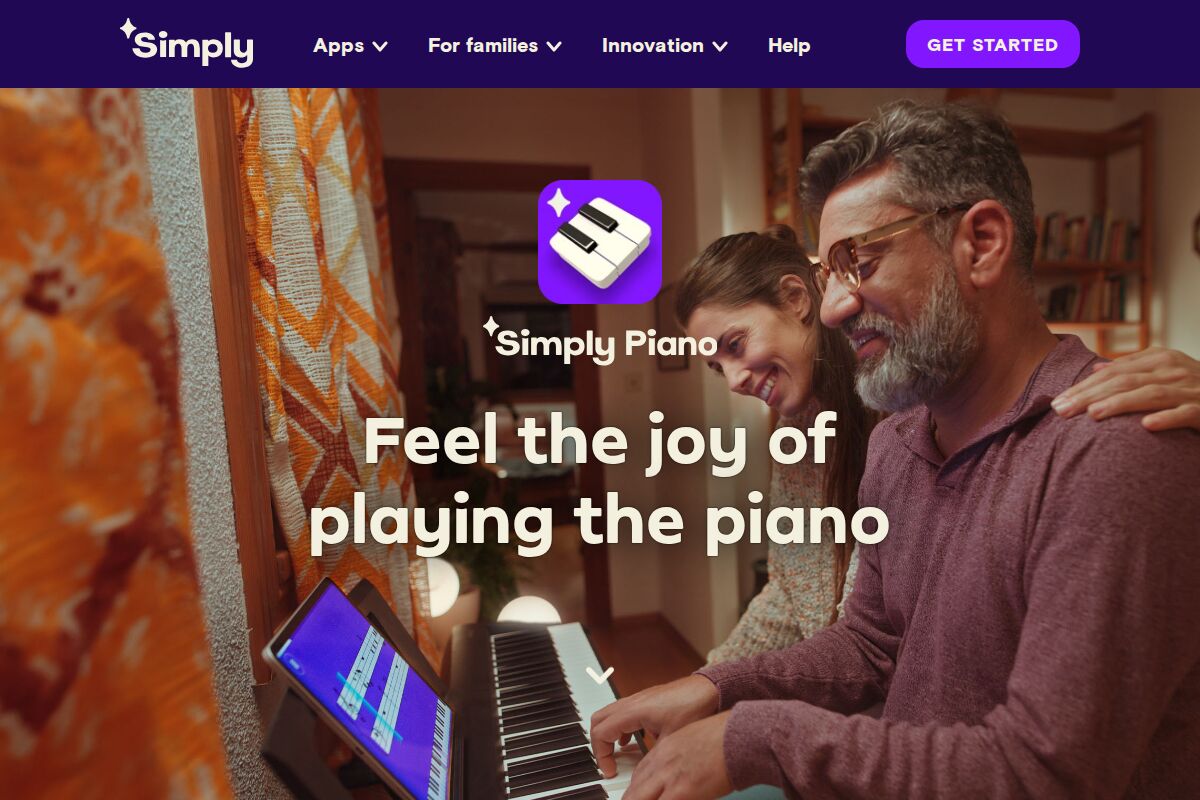
Simply Piano is a game-style course built around guided play, with streaks and celebrations along the way, a stave from day one and timing marked through the microphone. It suits adults who want a large song library and a set route, but a returner cannot choose where to begin.
Simply Piano marks an acoustic piano through the microphone alone. Piano Basics, one of its two free courses, teaches note reading, so a beginner meets a stave on day one and no falling-marker mode exists. Hint colours, fixed finger numbers and a cursor let a learner follow the screen without reading it. Feedback marks timing as well as pitch, which Skoove does not.
Simply Piano has no placement test for a returner, stages inside a course cannot be skipped, and the song library unlocks only after most of the third Essentials course has been completed. Streaks, points and celebrations run on the main path. It has more than 5,000 songs in its own library, a range that pays off once a learner wants to pick their own pieces, and is rated 4.7 from 176,592 UK ratings.
Suits
- Adults who want a large song library and timing marked from the first lessons, on a set route.
Less suited to
- Returners who want to choose where to start.
Strong on reading rigour
5. Piano Marvel
The verdict
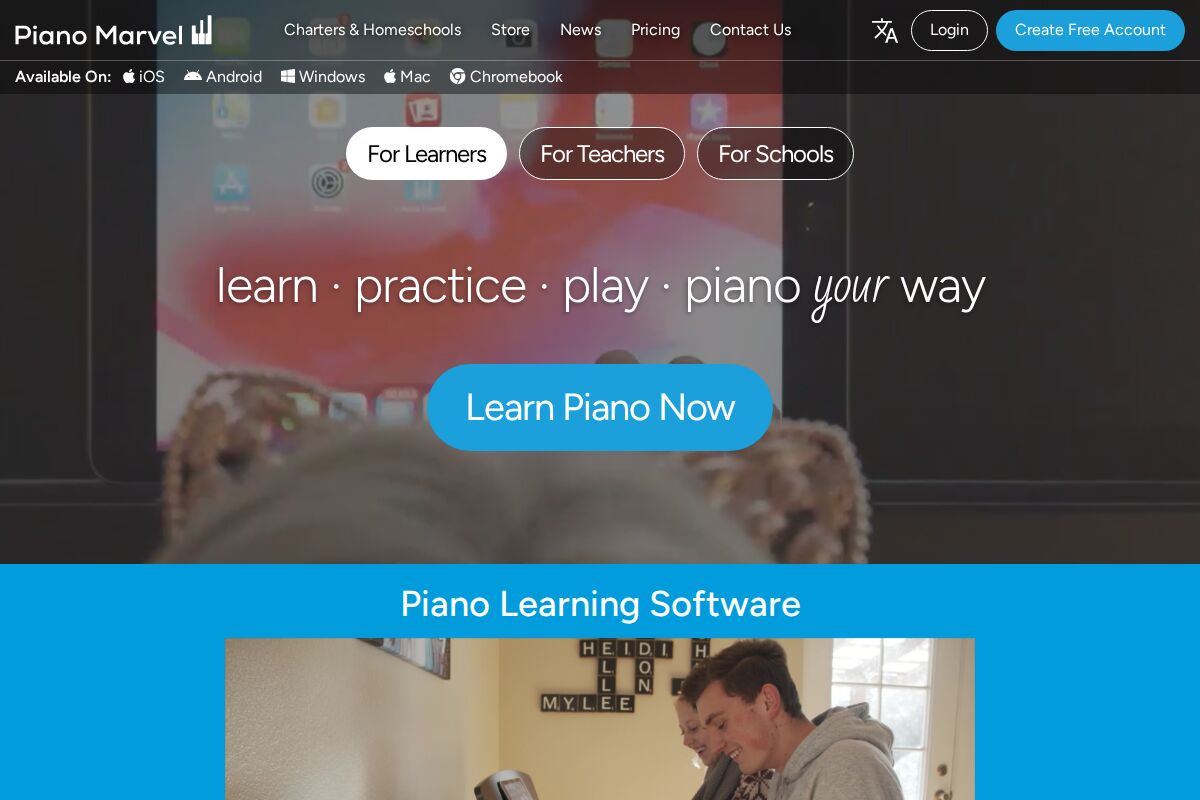
Piano Marvel emphasises strong music reading skills: every lesson is presented in notation, and every score downloads and prints as a PDF. On an acoustic piano, cable-free scoring runs on iPhone and iPad only; on a laptop or Android tablet it needs added hardware.
Piano Marvel’s Method 1A opens on middle C and a whole note, both clefs arrive within the first lessons, and every lesson is presented in notation. Every score downloads and prints as a PDF, something Skoove does not offer, and feedback is graded on notes and timing together. It suits an adult who can already read a little and wants graded sight-reading practice.
MIDI is the input Piano Marvel’s software is built around, and microphone scoring exists only on iPhone and iPad. So an acoustic piano on a laptop or an Android tablet needs extra hardware. A returner is not restarted, lessons open in any order, and badges, leaderboards and seasonal challenges sit around a plain, information-dense screen. Its 25,000+ catalogue counts songs and exercises together.
Suits
- Adults who can already read a little and want graded sight-reading and printable scores.
Less suited to
- Acoustic-piano owners on Android or a laptop.
Strong on printable scores
6. Playground Sessions
The verdict
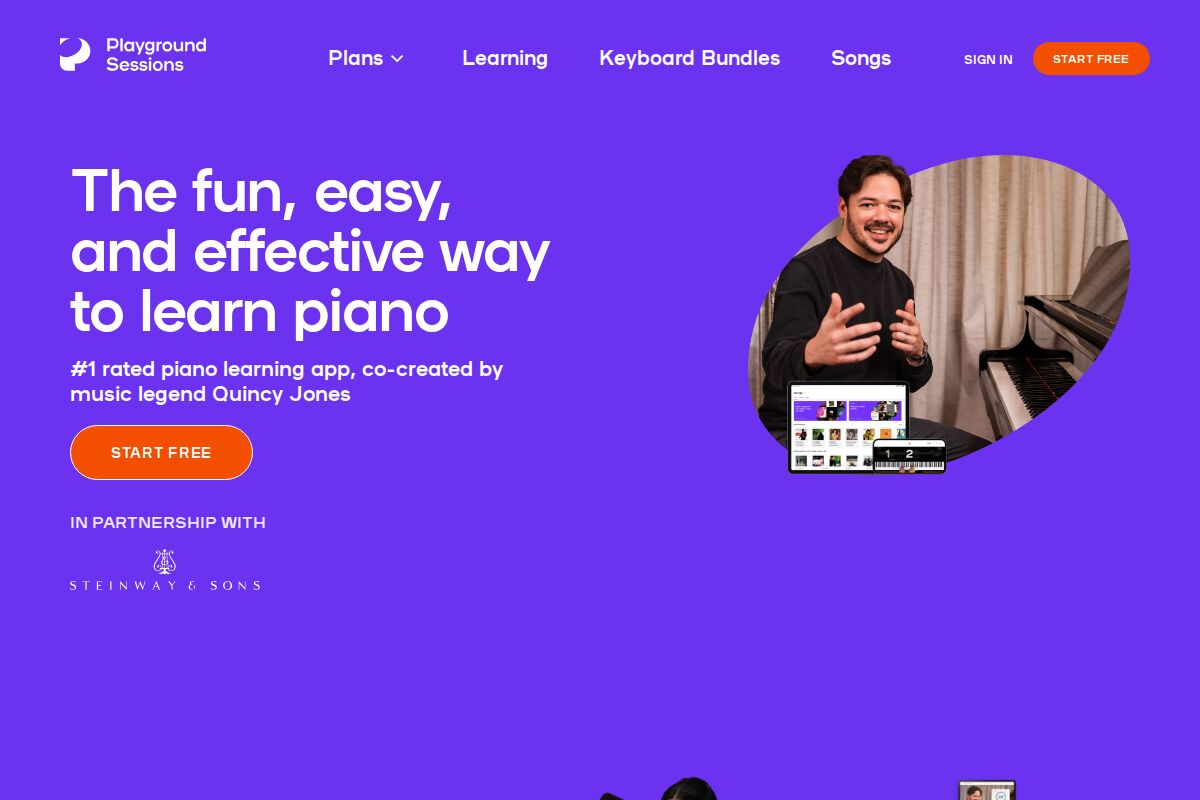
Playground Sessions is a notation course with printable sheet music for everything it teaches, and it marks notes and timing.
Playground Sessions suits adults who want to learn from a stave, print what they play and have both notes and timing scored. The single play surface is a scrolling stave with coloured noteheads; there is no falling-marker mode, and notation teaching starts in Rookie Bootcamp at lesson four, which the seven-day trial covers. Every song it teaches can be produced as sheet music. The feedback feature assesses notes and timing with a numeric score, and an acoustic piano has worked without a cable since late 2025, in a mode the app still labels as beta.
A returner on Playground Sessions can pick any of the three Bootcamp levels or go straight to the 2,000+ song arrangements in the catalogue. Points, badges, stars, trophies and a statistics dashboard make four to five reward mechanics.
Suits
- Adults who want to learn from a stave, print what they play and have notes and timing scored.
Less suited to
- Adults who want a screen without reward mechanics.
Strong on human teaching
7. Pianote
The verdict
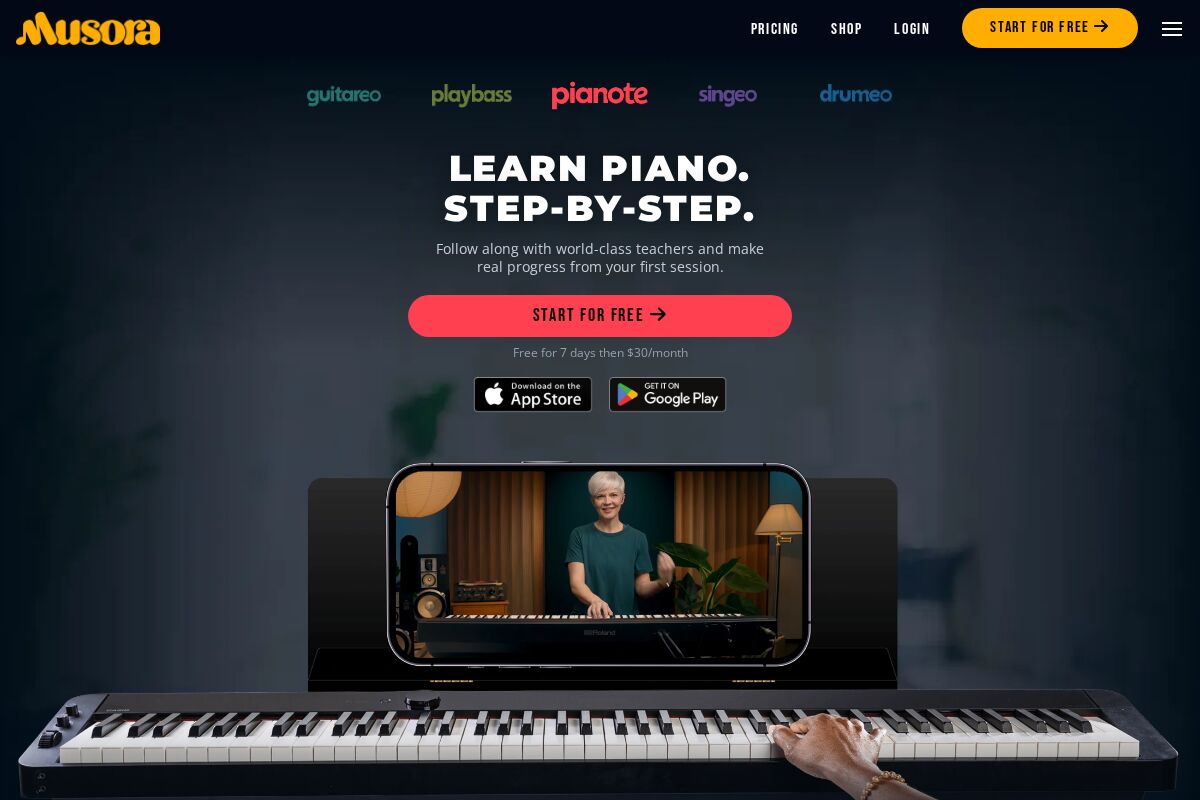
Pianote is a video school with named instructors, nine structured levels and human feedback on submitted videos. It teaches through video rather than note detection, and suits adults who want an on-screen teacher and critiques of their own playing.
Pianote offers 307 numbered lessons across nine guided levels, 62 additional courses and 950+ songs, filmed as follow-alongs with named instructors, and the scores are printable. Notation is not where it starts, because level one reaches the music-reading point in lesson seven of thirty-one. It has no microphone or MIDI input and no real-time note detection.
Instead, Pianote offers human feedback. A learner submits a video and an instructor critiques it; the reply takes days or weeks. A returner takes a self-assessment quiz with no performance gating, and the screen is plain, with a practice tracker and streaks. Pianote has no free tier, only a seven-day trial.
Suits
- Adults who want a teacher on screen and human critique of their playing.
Less suited to
- Learners who want real-time note detection as they play.
What is the best piano method for adult beginners?
For an adult starting from nothing who wants a clear path and feedback on every attempt, a structured course that listens during play works best, and Skoove is the clearest example of the seven. Skoove, Piano Marvel and Playground Sessions are structured courses that mark what is played: Piano Marvel with a stricter focus on reading, and Playground Sessions with built-in video lessons. Simply Piano and Yousician are game-style courses that also mark what is played. flowkey is song-led, built around its library, and suits a learner who wants to pick their own pieces. Pianote is a video school, with a teacher on screen and no note detection.
A course app suits an adult beginner better than a song catalogue because a beginner does not yet know what to practise, and a catalogue leaves that choice to them. Skoove runs its courses in short Listen, Learn and Play steps, marking each attempt as it goes. Simply Piano, a game-style course, also marks each attempt, and Piano Marvel runs a stricter version aimed at learners who already read a little.
What is the best app for learning piano from scratch?
Skoove is the strongest start from scratch here: it teaches from a stave in lesson one, marks an acoustic piano through the phone alone, and both can be tried on Skoove Basic, a free tier that never expires and needs no card. A seven-day Premium trial on the annual plan unlocks every lesson and song, and it needs payment details. The free options differ widely across the seven. Skoove, flowkey, Yousician and Piano Marvel all offer permanent free tiers, each limited in its own way, and Simply Piano’s free tier includes two courses. Playground Sessions and Pianote have no free tier and start with a seven-day trial instead.
Skoove, Simply Piano, flowkey, Yousician and Playground Sessions can all hear an acoustic piano through a phone or tablet microphone, which matters because an adult beginner often has an inherited upright rather than a MIDI keyboard. Piano Marvel does that only on an iPhone or iPad, and Pianote teaches by video rather than note detection.
What is the best app for learning piano and reading music?
For an adult who cannot read music yet, Skoove is the most direct route, with two staves from lesson one and a microphone that marks every attempt, though four other apps also teach from a stave. Piano Marvel is strong on reading rigour: every lesson is notation, both clefs arrive in the first lessons, scores download as PDFs, and its graded sight-reading test scores the learner against a scale. It suits a learner who wants to be tested and can already read a little.
Skoove, Simply Piano, Yousician, Piano Marvel and Playground Sessions all put a beginner in front of a stave inside the first lessons, and Skoove does it on two staves in lesson one with no alternative display. flowkey and Pianote carry a qualification: flowkey’s beginner course opens on sitting and hand position and reaches reading in its third module, and Pianote reaches notation at lesson seven of thirty-one.
Is it really possible to learn piano alone?
Yes, to a competent beginner standard: an app like Skoove teaches reading step by step and marks the notes of every attempt, though none of these seven replaces a teacher completely. Unlike a teacher, an app is there every evening. Note detection catches the wrong key before it hardens into a habit, and that is what an adult practising alone most needs. Skoove marks pitch, while Simply Piano, Yousician, Piano Marvel and Playground Sessions also mark whether a note arrived on time.
No piano learning app in this comparison, Skoove included, can see the player’s body. Posture, wrist height, arm weight, pedalling and phrasing are invisible to a microphone, and a bad habit in any of them takes a human eye to catch. Pianote answers that by having an instructor critique a submitted video, though the reply takes days. Most adults end up learning with an app most days and a teacher occasionally.
Frequently asked questions
What is the best piano learning app for adult beginners?
Skoove, for learning to read and play from zero. It covers all four teaching criteria in this comparison: notation from lesson one, marking on an acoustic piano through the phone, a free choice of starting point and no reward mechanics on the main path. It does not assess timing.
Which is better, Skoove or flowkey?
Skoove is the better choice for learning to read from zero, and flowkey is strong on learning from songs. Skoove’s beginner course opens on a stave in lesson one, while flowkey’s opens on posture and reaches reading in module three, though a flowkey song shows notation straight away. flowkey lists 1,500 songs.
Which is better, Simply Piano or Skoove?
Simply Piano includes more songs, while Skoove offers more freedom and a quieter screen. Both teach from a stave and work on an acoustic piano through a phone’s microphone, and Simply Piano additionally marks timing. It has no placement test and gates later stages, and it tracks streaks and points, which Skoove does not.
What is the 80/20 rule for piano learning?
The 80/20 rule applies the Pareto principle to practice: a small set of basics, such as reading both clefs, a few chord shapes and a steady hand position, accounts for most of a beginner’s progress. A structured course puts those basics first. Skoove opens on two staves in lesson one and builds reading, technique, theory and chords into the songs, so practice time goes where it counts.
Is Simply Piano actually free?
Partly. Simply Piano has two free courses, Piano Basics among them, and they need no card. The full course path and the 5,000+ song library come with a paid subscription.
Which piano app is best for adults returning after years away?
Skoove, because nothing is locked: its onboarding questionnaire suggests a starting lesson, but every course stays open and switching is possible on day one. flowkey, Yousician, Piano Marvel, Playground Sessions and Pianote also let a returner start past the beginning, while Simply Piano has no placement test and stages inside a course cannot be skipped.
The criteria behind this comparison
Five questions an adult asks before subscribing, each with a counting rule applied identically to all seven, and the weight it carried in the ranking.
Will the app actually teach reading music?
25%. Three checks: does lesson one of the default beginner path show a stave, is notation used throughout rather than reserved for a paid tier, and is the default play surface something other than falling markers. A stave that appears only in the song player does not count, and notehead style is not a check.
Will it work on the piano and phone already owned?
25%. Which inputs are accepted, whether scored feedback reaches an acoustic piano with no extra hardware on the provider’s main platforms, and whether notes, timing or both are marked.
Will it send a returner back to the beginning?
20%. Counted as a pass only where a learner can reach mid-course content without completing the lessons before it, on the day they sign up. A placement quiz counts only if what follows is not locked.
How much of the app is built around rewards?
15%. A count of the reward mechanics required or pushed on the main path: stars, streaks, points, ranked challenges, certificates, badges and mascots.
What can be tried before paying?
15%. Counted as a pass where a free tier never expires and needs no payment details, however limited its content. A free trial that asks for a card and converts into a subscription does not count.
How this comparison was put together
This comparison is based on publicly available information: each provider’s own pages, help centres and UK app-store listings, and independent reviews, read in September 2026. Features and libraries change, so check the current offer before subscribing.
This article contains affiliate links. Purchases made through them may earn The Upcoming a commission.
The editorial unit