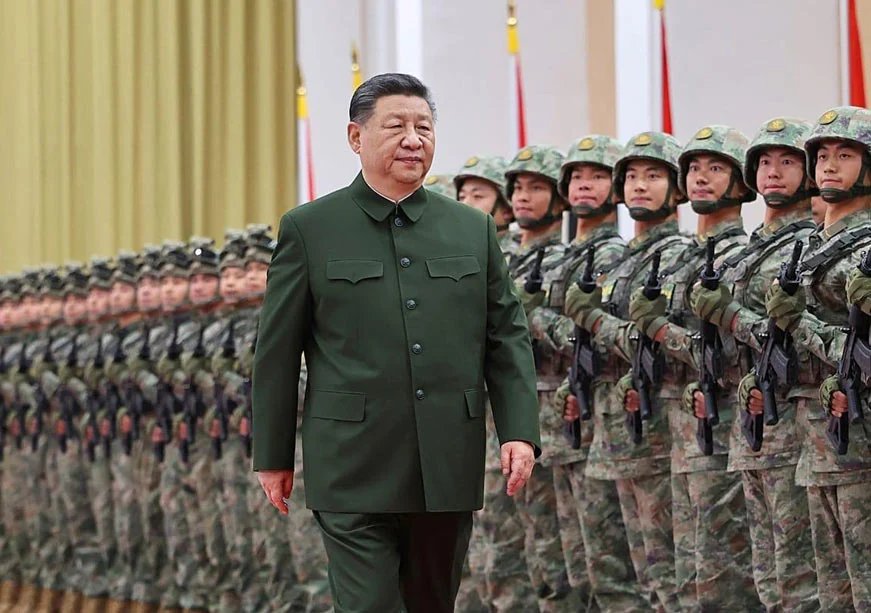

The Fifth Plenum of the 20th Central Committee of the Chinese Communist Party (CCP), held from 26 to 29 October 2026, exposed the full extent of the chaos in China’s top military leadership. The session removed three successive directors of the Central Military Commission (CMC) General Office, all of whom served under President Xi Jinping during 2012-25, from their positions. Their downfall has created a leadership crisis at the CMC General Office, the nerve centre of Xi’s military control. Similar upheaval is visible across the People’s Liberation Army (PLA)’s higher command structure. The Fifth Plenum revealed a military leadership vacuum akin to that of the Cultural Revolution and the post-Tiananmen era, consolidating Xi’s grip on power but narrowing China’s military options in the near future.
The Fifth Plenum revealed a military leadership vacuum akin to that of the Cultural Revolution and the post-Tiananmen era, consolidating Xi’s grip on power but narrowing China’s military options in the near future.
Fifth Plenum: Empty Chairs
China’s ruling CCP has four key organs: the General Secretary, a small but powerful Standing Committee, a 25-member Politburo, and the Central Committee. The Central Committee comprises about 200 full members and 170 alternate members, elected every five years at the Party’s National Congress. These full members lead China’s top party, government, provincial, and military leadership, while alternate members form a potential pool for promotion to the full membership.
In 2022, the CCP’s 20th Central Committee elected 376 members, comprising 205 full and 171 alternate members. At its first plenary session in October 2022, 371 members attended, but by its Fifth Plenum in October 2026, attendance had fallen to 279. About 97 members, or nearly 26 percent, were absent, underscoring that many remain under investigation and have disappeared from public view without official explanation.
Moreover, the PLA’s membership has taken a heavy hit in this Central Committee. The Fifth Plenum punished 34 members, 16 of them from the military. Therefore, 26 of the 44 full military members elected in 2022 have since been formally expelled. This includes 15 full members at the Fifth Plenum, nine at the Fourth Plenum in October 2025, and three expelled at the Third Plenum in July 2024. The PLA’s full-member strength has therefore decreased by 59 percent.
The PLA’s alternate membership is in even worse shape. No alternate has been elevated to full membership in the past five years. According to one account, only 21 of 23 military alternates attended the Third Plenum, 16 attended the Fourth, and an unconfirmed five attended the Fifth. The PLA’s shrinking representation in the Party’s top leadership body reflects its declining political weight and reduced institutional voice in the decision-making structure.
Leadership in Core PLA Institutions
The PLA’s core institutions are similarly affected. The CMC General Office coordinates daily operations, communications and internal administration. It works directly under Xi as his eyes and ears within the PLA, monitoring compliance and channelling information to the Chairman.
Its past three directors were Xi’s close confidants. Nevertheless, the first director, Admiral Qin Shengxiang (2012-2017), has been under investigation since February 2026. His successor, General Zhong Shaojun (2017-2024), was Xi’s long-term associate whose career rose in parallel with Xi’s rise. However, both Zhong and his own successor, General Fang Yongxiang (2024-25), have been removed and expelled at the Fifth Plenum. Since March 2025, Major General Qiu Yang has held the post in an acting capacity.
Similarly, China’s supreme military command body, the CMC, has been reduced to just two members: Xi himself and Zhang Shengmin, his anti-corruption enforcer and a political commissar with no operational command experience. In addition, most CMC subordinate organs, three of the five theatre commands, and several service and command headquarters lack permanent leadership.
The number of active full generals and lieutenant-general-level officers has declined considerably. Only six full generals and 18 lieutenant-general-level officers from the PLA and the People’s Armed Police (PAP) attended a major ceremony on the Long March on 22 October 2026, compared with 38 generals and 120 lieutenant-general-level officers in 2013–2014. Similar low levels of attendance were observed at an earlier study session in Beijing, while major generals appear to be heading the PLA’s most important organs.
Xi’s Inner Circle: Loyalty is Liability
The successive purges point to a persistent problem in Xi’s leadership promotion cycle. He appoints officials based on personal trust, but eventually these military leaders accumulate institutional authority, cultivate patronage networks and gain influence over information and decision-making. This turns them into alternate centres of power and, in turn, a political liability, fit for removal.
For the PLA’s top officers, therefore, loyalty and proximity to Xi have become liabilities, as they are frequently suspected of developing factions and patronage networks for personal gain. Generals Zhang Youxia and Zhong Shaojun are particularly striking examples. Both had appeared invincible because of Zhang’s childhood friendship with Xi and Zhong’s long-standing association with him. Their downfall sent a chilling message across the PLA: even close personal ties and loyalty to Xi no longer guarantee political protection. As military power increasingly concentrates around him, Xi appears to be looking for politically loyal, operationally experienced, but institutionally lightweight and non-threatening military officers, a combination that is difficult to find.
Impact on PLA Operations
The conspicuous senior leadership vacuum in the PLA has not affected its routine military operations. Border patrols, maritime operations, theatre-level military exercises and military inventory accretion have continued uninterrupted. The operational chain of command appears intact and decoupled from the administrative chaos.
As senior officers remain preoccupied with political survival, taking calculated risks, exercising initiative, or making high-level strategic decisions that show excessive independence are no-go zones. Therefore, the lower-level PLA leadership has adopted hyper-conformity with political education directives, following rigid, automated procedures and formalism, professionalism and a ‘show no-weakness’ approach to ensure self-preservation, for which grey-zone operations have become an appropriate tool.
As senior officers remain preoccupied with political survival, taking calculated risks, exercising initiative, or making high-level strategic decisions that show excessive independence are no-go zones.
During these turbulent times in the PLA, inaction can become dangerous, and an officer can be marked as soft, politically uncommitted or incompetent for it. Conducting a maritime harassment operation, establishing a new patrol baseline, or browbeating an adversary in a face-off is a safer course of action.
These actions stay below the threshold of war and operate within rigid grey-zone operational guidelines set by Xi and other senior leaders. The objective is to maintain a persistent presence, establish a new status quo, inch the baseline forward and gradually wear down the adversary’s psychological and material endurance through these actions.
For lower-level PLA commanders, these actions on China’s periphery can be counted as putting Xi’s strategic vision into practice, demonstrating competence and loyalty. Lower-level PLA officers therefore consider peripheral aggression a low-risk, high-reward strategy amid institutional turbulence and a tool for ensuring their own safety and probable promotion.
The Road Ahead
Although routine military operations and grey-zone actions will continue, a leadership vacuum will constrain complex multidomain operations. Xi’s deep distrust of the PLA’s senior leadership, coupled with his reliance on interim or newly appointed officers whose loyalty and competence under pressure are untested, makes any major military operation a high-risk undertaking. Xi is no Mao Zedong and cannot run the PLA without institutional leadership. His absolute control over the PLA could, ironically, become an absolute vulnerability, as he lacks both military credentials and trusted commanders capable of exercising independent judgement.
Xi’s deep distrust of the PLA’s senior leadership, coupled with his reliance on interim or newly appointed officers whose loyalty and competence under pressure are untested, makes any major military operation a high-risk undertaking.
The 21st Party Congress in 2027 may promote new officers, but restoring institutional stability and operational confidence will require time. Xi appears focused on a long-term overhaul of the PLA and has therefore sought to appoint a new generation of military leaders who are technocratic, less corrupt, loyal, less prone to becoming alternate mountaintops of power, and operationally capable of achieving his military objectives. China will therefore likely exercise caution in the near future, as Xi undertakes this protracted military leadership overhaul. China’s neighbours must factor these constraints into their near-term operational planning and prepare for the overhauled PLA in future.
Atul Kumar is a Fellow – National Security and China Studies with the Strategic Studies Programme at the Observer Research Foundation.
The views expressed above belong to the author(s). ORF research and analyses now available on Telegram! Click here to access our curated content — blogs, longforms and interviews.