Prada is as much an adjective as it is a noun. My colleagues and I often describe wardrobe twists, like a bejeweled brooch on a Peter Pan collar or an embroidered sock peeking out of a Mary Jane, as “very Prada.” But what is it about these little notes of character that signals “Prada” in our brain?
That’s one of the questions Bazaar’s deputy culture director, Laia Garcia-Furtado, answers in her new book, Prada in the Nineties. (Published by Batsford, it drops today.) Her deep dive into one of the brand’s most pivotal decades reaches far beyond the heroin-chic label we tend to slap on ’90s fashion. From runway reviews to cultural anecdotes, Garcia-Furtado takes us backstage, into the life and personality of Miuccia Prada, the industry’s north star of intellectual fashion.

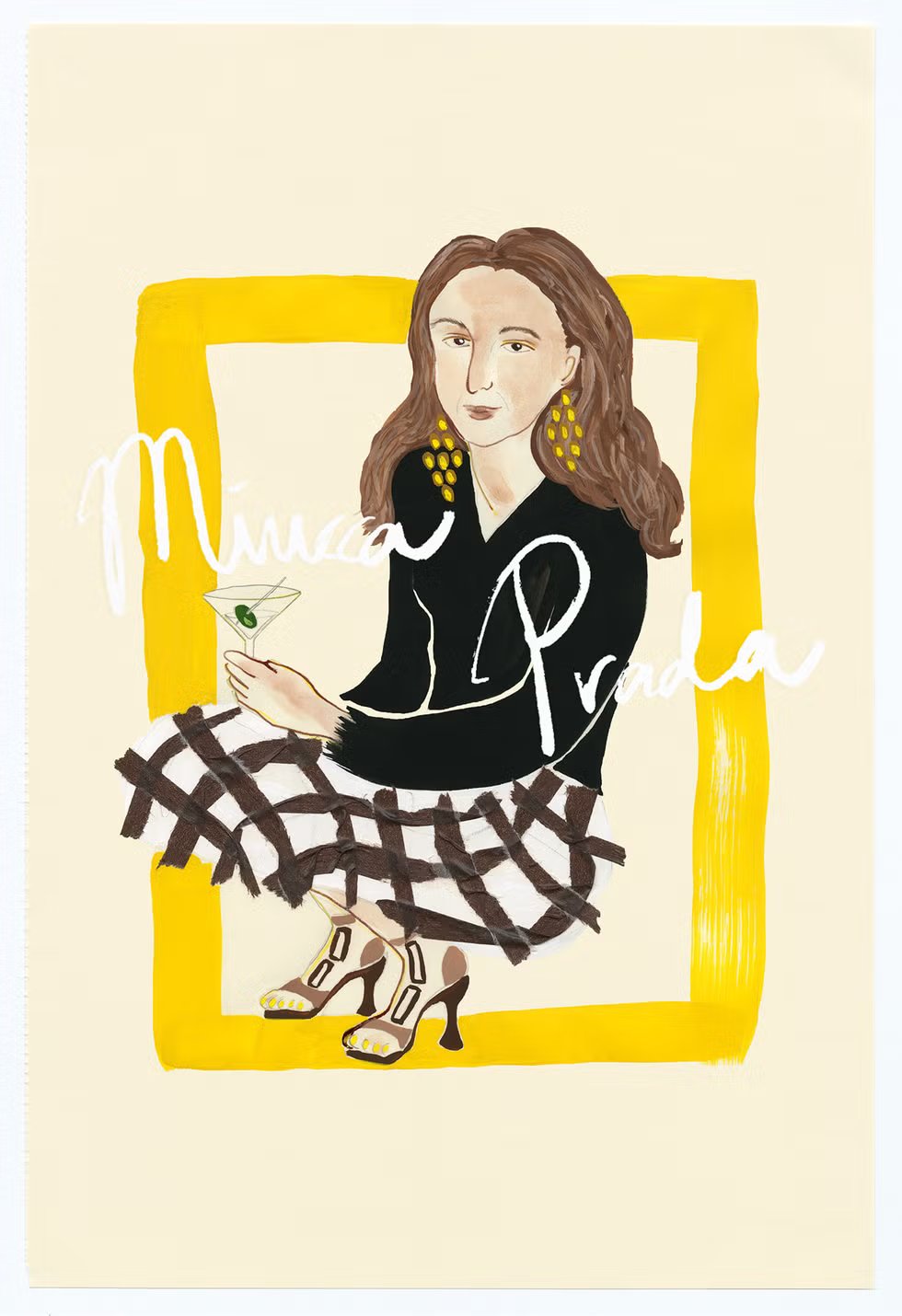
Illustration of Miuccia Prada by Rachel Song
Mrs. Prada’s arsenal of off-color prints and skirts have inspired generations of women to aspire to an ugly-chic kind of cool; looking at her today, it’s easy to find ourselves lost in her world. But in harkening back to the nascent stages of her career as a designer, Garcia-Furtado reminds us that the throughline of her genius lies in her sense of self.
It’s a story that began with nylon, an unexpected choice for a member of the Prada family, with its legacy of selling bespoke leather goods to royal clientele. Yet Mrs. Prada’s choice to bring nylon totes and duffels to the luxury market was not merely driven by rebellion—it was a manifestation of her own desire for a well-designed bag that embraced utility. And the groundbreaking success of the bags demonstrated that her dreams were shared by other women—a hint of where Prada would take the brand.

Illustration of looks from Prada Fall 1993 Womenswear Collection, by Rachel Song
Garcia-Furtado understands this lore firsthand. After all, she’s spent a lot of time in Mrs. Prada’s shoes—well, the ones she designed, at least. She began building her own archive of Miuccia merch in college with a pair of woven leather Mary Janes by Prada’s little sister, Miu Miu. A lucky eBay find from the spring 2001 collection, they were marked by interlaced checks of leather with pops of plum purple and canvas buckle straps. She has continued to build her collection ever since.

Miu Miu Spring 2001
Writing the book gave Garcia-Furtado carte blanche to dig into the nitty-gritty details that unite women of varying tastes and lifestyles as proud members of Prada’s hive. Below, she gathers with Bazaar’s fellow Prada obsessees, executive digital director Lynette Nylander and senior fashion writer Camille Freestone, to unpack all the things that have placed Mrs. Prada in a league of her own, from the ’90s to now.
Jennifer Jenkins: What inspired you to go on such a deep dive on Miuccia Prada?
Laia Garcia-Furtado: There are very specific images that we go to when we think of Prada in the ’90s, but all of those collections are from the late ’90s. So I thought, “Wait, what about the early ’90s?” When I started looking up those collections, I realized that what I was really doing was tracing how Prada went from almost an independent, fledgling designer to an icon in a period of ten years, which is really crazy. I love to go down a research hole; that’s actually my favorite thing. It was just great to have an excuse.
Lynette Nylander: One of the things that struck me about going through Laia’s book, and my own personal understanding of Prada in the ’90s, is that it was really foundational. A lot of the signatures and markers of what Prada is today were made in that formative time. One of my favorite things about being part of the Prada hive—and I think we all identify as that—is that she has carefully constructed a brand where you can mine from its past. She’s very okay with the idea that something is a rehashed idea from a ’90s collection in the 2000s, in the 2010s, in the 2020s. Everything is meant to be in dialogue with everything else. That’s really refreshing in a world where designers are making very distinct collections and basically almost asking you to do away with whatever you bought last year and buy into what’s “now.” She very much respects the past, which is why I think a book on the ’90s is brilliant.
Camille Freestone: Also, the designs are so pared back. We think now of much more heavy-handed embellishment when we imagine Prada. Part of it was that it was the ’90s and it was just a simpler time. Runways have just gotten more megawatt altogether. But the Prada collections are quite pure. The design is quite simple in the best way, so they let her creative touches shine in such a way that feels very present.
LGF: I mean everything old is new, et cetera. Going back to what you were saying about the simple shapes, even when things are heavily embellished and there’s a lot of beading and sequins, it never feels like putting on a bunch of stuff for the sake of putting on a bunch of stuff. Even if it’s super over-the-top, you think, “It’s exactly what it needs to be.” It feels very real. One of my favorite things I read while I was doing research is a quote where she’s saying how in movies and in art, you’re allowed to bring in real life and it’s allowed to be ugly and regular, but fashion was a place where you weren’t allowed to do that, and she wanted to change that. When I read that, everything from those old collections made so much sense.
But even now, I think you can read a collection, even if she and Raf are saying that it’s about one thing, and you look at it, you’re like, “It’s really about something else.”

Prada Spring/Summer 2027

Prada Spring/Summer 2027
LN: Yeah, and that’s always been a part of that duality. And I mean, even in the inception of Miu Miu, she talks about it as this other side of her personality. She’s someone who is really in dialogue with her more fantastical, imagined self. And I think what was interesting about going through the ’90s collections was that it was fantastical, but again, more real.
But I want to talk about what you learned. They always say hindsight is 20/20, but I don’t think we were lucky enough to understand what a unique time the ‘90s were. It was pre-social-media. Celebrity culture had hit this apex, and Miuccia was there as this brand that carried and collected a lot of celebrity in a way that is not how it is now.
LGF: It wasn’t grody! And I think that was especially evident when she launched menswear, and John Malkovich was her model or Willem Dafoe—I mean, now we all love Willem Dafoe, of course, but it was very different from what everyone else was doing.
And another thing that’s really interesting is that we have a vision of the ’90s, but the first couple of years of the ‘90s are still the ’80s. It takes years for the prevailing aesthetic that we all remember to rise up. Going back, Prada was a heritage label, but she launched ready-to-wear in the late ‘80s. And it wasn’t like when Vuitton launched ready-to-wear, when everybody understood it as a major brand. Prada was by no means in its flop era, but it wasn’t as well known as Vuitton. It was not the same.
So when she started, critics were writing things like “Prada also showed a collection.” There wasn’t even a long review. And then she sort of started getting talked about in the same breath as Martin Margiela or Ann Demeulemeester, like, “These people are the plucky new designers.” We think she’s so untouchable now and it’s like she almost can do no wrong, but you can go back and see how it all started and see her be like, “I hated this collection actually, and I’ll never do that again.” I mean, my kingdom for any designer that would say that now—to just be that honest.
JJ: You touched a lot on her unapologetic way of expressing herself, even while taking in different cultural references and touchpoints. Was there anything in particular you were most surprised to learn about her?
LGF: My favorite trivia is that she got married on Valentine’s Day.
LN: Oh, I love that. She’s a romantic.
LGF: She’s a romantic. I feel like that says so much.
CF: It’s amazing. She was in the Communist Party of Italy, and so not of the fashion world at all, but so endlessly fascinated by it.
LGF: It’s so funny because it’s very much like her parents said, “Okay, you’ve had your fun. Now, come back home, join the family business.” And she wanted to be an actor—the mime thing! In one interview, she said, “My favorite part was when we had to do really specific body control stuff.” And you can totally see her just being so good at that.
CF: Yet she’s so good at fashion.
LN: Well, I think that she’s so good at it because I can’t think of a designer, at least in more modern history, that really sort of mines from herself. Have you ever noticed, if you read a part of a review, or you’ve seen those videos of her backstage, it’s never like, “I was looking at the art of Georgia O’Keeffe”?
CF: She doesn’t really give you a story.
LN: She doesn’t even mine it from a place. She isn’t even saying, “Oh, I was walking down the piazza in Milan.” It’s not about that—it’s this higher sense of self. I think about the fall/winter 2026 collection, with Bella Hadid and the four rounds of looks. And of course she did that because she’s the only person who would do that, because those are the things that ticktock around in the caverns of her mind when we’re all fast asleep.
CF: Well, she’s oddly practical. She’s kind of utilitarian. And I think now I’m just saying a different thing in different words, but you think of a crystal embellishment when you think of Prada, you think of a quirk, but it’s all rooted in a really utilitarian approach. I feel like this is clothing, not art.
LGF: It’s also because that’s how she dresses. I mean, yes, are her high heels too high for us to walk and not get blisters? Yes, but we still wear them. It’s fine. But she designs clothes that she wants to wear, and we always look at what she’s wearing at the end of the show to see how she’s styling.
LN: She’s the model that we’re looking for at the end of the show.
CF: Then it’s funny to put her back in dialogue with a Martin Margiela; they both were subversive in their own ways, but hers was lensed through an idea that these are just clothes. You need to get dressed in them!
LGF: There is something about the two of them. Margiela never wanted to be interviewed, but when you look back at a lot of the profiles of her, there will be editorials where it’s designers with their muses, and she’s almost always by herself. She’s her own muse.
It’s just her. It’s like her looking in a mirror. It’s her and her son, or it’s her by herself, but it’s such a clear vision. And I mean, I think it also makes a difference because a lot of the male designers need a muse…but for her, it’s always her.
CF: I’m also always fascinated by the “designer uniform.” There are so many examples. Phoebe Philo, Michael Kors, Jonathan Anderson: everyone takes their bow, and it’s almost like they’re the antithesis of their clothes. So obviously, we are always talking about a woman designing for women, but in that particular context of those big houses, she’s one of the few who is just dressing just like her collection.
LGF: And it’s amazing the few times she’s come out wearing pants.
CF: It’s so rare.
LGF: It’s so rare! You’re like, “Oh my god, the slim cigarette.”
LN: I have two things I want to say to the idea that she doesn’t really have a muse. The muse is herself, but somehow that doesn’t come across as arrogant. It’s not the opposite. It comes across as, “I just do what I know I’ll respond to and hopefully other people like it.” And I think there’s something really earnest about it.
CF: There’s also no ideal of the perfect woman, either.
LN: Yes, in fact, I don’t think she even really deals or trades in ideals.
I also want to talk about the colors. I mean, if I think about Prada, I just think about this kaleidoscopic universe of color. She can go anywhere. She can put any color combination together. It’s kind of genius. But particularly in the ’90s… they’re all quite muted. You have this line from Robin Givhan in the book, “The greens hovered somewhere between shades of slime and mold. The browns were”—I mean, this is the beauty of the Robin Givhan written line—“the browns were murky, the color of water as it stagnates over a long, steamy summer. The dizzy and crisscross patterns were reminiscent of UHF static or an old-fashioned labyrinth in rusted plumbing.”
LGF: It’s funny though because Miuccia Prada hated all of those collections.
LN: I think if there was ever going to be a brand that’s going to respect the fact that Robin Givhan ripped her to shreds, it’s going to be her. I think she believes in the idea of free thought, and that was Givhan’s thought and put so beautifully.
But I do want to talk about the colors, because I just think it’s so specific of how I think about Prada, but also how I think about my own relationship to color. I don’t know if you feel like that, but probably in an inadvertent way, she has given me the confidence and the permission to put together these really disparate color combinations.
LGF: I mean, I think that collection that Robin is talking about, from spring ’96 (which is the root cause of my everything; I had a slime green room—I love slime green) is really interesting. Even before she got into the cool color combinations that we know her from, those early ’90s collections, even when it was like, “Here’s a bunch of beautiful white dresses,” suddenly there would be weird goldenrod silk and a weird orange. The color thing was always there from the beginning. And when you look at the collections throughout the years, you see how she gets a little bit more confident in that and starts mixing it. But that punch of weirdness was present from the beginning.
CF: But somehow, I think, “Why do I like this slime shade? Why do I like this brown? Why do I like this purple?” But all of a sudden, she’s made me want purple.
LN: I hate purple in any other context than hers—I need purple.
CF: All of a sudden I want purple. And there’s these weird plaids that all of a sudden make me think, “Oh, I need that.”
LGF: Also, in the late ’90s, she does collections with things embellished with mirrors, and she was like, “Well, everyone is being a hippie and doing this, so I also did it,” but she did it extra crazy. And I love when she is engaging.
Going back to what you said about her being probably one of the few designers that is like, “This review panned me, it’s fine,” I feel like she really was engaging with what was being written about her.
One season editors were like, “There are no suits. This is outrageous! Where are all the suits?” So then the next season she opened the collection with a suit and it’s very like, “You’re welcome. Are you happy now?” I like to see her engage, not that she doesn’t do that anymore, but I think in the ’90s, it was a little bit more obvious.
LN: And now she kind of hovers above it all. I want to talk about 1998. Her ascent was complete, you say, in 1998, when she was now at over a half a billion dollars in sales. She landed at 15 in Vogue’s list of the most influential brands. Other women at the top 20 were Donna Karan, Angela Missoni, and Mariuccia Mandelli, and Miuccia is one of the only working designers left. What was happening in 1998, and what collection is that?
LGF: It’s the one with the cool red-and-white boots that are space-age. It’s all very space-age mod. ‘98 is the time when she went all-in on the millennial aesthetic that everyone was into, when she did her sports thing.
CF: I also think she doesn’t deal very much in volume. That’s not really her game.
LN: Thank god. I don’t know if I’d want a poofy Prada.
LGF: Yeah. But it’s so crazy—in a decade you go from reviews that say, “Oh, Prada also showed a collection,” to, “Everyone is focused on whatever she does.”
LN: And what happened in that time?
LGF: I think she just became more confident in her vision, which was different from everyone else. And I mean, Tom Ford was also doing something at Gucci; there was that vibe shift, and she was part of it, but it was different. From the beginning, she was always the thinking woman’s sex-appeal designer, and that just stayed. She was very in tune with the culture, but she wasn’t just doing reproductions of what you could see. She was injecting it with her own aesthetic.

Prada Fall/Winter 1998

Prada Fall/Winter 1998
You can look at something and say, “Oh, this was her way of doing grunge,” but it was not grunge. It was her own thing.
LN: What was that thing? I mean, do you look at broader context and get a sense of the music she listens to or the boys she kissed or the movies she liked?
LGF: Yeah, I think it’s very much a movies thing. I feel like you get a sense of her upbringing. The Mary Jane—the shoes she wore as a little girl—were always a thing. She got married in a dress and a coat made by a childrenswear designer. The little socks—you start seeing those reflections of her life, and they’re more apparent the more that you know her, but I don’t think it’s the kind of thing where you need to know what it is in order to like it. And I think there is something about it where it’s for grown women. Young people also like it, but her clothes are not clothes for young teen girls.
LN: Was that also something you learned from your research?
LGF: I mean, technically, I think Miu Miu was supposed to be the younger brand, and the vibe did feel a little bit younger, but Prada always felt a little bit adult. Even when you look at the suits or the proper little silk dresses, you’re like, “These are clothes for adults.”
CF: I feel like that’s also where the styling sneaks in. You’ll see the childlike Mary Jane with the suit and maybe one little brooch or something that is so subtle…but it’s not hitting you over the head.
LGF: Yeah, because I think there’s also a thing where you always look up to something. You know how you read Seventeen magazine when you’re 12? And I think there is something about Prada where no matter how old you are, it still feels just beyond where you currently are.
CF: It’s very womanly.
LN: Every time I buy a piece, it still feels, in a weird way, unattainable, or I question if I’m mature or smart or cool enough.
LGF: And then you look in the mirror, and it feels like it feels exactly where you should be.
CF: It is like, “Am I a woman? Am I a glamorous woman?”
LN: Yeah. Maybe it’s just because we think about her so much as the likeness of that.
CF: Well, we have made her the ideal almost. She is the one to be judged against, for so many people, but then that makes it hard to articulate what she actually is.
LGF: But even her glamour—there is something attainable about it. She doesn’t wear crazy makeup, and she doesn’t style her hair in any kind of way. It’s just her holding her little scarf, and you think, “I need a scarf to hold!” Going back to her interest in real life, it’s just so her. And who doesn’t want to just be like themselves? You want to be her, but you really just want to be you.