The seeds of Van Gaal’s coaching career were planted when he was still in school. Heading to Ajax’s old De Meer stadium to watch the team train after his lessons, a young Van Gaal saw Rinus Michels in the throes of revolution with his Total Football philosophy.
“Someday I want to be like Michels,” he thought to himself, and by the time he joined the club as a 20-year-old midfielder, he was already teaching in schools in Amsterdam while completing his studies at the Academy for Physical Education.
Ajax, in 1971, had just won the European Cup, and there was no place for Van Gaal in a squad consisting of players of calibre of Johan Cruyff, Johnny Rep, Sjaak Swart, Johan Neeskens and Piet Keizer, so he was offloaded to Antwerp while the Amsterdammers went on to win two more continental crowns. After four years in Belgium, he returned to his homeland and resumed teaching alongside spells playing for Telstar, Sparta and AZ.
Even as a player, Van Gaal had immense hubris and was astounded that he had not been called-up to the national team. “That boy has absolutely no self-criticism,” Sparta team-mate Leen de Goeij reportedly said of him.
The call-up never came and Van Gaal hung up his boots to start coaching at AZ before returning to Ajax as a youth coach.
Ajax’s glorious era was over. Since their European Cup three-peat, the 1987 Cup Winners’ Cup success had been the only achievement as the waning Dutch greats watched Bayern Munich, Liverpool, Nottingham Forest and AC Milan enjoy spells of dominance. They had surrendered their domestic throne, too, failing to win the league in four seasons before Beenhakker, with Van Gaal as assistant, guided them to the 1990 title.
When Beenhakker departed for Real Madrid in September 1991, promoting Van Gaal felt to many like an uninspired choice.
“The season had just started when Leo Beenhakker left for Real Madrid,” Van Os explained to Parool. “Louis was his assistant. He had a good reputation as a youth coach, but no experience as a head coach. In that sense, it was a gamble, but we thought: why not?”
The cocky new coach knew his radical vision would restore the club’s pride. Putting his 11 years of experience as a school teacher to good use, Van Gaal made the prestigious youth academy the core of his revolution.
“I learned that everyone has their own approach, that every group requires a unique method,” he told De Psycholoog. “In education, I learned to touch people, to stir them, to set them in motion. Especially when they were in groups.”
Young stars Dennis Bergkamp, Edwin van der Sar and Frank de Boer were already established in the team by then, but Van Gaal opened the doors for other academy gems, handing young midfielder Edgar Davids his debut early on. It may have been his way of commanding respect, too, as some of the older, established players seemed to switch off in the early stages of his tenure and had him fearing the sack after just two months.
“I had a very difficult first year,” Van Gaal said in an Andere Tijden Sport documentary. “I took over from Beenhakker and, of course, I had a different vision than Leo. I also trained differently. It’s clear that things were not running smoothly.”
It took an intervention from above to get the players on his side.
“I had the feeling that some players were slacking off and testing Louis,” Van Os said. “Don’t forget, he wasn’t yet the great manager he would later become. I didn’t think that behavior was acceptable; I thought: I won’t be fooled. So I asked [chairman Michael] Van Praag, and subsequently Van Gaal, for permission to address the players.
“After lunch they always went home quickly, but now they had to stay. They gathered in the press room at De Meer, where they had to sit. I sat behind a lectern, with Louis next to me. A bit like they were sitting in school desks.
“I said that I had the impression they didn’t support the manager, that the board wouldn’t tolerate that and stood behind Van Gaal 100 percent. If there were players who didn’t like that, they had to raise their hand, and I would make sure they were sold very quickly. No one raised their hand.”
He added: “Louis said afterwards: ‘You’ve got nerve, Arie.’ It was necessary to show my teeth. It is the only time I have intervened like that.”
Van Gaal’s spirits were lifted, and while PSV beat them to the league title by three points and Feyenoord knocked them out of the KNVB Beker, his men won the UEFA Cup, beating Torino over two legs in the final.
The summer of 1992 brought vital changes. Ronald de Boer, 22, returned to the club that produced him after a two-year spell at Twente, 19-year-old Marc Overmars was signed from Willem II and Jari Litmanen, a 21-year-old attacking midfielder, arrived from Finnish side MyPa. Meanwhile, Clarence Seedorf, 16, came up from the youth academy and became Ajax’s youngest-ever first-team player.
Van Gaal’s second season was even worse, though. Ajax finished third in the league behind champions Feyenoord and PSV despite Bergkamp topping the goal chart, and while they won the KNVB Beker, their UEFA Cup defence ended at the quarter-finals.
That summer, Van Gaal turned the tide with an audacious changing of the guard. Bergkamp and Wim Jonk departed for Inter – losses many believed would only weaken them further, but which Van Gaal later acknowledged were essential. “The balance with those two was not ideal,” he said. “It was only later that everything was so balanced that we could even win the Champions League.”
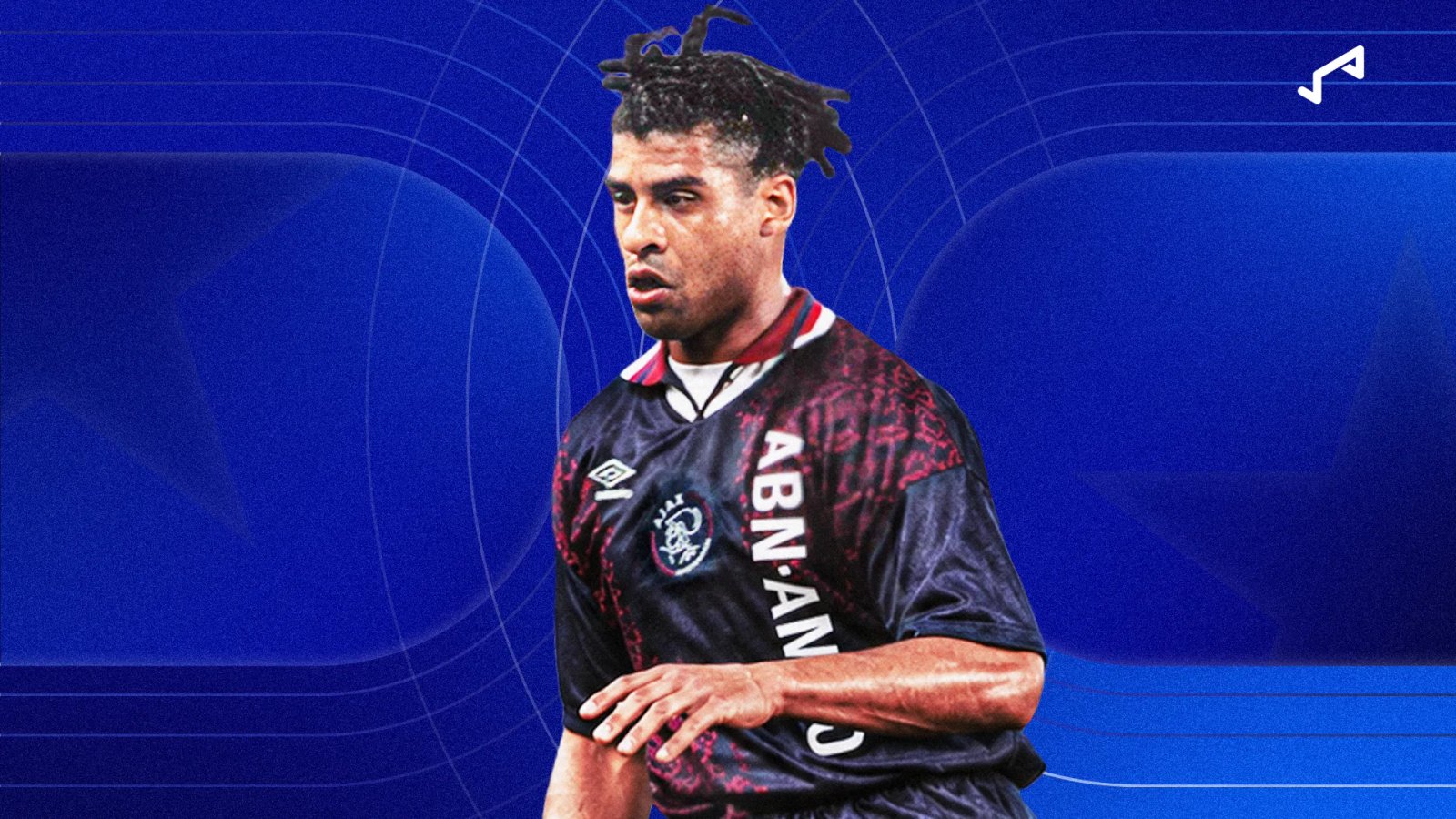
Another key piece of the puzzle was convincing 30-year-old European champion Frank Rijkaard to return after five glorious years at Milan to help fill the void in leadership while providing defensive solidity alongside skipper Danny Blind.
“With the arrival of Rijkaard and a Finn, Litmanen, from a division where they do not play at the highest level and who had to get used to playing in Ajax for a year, the balance in the team turned out to be much better than with Jonk and Bergkamp,” Van Gaal added.
Litmanen stepped into Bergkamp’s shoes as the team’s top scorer, netting 26 league goals in his first full season as a starter. “I have not seen a better number 10 than Litmanen,” said Van Gaal.
Nwankwo Kanu, 16, and Finidi George, 22, arrived from Nigeria, with the former providing height and technical skill while the latter’s relentless pace and tactical discipline proved useful on the right flank. With Seedorf, Davids and Ronald de Boer controlling midfield, Van Gaal had the mix of energy, technical proficiency and tactical intelligence needed to execute his brand of football.
His philosophy varied from the Total Football spearheaded by Michels and Cruyff. Rather than intense pressing and fluid positional changes being at its core, his version was rigid, with players restricted to their position in a 3-4-3 diamond formation and given strict instructions.
Training drills were repetitive, too. “It was repetition, repetition, repetition,” Ronald de Boer told The Guardian. “Even with Frank. He’d won everything in the game but, like Kanu, he had quite a poor left foot and couldn’t really hit a straight ball with it. Van Gaal had a passing drill that we did every day as an extension of the warm-up, and sometimes you’d think: ‘Oh, that again.’ After three months of ‘ping, ping’, Frank’s left was perfect.”