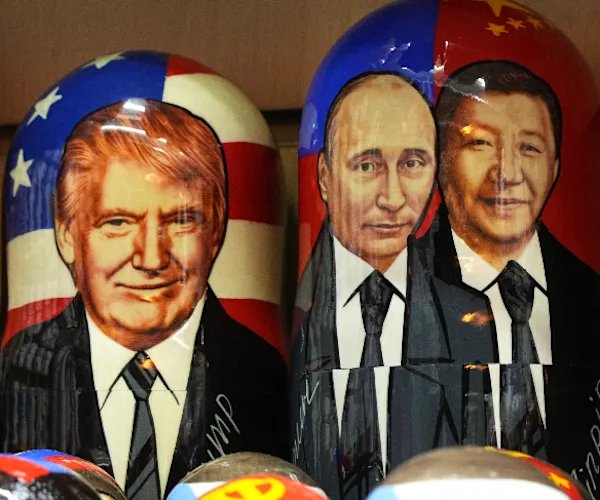

The United States and China are at odds over plans for a potentially historic summit involving President Donald Trump, Chinese President Xi Jinping, and Russian President Vladimir Putin later this month, with Beijing demanding a tightly scripted meeting that would leave little room for direct negotiations.
The proposed three-way meeting would take place on the sidelines of the Asia-Pacific Economic Cooperation summit scheduled for Nov. 18-19 in Shenzhen, China, although no final agreement has been reached on whether the three leaders will meet.
China wants prepared statements and predetermined outcomes, while the Trump administration is pressing for more flexible discussions that would allow substantive exchanges, The Wall Street Journal reported Monday, citing people familiar with the preparations.
Trump wants to use the gathering to discuss ending the war in Iran, nuclear arms reductions and broader international security issues, while Putin has proposed using the summit to explore a settlement of Russia’s war in Ukraine.
Speaking to reporters Sunday before returning to Washington from Florida, Trump said he expected to meet with both leaders, according to Reuters.
“One of the meetings, I think, will be with President Putin and President Xi, and that’ll be interesting,” Trump said.
“We’re talking a lot of things, including denuclearization, but we’ll be talking a lot of things. We’re trying to end the war in Iran,” he added.
The disagreement over the meeting’s format threatens to complicate a summit that could bring together the leaders of three major nuclear powers at a time of heightened international tensions.
Trump has expressed interest in pursuing a new nuclear arms control agreement following the February expiration of the New START treaty, which limited deployed strategic nuclear weapons held by the United States and Russia.
Washington has argued that any successor agreement should include China, whose expanding nuclear arsenal has become a growing concern for U.S. national security officials.
Beijing, however, has resisted participating in trilateral nuclear arms negotiations, maintaining that its arsenal remains substantially smaller than those of the United States and Russia.
China’s economic and diplomatic relationships with Iran and Russia could also complicate discussions.
Beijing remains the largest buyer of Iranian oil, providing Tehran with a major source of revenue despite U.S. sanctions.
Treasury Secretary Scott Bessent has repeatedly urged China to use its economic leverage to help end the Iran conflict and restore unrestricted shipping through the Strait of Hormuz, Reuters reported.
In September, Bessent said Washington and Beijing shared an interest in preventing Iran from acquiring nuclear weapons and restoring maritime trade through the strategic waterway.
Reuters also reported in September that Iran had used a barter-like arrangement involving oil sales to purchase billions of dollars in Chinese goods, including military equipment, helping Tehran circumvent Western sanctions.
China’s relationship with Moscow presents another potential source of friction.
Beijing has maintained extensive trade and energy ties with Russia throughout the war in Ukraine, while U.S. officials have accused Chinese companies of supplying dual-use goods that support Russia’s military industry.
China has denied providing lethal weapons to either side and maintains that it supports a negotiated settlement.
Neither China’s support for Iran nor its economic relationship with Russia has been formally confirmed as a separate agenda item for the proposed summit.
Putin, meanwhile, has pushed for discussions about ending the war in Ukraine, now in its fifth year, according to the Journal.
Such negotiations could raise concerns in Kyiv, particularly if discussions about Ukraine’s future proceed without Ukrainian President Volodymyr Zelenskyy’s participation.
Trump recently told CBS’ “60 Minutes” that he believed an agreement to end the war was close, although he offered few specifics about its potential terms.
China confirmed last week that diplomatic discussions about the proposed three-way meeting were underway.
Chinese Foreign Ministry spokeswoman Mao Ning said Beijing was communicating with the relevant governments, according to The Associated Press.
The proposed gathering would also come as Trump and Xi seek to preserve a fragile trade truce between Washington and Beijing.
U.S. Trade Representative Jamieson Greer pressed Chinese officials Friday to fulfill commitments involving agricultural purchases, rare earths, and other critical minerals, according to the AP.
China, meanwhile, expressed concerns about U.S. trade restrictions.
For Xi, hosting the American and Russian presidents would provide an opportunity to showcase China’s diplomatic influence ahead of a major Communist Party leadership reshuffle in 2027.
But Beijing’s insistence on controlling the meeting’s format reflects its reluctance to engage in unpredictable negotiations over nuclear weapons, Ukraine and Iran.
The Journal reported that separate bilateral meetings could emerge as an alternative if the three governments cannot agree on arrangements for a joint session.
For now, the Nov. 18-19 APEC gathering remains the proposed setting for the talks, but the Trump-Xi-Putin summit itself has not been formally confirmed.
© 2026 Newsmax. All rights reserved.