At the Winter Olympics earlier this year, many of us found ourselves ensorcelled by young female figure skaters furiously spinning on ice. But designer Petra Fagerström’s gaze has always been rinkside. “Coaches are so often the supervillain in the media, but I love them,” says the 28-year-old designer on a June afternoon. “That power dynamic has emotions that many women can relate to.”
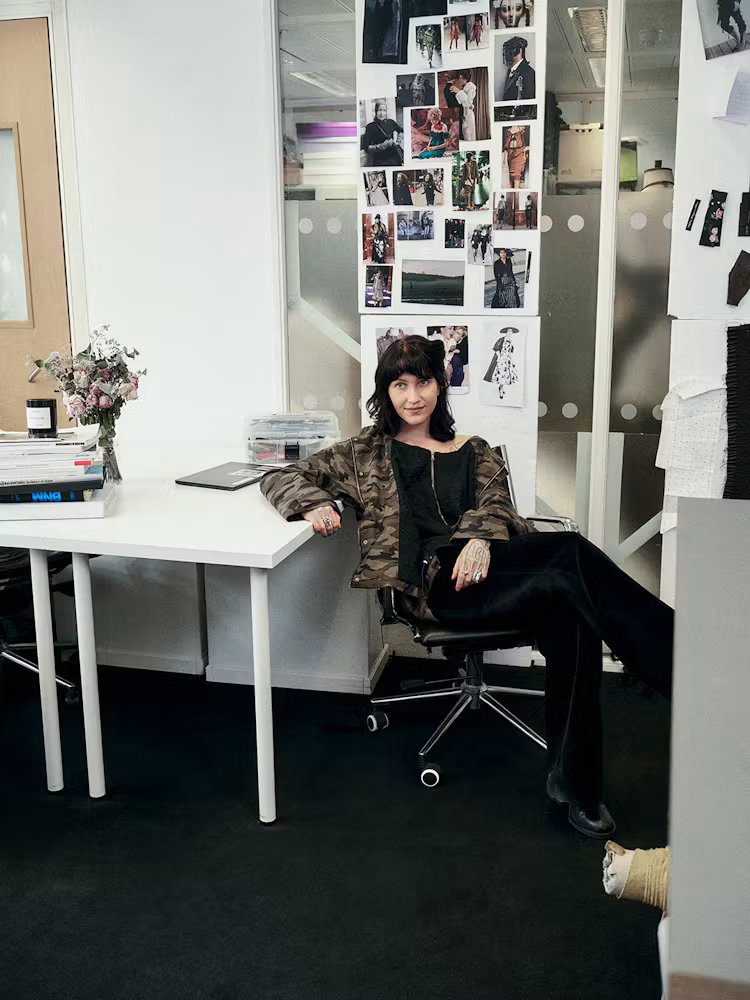
Fagerström is serene among the organized chaos of her studio, located in London’s historic Smithfield meat market. Although the Swedish designer’s dark hair, pale skin, and all-black uniform give the impression of a Scandinavian noir protagonist, when she was a teenager in Gothenburg, her look was considerably sparklier. From age 14 to 16, she trained at a skating rink every day after school, even making Sweden’s national team for synchronized figure skating. Still, when she thinks back to that time, what comes to her mind is not girls in spangly costumes but the strength of the woman in charge. “My coach was this matriarch. She had power but perhaps hadn’t reached what she had wanted to for herself,” says Fagerström. “There’s something really vulnerable about where that presence comes from.”
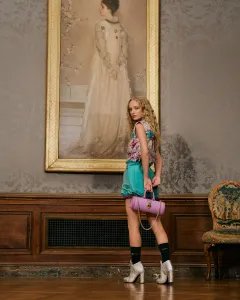
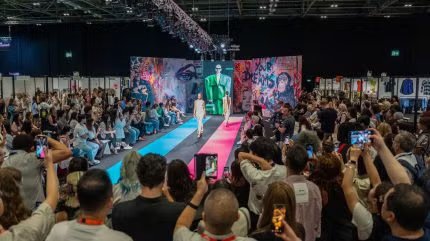
For her most recent collection, Fagerström, who launched her label in February 2025, explored that duality through a tug-of-war between structure and softness. Take her signature double-fronted jackets with interior tailoring, or her lenticular-printed pleats, which create an optical illusion like an ice skater speeding by, as mediated by our screens. Although the collection, which marked her first time on the London Fashion Week schedule, happened to coincide with Alysa Liu fever, Fagerström is determined to “talk about fashion” with her garments. Don’t expect any leotards. (You may, however, find a floral print that pays homage to a coat once worn by the mother of 1990s Olympic figure skater Tonya Harding.)
The designer in a jacket from her namesake label.

While she was always interested in clothes—during her emo phase, at 13, she was influenced by the band Tokio Hotel—Fagerström truly decided clothes were her future after quitting skating at 16. “I found Nicolas Ghesquière’s Balenciaga and fell in love. I was like, I’m going to be a designer,” she explains. She studied at Parsons Paris, then completed stints at Acne Studios and Demna’s Balenciaga before heading to London in 2023 for Central Saint Martins’s MA fashion program. Her particularly wearable graduate collection laid out her distinctive point of view: distorted New Look–inspired tailoring, shimmering eveningwear worn over warm-up sweats. “Fashion, to me, is thinking about womanhood: how you want to present, and how you want to be perceived,” says Fagerström. “Looking at a lot of fashion now, it’s like: Where’s the agency? In clothes, the idea I usually come back to is breaking what is obedient.” Think of her designs as the flyaway hair in a gelled ponytail.
At a time when revisiting the tchotchkes of girlhood is trendy, Fagerström is more interested in maturity and all the friction that entails. When she designs, she asks herself: “How does this woman feel? Does she like music, food, and sex? You want to feel that there is a woman behind the fashion image.” In just a short time, those questions have resonated: Her brand is already sold at Dover Street Market Paris and 10 Corso Como, as well as on her own website, and she was a finalist this year for the prestigious LVMH Prize. “My course director at Saint Martins said to me, ‘Don’t feel like you’re only one year young, because you’ve obviously been creating this brand for much longer.’ When things happen, they happen.”
Models Belladonna Beeby and Jessie Craig.

Fagerström has been at work on her new collection. Spring presents a challenge for the designer, given her penchant for dark colors and layers. She’s exploring an idea she’s long been interested in: “My next collection is about women’s relationship to sex,” explains Fagerström. “Conservative values seem to be back in my generation.” She’s been rewatching Michael Haneke’s The Piano Teacher, a portrait of repressed desires, and reading Gillian Anderson’s Want, a book of compiled anonymous sexual fantasies. “How do these things come out in other ways when you repress them?” asks Fagerström. In her designs, they emerge as controlled slippages: jackets that fall a little off the shoulder, or trompe l’oeil that pretends to reveal the body underneath.
The designer partly credits all those years on the ice for her single-minded drive. “Being disciplined enough to practice something repetitive is a good skill,” she says. “When I started studying fashion, I would perfect my pockets for days.” Whenever Fagerström’s head isn’t focused on the cutting table, she is researching, just as she did on the pre-algorithmic Internet when she was seeking out what Raf Simons listened to, or looking for archival Junya Watanabe runway images. “You had to do a lot of digging on Tumblr,” she says, explaining that the magic was in the effort. “If you remove the pursuit of something, it feels less exciting.”
Hair by Ali Pirzadeh at Streeters; Makeup by Abbie Nourse. Models: Belladonna Beeby at Storm Management; Jessie Craig, Khadijat Olafemiwa at The Squad Management; Astrid østergaard, Echo Zhao at Premier Model Management. Casting by Ashley Brokaw Casting; Photo Assistants: Emma Ercolani, Fiona Fitzpatrick; Retouching: SHE POST PRO; Fashion Assistants: Ella Bacon, Zaza McDonald; Hair Assistant: Krisztian Szalay; Makeup Assistant: Maho Moriyama.