
Key Points
Even before OpenAI released ChatGPT to the public in November 2022, technology was by far the most valuable sector in the S&P 500 (SNPINDEX: ^GSPC) — led by software, hardware, consumer electronics, digital services, and cloud computing. The artificial intelligence (AI) boom has taken the S&P 500’s concentrated technology sector exposure to a whole new level.
As of Aug. 31, tech stocks accounted for 37.9% of the Vanguard S&P 500 ETF (NYSEMKT: VOO) — which mirrors the index’s performance. And that’s even when considering Alphabet, Meta Platforms, Amazon, Tesla, and Space Exploration Technologies are not classified as tech stocks.
Missed AI’s “Act 1”? Act 2 Could Be 15x Bigger. Most investors think they missed the AI boat because they didn’t buy Nvidia in 2005. But according to our analysts, we’re only at the end of “Act 1″—the R&D phase. “Act 2” is the global rollout. Continue »
By comparison, the STOXX Europe 600 — which represents nearly 90% of the investable market in Europe’s developed economies — has a mere 8.9% weighting in technology.
Here’s what’s driving U.S. tech sector concentration, and why the Vanguard Information Technology ETF (NYSEMKT: VGT) is a simple, low-cost way to bet big on sustained AI-driven growth.
Image source: Getty Images.
Semiconductor stocks make up 42% of the tech sector
The tech sector has evolved with AI-driven demand. Nvidia (NASDAQ: NVDA) is now well ahead of Apple as the world’s most valuable company. Many of today’s largest tech companies are no longer software and consumer electronics companies, but rather semiconductor and hardware companies.
Semiconductors, semiconductor materials, and semiconductor equipment companies make up a combined 42% of the Vanguard Tech ETF. Throw in technology hardware, storage, communications equipment, electronic components, and electronic equipment and instruments– and that’s 68.7% of the sector ETF.
Six of the ten largest components in the Vanguard Tech ETF are semiconductor stocks — Nvidia, Broadcom (NASDAQ: AVGO), Micron Technology (NASDAQ: MU), Advanced Micro Devices (NASDAQ: AMD), Intel (NASDAQ: INTC), and Lam Research (NASDAQ: LRCX). They now account for 32.4% of the Vanguard Tech ETF — much larger than their 14.8% weighting in the Vanguard S&P 500 ETF.
Nvidia’s market cap is over $5.5 trillion at the time of this writing — roughly the size of Microsoft and Meta Platforms combined. Broadcom was in the $2 trillion club earlier this year, but has since fallen out. Micron and AMD both joined the $1 trillion club this year. Intel set a new all-time high earlier this year, finally surpassing its previous high from 2000, before the dot-com bubble burst. And Lam Research, combined with its U.S. semiconductor equipment peers Applied Materials and KLA, have a market capitalization of over $1 trillion.
Leading chip stocks at reasonable valuations
The Vanguard Tech ETF is up 34.8% year-to-date compared to a 12% gain in the S&P 500. Since the start of 2023, the tech sector is up a staggering 218.1% while the S&P 500 has doubled.
On Dec. 31, 2022, Nvidia, Broadcom, Micron, AMD, Intel, and Lam Research were collectively worth less than $1 trillion. As of Oct. 1, 2026, their combined market cap is a mind numbing $10.5 trillion.
Some investors will take one look at the price action of major semiconductor stocks and assume the whole industry is overvalued, and that an AI bubble is bursting at the seams and will pop any minute. But the big difference between this tech stock boom and past run-ups, like the one leading up to the dot-com bust, is that earnings are playing a big role in driving stock prices — not speculation alone. Valuations remain reasonable for many chip stocks.
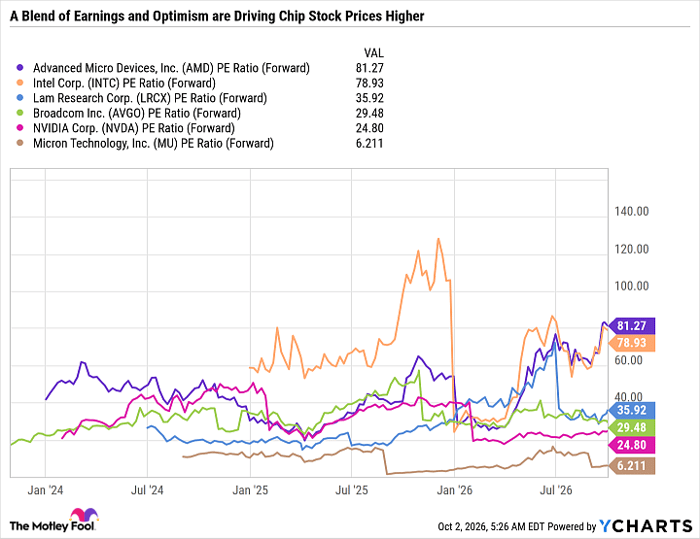
AMD PE Ratio (Forward) data by YCharts
Nvidia trades at just 24.8 times forward earnings compared to 18.9 for the S&P 500, even though Nvidia is a far higher quality company than the typical index component.
AI data center demand shows no signs of slowing. Data center rack-scale systems like Nvidia’s Vera Rubin NVL72 or AMD’s Helios consist of several graphics processing units and central processing units, which are packed together with high bandwidth memory chips, like those made by Micron. Broadcom’s custom AI accelerators and networking solutions are playing an integral role in cost-effective scaling of application-specific needs for key customers like Alphabet, Meta Platforms, OpenAI, and Anthropic.
Demand for Intel products and semiconductor foundry is surging. While Lam Research plays an integral role in manufacturing cutting-edge semiconductor equipment used in advanced AI fabs, such as those operated by Intel, Samsung Electronics, and Taiwan Semiconductor Manufacturing.
Capital expenditure (capex) budgets from major hyperscalers, AI labs, and enterprises continue to surge — giving semiconductor companies the green light to ramp up production and invest in next-generation chips. Demand is so massive that Nvidia is partnering with a consortium of six financial institutions to fund $500 billion in AI infrastructure, enabling customers to finance their compute needs rather than buying chips directly. Just last week, reports surfaced that Broadcom is lending up to $42 billion to Anthropic for its infrastructure build-out. On Broadcom’s September earnings call, the company forecast that Anthropic’s AI demand could reach 5 gigawatts (GW) in 2027 and 10 GW in 2028 — which would make it Broadcom’s largest customer — even exceeding Alphabet.
The Vanguard Information Technology ETF is chock-full of leading AI stocks
The Vanguard Information Technology ETF is a better buy than the Vanguard S&P 500 ETF for investors looking for even more outsize exposure to tech stocks. A great deal of AI capex is funneling into the coffers of the semiconductor industry, and the Vanguard Tech ETF provides a simple way to get exposure to a basket of semiconductor stocks rather than betting on Nvidia versus AMD or Broadcom over a memory chip stock.
The ETF sports a mere 0.09% expense ratio, or just $9 for every $10,000 invested, compared to a 0.03% for the Vanguard S&P 500 ETF. The low expense ratio ensures that fees don’t erode gains for long-term investors.
Add it all up, and the Vanguard Tech ETF is an excellent buy for investors who believe that we are still in the early innings of the AI infrastructure build-out.
Should you buy stock in Vanguard Information Technology ETF right now?
Before you buy stock in Vanguard Information Technology ETF, consider this:
The Motley Fool Stock Advisor analyst team just identified what they believe are the 10 best stocks for investors to buy now… and Vanguard Information Technology ETF wasn’t one of them. The 10 stocks that made the cut could produce monster returns in the coming years.
Consider when Netflix made this list on December 17, 2004… if you invested $1,000 at the time of our recommendation, you’d have $361,650!* Or when Nvidia made this list on April 15, 2005… if you invested $1,000 at the time of our recommendation, you’d have $1,437,517!*
Now, it’s worth noting Stock Advisor’s total average return is 936% — a market-crushing outperformance compared to 213% for the S&P 500. Don’t miss the latest top 10 list, available with Stock Advisor, and join an investing community built by individual investors for individual investors.
*Stock Advisor returns as of October 5, 2026.
Daniel Foelber has positions in Broadcom and Nvidia. The Motley Fool has positions in and recommends Advanced Micro Devices, Alphabet, Amazon, Apple, Applied Materials, Broadcom, Intel, KLA, Lam Research, Meta Platforms, Micron Technology, Microsoft, Nvidia, Taiwan Semiconductor Manufacturing, Tesla, and Vanguard S&P 500 ETF. The Motley Fool has a disclosure policy.