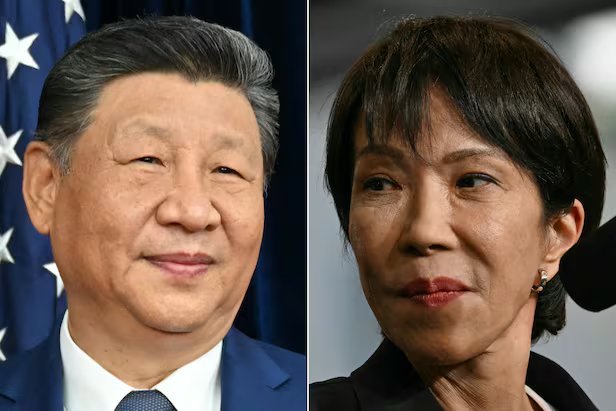
Ahead of the Asia-Pacific Economic Cooperation (APEC) summit in Shenzhen, China, on the 18th and 19th of this month, the Japanese government is watching closely for the first face-to-face meeting between Chinese President Xi Jinping and Japanese Prime Minister Sanae Takaichi. With the two leaders set to meet for the first time since tensions over Taiwan, Tokyo is working diplomatically to prevent Takaichi from being snubbed by Xi.

On the 8th (local time), Bloomberg, citing people familiar with the matter, reported that the Japanese government has asked Beijing to assure that President Xi will treat Prime Minister Takaichi on equal footing with other world leaders. The people said Tokyo plans to protest if any protocol that breaks with precedent is arranged at this APEC summit.
Japan expects that Xi, as leader of the host nation, will at least exchange a customary handshake with Prime Minister Takaichi. But with relations between the two countries in a deep freeze, even that basic protocol is no longer a given, and the government is focused on preventing Takaichi from being publicly snubbed.
Ties between Japan and China have deteriorated rapidly since late last year. The trigger was Takaichi’s remark in November last year suggesting that a Chinese attack on Taiwan could constitute a “survival-threatening situation” for Japan, implying a possible Self-Defense Forces response. By publicly raising the Taiwan issue, which China sees as highly sensitive, the rift between the countries widened. In May, media also reported that during a U.S.-China summit in Beijing, Xi criticized Takaichi by name in a conversation with U.S. President Donald Trump.
Bloomberg said that over the past year, Japan-China relations have worsened to among their lowest points since the normalization of diplomatic ties in 1972, making even basic protocol uncertain.
According to some Japanese government officials, Xi has directly demanded that Takaichi retract her Taiwan-related remarks. Takaichi has refused to do so. In May, she further angered Beijing by agreeing with Philippine President Ferdinand Marcos Jr. to launch formal talks to demarcate maritime boundaries east of Taiwan.
Tokyo also worries that Takaichi could be sidelined or slighted in seating arrangements or during the group photo of leaders at the APEC summit. If Xi treats Takaichi colder than other leaders, it could further highlight the diplomatic rift between the two countries.
Jeremy Chan, a senior analyst at Eurasia Group and a former U.S. diplomat, said, “Over the past year, the Chinese government has escalated its criticism of Japan into personal attacks, with an unusual share focused on demonizing Prime Minister Takaichi.” He added, “China is increasingly likely to look for an opportunity at the APEC summit to downgrade Takaichi’s protocol status or publicly embarrass Japan through criticism.”
Xi’s past practice of publicly scolding foreign leaders at international meetings also heightens Japan’s concern. At the Group of 20 summit in Indonesia in 2022, Xi openly rebuked then–Canadian Prime Minister Justin Trudeau after details of a private leaders’ conversation appeared in the media.
When China last hosted an APEC summit in 2014, relations with Japan were also strained, yet Xi and then–Prime Minister Abe Shinzo exchanged a handshake. That came after months of advance coordination to create a mood for rapprochement. This time, however, there has been no such prior contact, according to reports.
The possibility of holding a summit meeting between Takaichi and Xi at this APEC gathering is also seen as low. Their interaction is expected to be limited to ceremonial encounters during official APEC events, such as the leaders’ dinner where Xi greets visiting heads of state.
Masaki Taniguchi, a political science professor at the University of Tokyo, said Takaichi needs a calm and steady response. “There’s no need to provoke China unnecessarily, but there’s also absolutely no reason for Japan to be subservient to China,” he said.