One of the most interesting things about public opinion right now is the growing gap between how Canadians feel about the federal government overall and how they assess its performance on the issues that matter most to them.
Our latest Abacus Data survey finds that 57% of Canadians approve of the job the federal government led by Mark Carney is doing.
The Liberals also continue to lead the Conservatives by 11 points, 45% to 34%, although that lead has narrowed from 16 points two weeks ago.
And Carney’s personal impression remains substantially more positive than Pierre Poilievre’s.
Taken together, these are still strong numbers for the government.
But there’s another finding that I think deserves just as much attention.
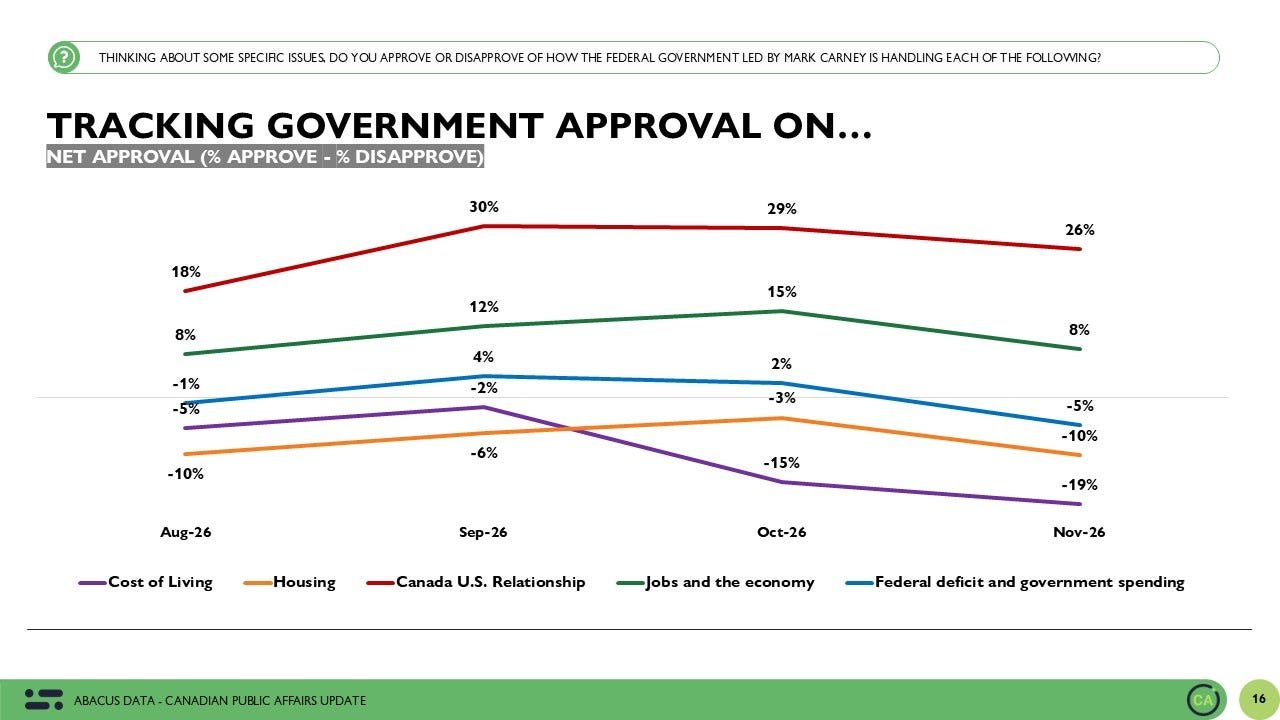
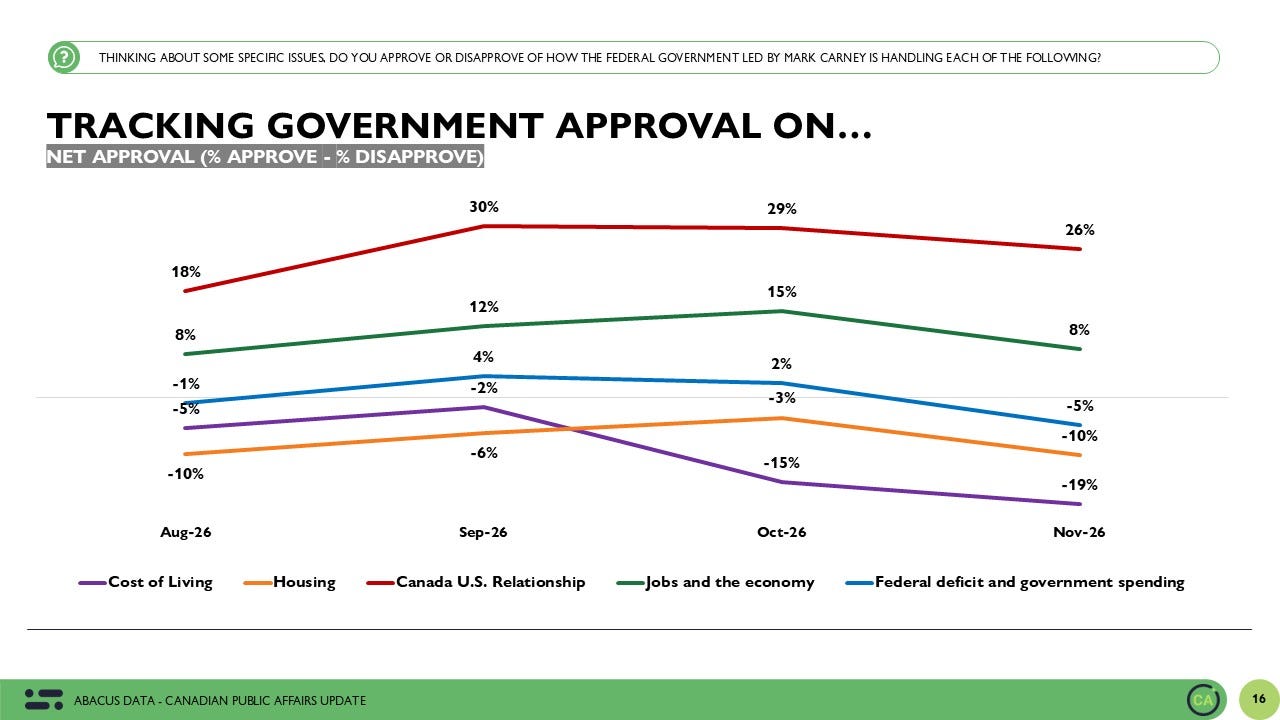
Only 29% of Canadians approve of how the federal government is handling the cost of living and inflation.
That’s down from 38% in September.
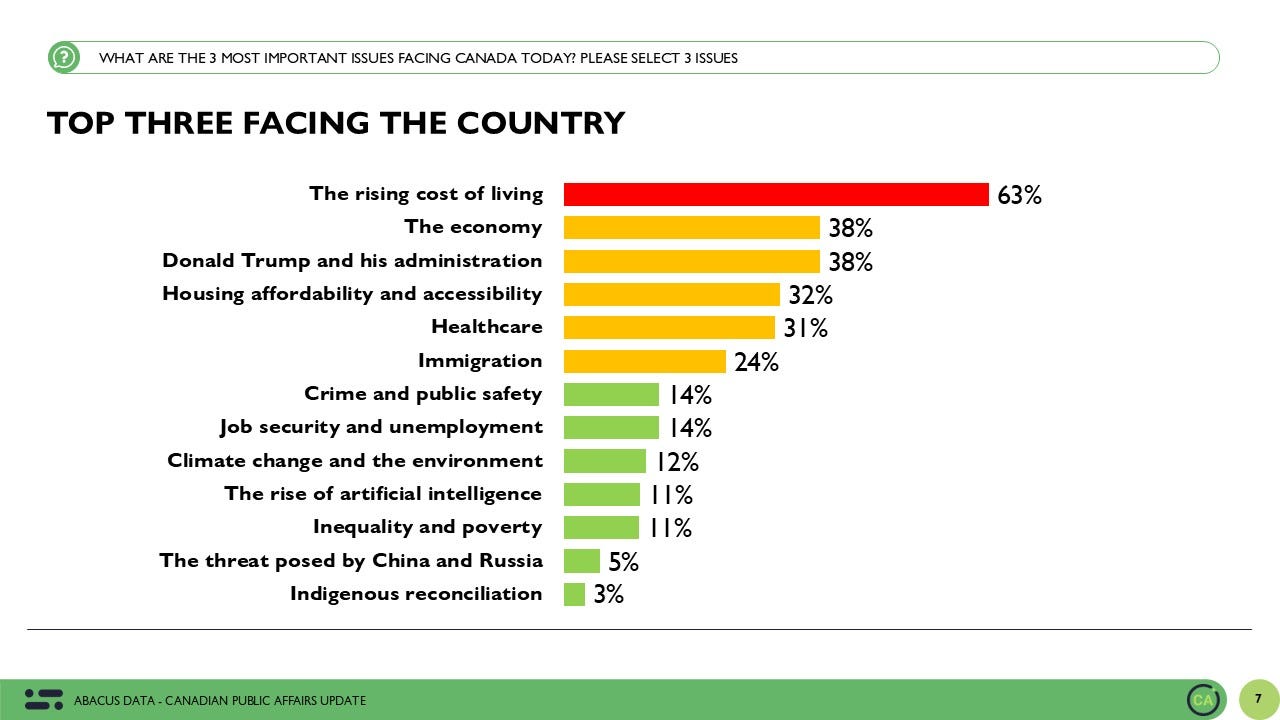
Meanwhile, 63% identify the rising cost of living as one of the three most important issues facing Canada.
Almost six in ten Canadians approve of the government overall. But fewer than three in ten approve of how it is handling the issue that almost two thirds identify as one of the country’s most important challenges.
How do we explain that?
We ran a regression model examining the relationship between Canadians’ assessments of the government’s performance on ten specific issues and their overall approval of the government.
By far the strongest independent predictor of overall government approval is how Canadians assess its handling of Canada-U.S. relations.
Approving of the government’s performance on that file multiplies the odds of approving overall by approximately 5.6, even after accounting for its performance on the other nine issues.
National defence and security is next, followed by jobs and economic growth.
And then something interesting happens.
Cost of living, housing affordability, crime, and climate change are not statistically significant independent predictors of overall approval in this model.
This is particularly notable because our August modelling identified cost of living as a significant predictor. In November, that independent relationship is no longer statistically significant.
I don’t interpret this as evidence that Canadians have stopped caring about affordability. Instead, I think it suggests that Canadians are making a distinction between their assessment of the government’s performance on specific domestic issues and their broader judgment about its leadership.
The model doesn’t establish what causes approval. People who already support the government may also be inclined to rate its performance more positively.
But it does tell us which issue assessments are most closely associated with overall approval after accounting for the others. And right now, the Canada-U.S. relationship stands apart.
Watch my video briefing below
What strikes me is how closely these results align with the political environment in which Carney became Prime Minister.
His leadership has been closely associated with managing the American relationship, protecting Canadian sovereignty, and navigating economic uncertainty.
Those remain the areas most strongly associated with his government’s overall standing. And that helps explain why the government can retain relatively high approval despite weaker assessments of affordability.
But there’s a potential vulnerability here.
The government’s overall approval is closely connected to an issue where events and decisions south of the border can significantly shape the public agenda.
Meanwhile, dissatisfaction with the cost of living is widespread, and approval of the government’s handling of that issue continues to decline.
For now, affordability is not independently associated with overall approval once other issue assessments are considered.
But that relationship could change.
If Canadians increasingly evaluate the government based on whether their own financial circumstances are improving, its weaker affordability ratings could become more politically consequential.
That’s not a prediction but I think it’s a risk worth watching if you’re the Carney Liberals and an opportunity if you’re the opposition parties.
The big takeaway from this survey is that while the Carney government remains popular, it’s not as popular as it was a few weeks ago. Inflation is rising, interest rates are rising, and maybe, post mid-terms, the Trump threat subsides. That could change a lot in how the Carney government is evaluated.