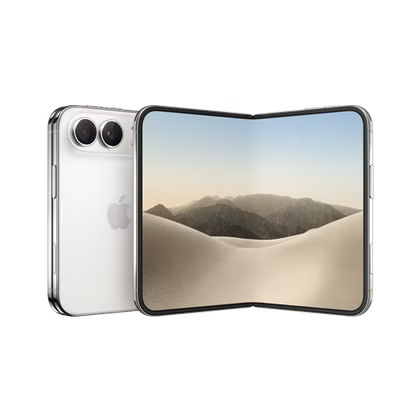
Love it or hate it, the iPhone Duo is the buzziest new smartphone release in a while, especially for Apple, which has stuck with the tried-and-true slab phone designs for longer than its competitors.
I’m definitely in the former camp, but it comes after some experience with another passport-style foldable, Samsung’s Galaxy Z Fold 8. Honestly, the differences between the two devices are minimal. The Galaxy is lighter and thinner, but it’s an iteration on previous models. Apple gets most everything right on its first-generation folding phone, and while there are some compromises you’ll have to endure and learn to work with, it’s a pretty robust offering.
Apple’s always been good at integrating its hardware and software, and that’s no different on the iPhone Duo. There’s a level of polish and what feels like considered design that I just don’t feel on the Galaxy.
Add to that the fun in having the phone that everyone is talking about (my coffee baristas and bartenders have been so excited to see the Duo), and it adds up to a new iPhone I can’t help but love.


9/10
- Brand
-
Apple
- SoC
-
A20 Pro chip
- Display
-
7.6-inch inner display; 5.4-inch outer display
- RAM
-
11.3GB (Geekbench 7)
The iPhone Duo is Apple’s first foldable with a wide aspect ratio and a 7.6-inch main screen. It’s powered by an Apple A20 Pro chip and offers up to 31 hours of battery life. You can get it in 256GB, 512GB, 1TB, or 2TB configurations, starting at $1,999.
- Versatile foldable form factor
- Software is thoughtfully designed
- Same chip as iPhone 18 Pro; outperforms previous generations
- Large, gorgeous inner glare-reducing inner screen
- Solid battery performance; fast charging
- IP68 water and dust resistance
- Rear-camera selfies via outer screen
- Lacks telephoto lens
- Inner camera is not great
- Apps haven’t all caught up with the form factor
- No Face ID
- Expensive; starts at $1,999
- Heavy at 254 grams
- Outer selfie camera only 12MP
iPhone Duo pricing and availability
The iPhone Duo went on sale in Apple Store locations worldwide October 23, 2026, and comes in two colors: Night Sky and Star White. Pricing starts at $1,999 for 256GB, with the 512GB model running $2,199, the 1TB model $2,599, and the 2TB model $3,199. You can buy it directly from the Apple Store or through AT&T, T-Mobile, and Verizon, and Apple’s carrier deals offer up to $1,200 in credit with an eligible trade-in.
- Brand
-
Apple
- SoC
-
A20 Pro chip
- Display
-
7.6-inch inner display; 5.4-inch outer display
- RAM
-
11.3GB (Geekbench 7)
- Storage
-
256GB, 512GB, 1TB, or 2TB
- Battery
-
Up to 31 hours
- Ports
-
USB-C (USB 3, up to 10Gb/s; DisplayPort output)
- Operating System
-
iOS 27
- Camera (Rear, Front)
-
Rear: 48MP Fusion Main, 48MP Fusion Ultra Wide; Front: 12MP Center Stage (outer), under-display FaceTime camera (inner)
- Front camera
-
12MP Center Stage, f/2.2 (outer display); under-display FaceTime camera, f/1.8, 1080p video (inner display)
- Rear camera
-
48MP Fusion Main (26mm, f/1.6, sensor-shift OIS); 48MP Fusion Ultra Wide (13mm, f/2.2, 120° field of view)
- Connectivity
-
5G (sub-6GHz and mmWave), Wi-Fi 7, Bluetooth 6, Thread, NFC, second-gen Ultra Wideband
- Others
-
IP68 (6 meters, 30 minutes); Camera Control; Apple Pencil (USB-C) support; Emergency SOS, Messages, and Find My via satellite; Crash Detection
- Dimensions
-
Open: 117.8 x 164.6 x 5.2mm; Closed: 117.8 x 84.1 x 11.3mm
- Colors
-
Star White, Night Sky
- Camera
-
48MP Dual Fusion camera system
- Display type
-
Super Retina XDR OLED, ProMotion up to 120Hz, Always-On
- Weight
-
254g (8.96 oz)
- Charge speed
-
Up to 50% in about 20 minutes (60W-capable adapter); 25W MagSafe and Qi2
- Telephoto
-
None (12MP optical-quality 2x from Fusion Main, 52mm)
- Processor
-
6-core CPU (2 super cores, 4 efficiency cores), 7-core GPU with Neural Accelerators, Dual 16-core Neural Engine
- Display dimensions
-
7.6-inch inner, 5.4-inch outer
- Display resolution
-
Inner: 1878 x 2670 (430 ppi); Outer: 1398 x 2034 (460 ppi)
- Charge options
-
USB-C wired, MagSafe, Qi2
- SIM support
-
Dual eSIM (no physical SIM)
- Cellular connectivity
-
Apple C2 modem; 5G (sub-6GHz and mmWave) with 4×4 MIMO; Gigabit LTE
- Wi-Fi connectivity
-
Wi-Fi 7 (802.11be), 2×2 MIMO, Apple N1 chip
- Bluetooth
-
Bluetooth 6
- Cover screen
-
5.4-inch Super Retina XDR OLED, 1398 x 2034, 120Hz ProMotion, 3,000 nits peak (outdoor)
- Main screen
-
7.6-inch Super Retina XDR OLED folding display, 1878 x 2670, 120Hz ProMotion, nano-texture, 3,000 nits peak (outdoor)
- Telephoto Camera
-
none
- Authentication
-
Touch ID (side button)
- Charging performance
-
Up to 50% in about 20 minutes wired; up to 50% in about 30 minutes via MagSafe (35W+ adapter)
- Macro Camera
-
48MP macro photography (no dedicated macro lens)
- Audio
-
Stereo speakers; Spatial Audio playback; Dolby Atmos; Spatial Audio and stereo recording
- Periscope Telephoto
-
none
What you’re actually paying for
A new form factor
I hear people all the time complaining about the $1,999 cost of the iPhone Duo. The Z Fold 8, Samsung’s brother from another mother, starts at $1,899.99 for 256GB. That’s only $100 less. Foldables are relatively new, and the passport size is even newer. Heck, the Google Pixel 11 Pro Fold comes in at $1,899, as does Motorola’s Razr Fold. There is no Apple tax here; a foldable is going to set you back.
What you get, though, with Apple’s take on the format, is a thoughtfully designed software and hardware experience that helps define the foldable style phone. You get iOS 27, which adds new icons and introduces new experiences that just feel like they’re made the way they’re supposed to be. I never had that feeling with the Z Fold 8, even though it’s lighter and thinner.
From the blurring animation on the Duo that excited everyone (so much so that I tried to replicate it on my Samsung, to varying results) to the easy multitasking, Apple’s first foldable phone makes sense to my brain in a way the Android handset did not.
Sure, not everything is perfect. Apple’s apps are all set for the larger inner screen; not all third-party apps are. Facebook updated within a day of my owning the Duo, while apps like Discord and Geekbench still act like they’re on a slab phone.
Design, build, and durability
Yeah, I got a case for it

The iPhone Duo is a marvel of engineering, though it’s similar enough to the Galaxy Z Fold 8 that I wasn’t initially impressed. It’s thicker and heavier, too, which bugged me at first. Over time, though, the rounded corners and shiny edges won me over. It’s got a Titanium frame and hinge cover, and weighs in at about 254g. It feels heavy in the hand when closed, but it’s not a big deal when opened and held in both hands.
I use a PopSocket low-profile MagSafe grip, and it’s a finger saver when reading off the phone for any length of time. That’s when the weight factor comes in, as holding it open one-handed can get awkwardly heavy after a little while. I tend to switch to the iPad Mini-style portrait orientation, and hold it that way when using the expansive inner display.
Folding and unfolding feels pretty premium, and I don’t really worry about it breaking or getting floppy at any point. The crease is less noticeable on the iPhone Duo than on my Z Fold 8, mostly due to the lovely matte screen finish. It also makes it nicer to use in bright light. The outer screen is shorter than a typical slab iPhone, but I find I like it a lot. Using a smaller phone works out well for me when I’m on the go, and I have a huge display when I’m sitting still. It’s win/win.
I’ve been using Apple’s $79 iPhone Duo Case in Sand, a two-piece shell that clips onto each half of the phone. The soft, grippy finish makes the 254-gram Duo easier to hold, and the shell underneath feels solid. Snap on the orange PopSocket, and the whole thing looks like retro-futuristic gear straight out of Mirror’s Edge. It even charges wirelessly with the grip attached.
Sure, I could use the Duo without a case, but even I don’t want to tempt fate that much. That said, I’m really liking the way it looks with the case on.
And then there’s the cameras
This isn’t the phone for photographers

I get it, the Duo doesn’t have the camera tech that the iPhone 18 Pro does. If you rely on telephoto or higher megapixels, the Duo isn’t going to work for you. However, for most images I’m going to take, the Duo does just fine.
The main and ultra-wide cameras are close enough on paper (the Duo’s main sensor lacks the variable aperture and has slightly narrower framing). The real losses are zoom (4x optical-quality range vs. 16x), the selfie camera (12MP vs. 18MP), and the pro features: the Duo has no RAW, ProRes, Log, or manual controls. In exchange, the Duo gets the outer-screen tricks no other iPhone can do.
The inner camera doesn’t just drop to 4MP, either. It also skips Portrait mode, Night mode, and Apple’s usual photo processing, so it really is a FaceTime camera, just as Apple’s name for it suggests.
Apple doesn’t list a resolution for the inner camera, but the Photos app does: 4MP, or 2432 x 1824 pixels. That’s a third of the outer camera’s 12MP, and it shows.
|
Camera feature |
iPhone Duo |
iPhone 18 Pro / Pro Max |
|---|---|---|
|
System |
48MP Dual Fusion |
48MP Pro Fusion |
|
Main camera |
48MP Fusion Main, 26mm, f/1.6, sensor-shift OIS |
48MP Fusion Main, 24mm, variable aperture (f/1.48, f/1.8, f/2.8, f/4.0), second-gen sensor-shift OIS |
|
2x crop |
12MP, 52mm |
12MP, 48mm |
|
Ultra-wide |
48MP, 13mm, f/2.2, 120° |
48MP, 13mm, f/2.2, 120° |
|
Telephoto |
None |
48MP Fusion Telephoto, 100mm (4x), f/2.8, tetraprism; 12MP 8x crop at 200mm |
|
Optical-quality zoom range |
4x (0.5x to 2x) |
16x (0.5x to 8x) |
|
Digital zoom (photo) |
Up to 10x |
Up to 40x |
|
Digital zoom (video) |
Up to 6x |
Up to 24x |
|
Front camera |
12MP Center Stage, f/2.2 (outer); under-display FaceTime camera, f/1.8, 1080p video (inner) |
18MP Center Stage, f/1.9, autofocus |
|
Max video |
4K Dolby Vision at 120 fps |
4K Dolby Vision at 120 fps |
|
Cinematic mode |
Up to 4K at 60 fps |
Up to 4K at 60 fps |
|
Macro |
48MP macro photography |
48MP macro photography |
|
Photo formats |
HEIF, JPEG |
HEIF, JPEG, DNG (ProRAW) |
|
Pro controls (aperture, shutter, white balance, histogram) |
No |
Yes |
|
Pro video (ProRes, ProRes RAW, Apple Log 2, ACES, Genlock) |
No |
Yes |
|
Spatial photos and video |
No |
Yes |
|
Apple Reference Image |
No |
Yes |
|
Flash |
True Tone |
Adaptive True Tone |
|
Exclusive features |
Smart Take, Duo Preview, Kid Cue, Duo FaceTime |
None of these |
I’m not a professional photographer, so I’m not qualified to walk through the nuances of each lens and its pixel performance. Bottom line, though, the Duo has enough camera power to take the images I’m usually taking: pictures of groups, selfies, and images of various products for work. I do miss a dedicated telephoto lens, though.
What you get instead, though, is an easy way to take 48MP selfies using the main camera and the outer screen as a viewfinder. You also get the Duo Preview, Kid Cue (Snoopy as kiddo attention getter), and Duo FaceTime, which no other iPhone has.
If you mostly shoot people, kids, and everyday scenes at normal distances, you’ll barely notice the lack of zoom, pro tools, and a good inner selfie camera. If you shoot your subjects from far away or edit RAW files, the 18 Pro Max is the better camera.
iPhone Duo Performance
Benchmarks show a surprisingly capable phone
I’m upgrading from an iPhone 15 Pro Max, so the Duo is a heck of an upgrade in terms of performance. Everything moves quicker, opens faster, and just works better.
Still, I wanted to check the specs based on two benchmarks we use here quite a bit: Geekbench 7 for CPU and GPU performance, and 3DMark for gaming performance.
|
Benchmark |
iPhone Duo |
iPhone 18 Pro Max |
iPhone 15 Pro Max |
Galaxy Z Fold 8 |
|---|---|---|---|---|
|
Geekbench 7 |
My testing |
Primate Labs avg. |
Primate Labs avg. |
My testing |
|
CPU single-core |
3,981 |
3,992 |
2,521 |
3,105 |
|
CPU multi-core |
10,632 |
11,250 |
6,851 |
10,542 |
|
GPU |
60,913 (Metal) |
61,668 (Metal) |
22,860 (Metal) |
17,581 (OpenCL) |
|
3DMark Wild Life Extreme |
||||
|
Overall score |
7,448 |
n/a |
3,019 |
7,215 |
|
Average FPS |
44.6 |
n/a |
18.1 |
43.21 |
|
Stress test best loop |
7,861 |
n/a |
n/a |
7,155 |
|
Stress test lowest loop |
3,522 |
n/a |
n/a |
3,500 |
|
Stability |
44.8% |
n/a |
n/a |
48.9% |
The iPhone Duo’s A20 Pro performs like the flagship chip it is. In Geekbench 7, it lands within about 1% of the iPhone 18 Pro Max’s average single-core and GPU scores, and it more than doubles the iPhone 15 Pro Max’s graphics performance. It also beats the Galaxy Z Fold 8 by about 28% in single-core performance, though the two foldables are nearly tied in multi-core and in actual gaming, where the Duo leads 3DMark Wild Life Extreme by just 3%. The catch is heat: in 3DMark’s 20-loop stress test, the Duo lost more than half its peak performance, and so did the Fold 8. For everyday use and shorter gaming sessions, the Duo has power to spare, but long, demanding sessions will run noticeably slower than the first few minutes.
Battery life and charging
A dual battery that works harder when unfolded

Apple doesn’t list a capacity for the iPhone Duo’s dual batteries, but it rates them for up to 24 hours of typical use. How you hold it matters, though: Apple rates video playback at up to 44 hours on the outer display but just 31 hours on the bigger inner screen, so a day spent mostly unfolded will drain the battery faster.
Charging is quick, though: Apple says the Duo reaches 50% in about 20 minutes with a 60W-capable adapter, or about 30 minutes on a MagSafe charger with a 35W or higher adapter.
In my own daily use, the battery tops up fast, going from 61% to 87% in 30 mins. I end each day with plenty of room on the battery, too. I don’t usually use wireless charging, except in the car, but if that’s something you enjoy, the Duo gives you MagSafe and Qi2 wireless charging up to 25W.
Should you actually buy the iPhone Duo?
Honestly, the iPhone Duo is a fantastic phone all on its own. The hardware and software are new for Apple, but they work surprisingly well for a first-gen foldable. The specs and price are comparable to competitors like the Galaxy Z Fold 8 and Pixel Pro Fold, making it a no-brainer if you’re interested in a passport-sized, iOS-powered folding handset.
I bought this Duo because I loved the format on the Galaxy phone, but I’m much happier in the iOS world; all my things are there, and I believe it’s just a better user experience overall.
Sure, I’d love a better camera array, but the rest of the phone is top-notch. I don’t feel like I’m missing anything.
9/10
- Brand
-
Apple
- SoC
-
A20 Pro chip
- Display
-
7.6-inch inner display; 5.4-inch outer display
- RAM
-
11.3GB (Geekbench 7)
The iPhone Duo is Apple’s first foldable with a wide aspect ratio and a 7.6-inch main screen. It’s powered by an Apple A20 Pro chip and offers up to 31 hours of battery life. You can get it in 256GB, 512GB, 1TB, or 2TB configurations, starting at $1,999.