Prime Minister Mark Carney promised a government that would “spend less to invest more.” Budget 2026, tabled Thursday, does neither.
Program spending is set to rise $44.2 billion this fiscal year, from $498.5 billion in 2025-26 to $542.7 billion in 2026-27—an 8.9 percent jump. The biggest driver is not old age benefits or health transfers. It’s what Finance Canada calls direct program expenses: departmental operations, Crown corporations, defence and the grants Ottawa hands out itself. That category climbs 10.7 percent, to $272.4 billion, with departmental operating and other spending alone up $19 billion, or 14.5 percent.
The bill for all of it is always coming due. Public debt charges rise from $53.5 billion last year to $85.5 billion by 2030–31, a 60 percent increase. Starting this year, Ottawa will spend more servicing its debt than it sends the provinces through the Canada Health Transfer, and by 2030–31 the gap reaches nearly $18 billion.
Whatever this budget is, it cannot be credibly called austerity.
What a difference a year makes
The clearest test of the federal government’s restraint is to compare this budget with Carney’s first one. A year ago, Budget 2025’s fiscal plan projected program spending of $528.4 billion for 2026-27—growth of just 0.6 percent. Budget 2026 now puts that figure at $542.7 billion, $14.3 billion higher.
The gap widens in every year that follows in the latest budget compared to the previous year. Next fiscal year, it jumps to $21.4 billion more in 2027–28, then $18.6 billion more in 2028–29, and $18 billion more in 2029–30. Across the four years both plans cover, Ottawa now expects to spend $72.3 billion more on programs than it told Canadians a year ago.
That’s after the government trimmed its own forecast. Budget 2026 lowers projected direct program spending by about $12.4 billion a year, an “aggregate forecasting adjustment” that the document says is “not attributed to particular departments, programs, or policy decisions.” In other words, it assumes money will go unspent, not that anything will necessarily be cut.

Look past the red ink
Sean Speer, The Hub‘s co-founder and editor-at-large, argued in a special budget-night Hub podcast conversation that the year-over-year jump is “frankly higher than we saw from the Trudeau government,” excluding the pandemic.
But Speer cautioned against fixating only on the deficit. Deficits and debt, he pointed out, are “a function of the demands on government itself [relative to] what Canadians are collectively prepared to pay.”
“The more important question is, what is this 9 percent growth in spending buying us?” Speer said. “What are we getting for an incremental $44 billion?”
The watchdog’s warnings
Parliamentary Budget Officer Annette Ryan’s office has been flagging this pattern for months. In its October economic and fiscal outlook, released two weeks before the budget, the PBO found that fiscal room had improved by $37.4 billion since June. New spending measures, it estimated, would cost $52.6 billion over five years, “more than offsetting the revenue improvement,” and concluded the fiscal anchors “have imposed limited fiscal discipline on government spending and borrowing.”
The PBO has also questioned whether Ottawa’s own numbers hold up. Its assessment of departmental spending in the spring economic update warned that missing planning detail and “front-loaded” spending profiles raised questions about whether departments could actually deliver at the pace proposed. It also noted the update gave no figures on savings or job reductions from the Comprehensive Expenditure Review for 2026–27.
The forecasts also shift quickly. The PBO’s review of the Main Estimates noted that weeks after those estimates were tabled, the spring update raised the 2026–27 forecast for elderly benefits by $6.2 billion, or 7.5 percent. The $26.7 billion underspend in 2025–26 suggests the PBO’s capacity warning was well founded.

Deficits stuck, debt and interest both climbing
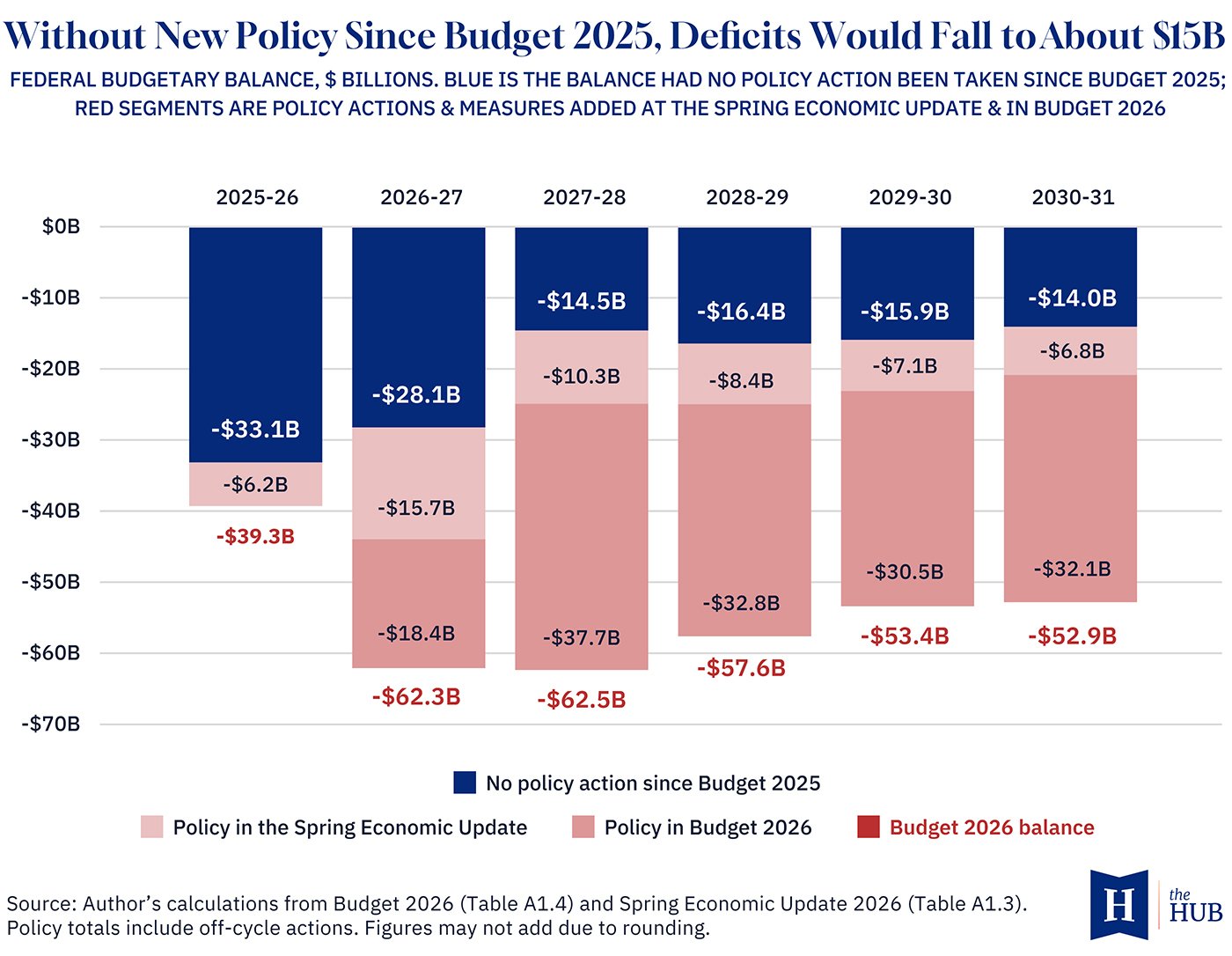
Despite the extra spending, the headline deficit looks familiar. Budget 2026 projects a $62.3 billion shortfall this year, edging down to $52.9 billion by 2030–31. Those are almost exactly the deficits Budget 2025 forecast for the same years—$3.1 billion smaller in 2026–27 and just $0.3 billion smaller in 2028–29.
The deficit also understates how much Ottawa will borrow. The PBO projects federal borrowing will rise $732.9 billion over five years, more than double the $333.3 billion in cumulative deficits, as Ottawa lends to Crown corporations and finances capital and defence purchases that sit off the bottom line.
“We are seeing a pretty significant kind of off-the-books increase in the national debt,” Speer said, pointing to the Canada Strong Fund, Build Canada Homes, and numerous other arm’s-length vehicles.
Net debt rises from $1.45 trillion last year to $1.92 trillion by 2030–31. Public debt charges climb from $53.5 billion to $85.5 billion over the same period, eating almost 14 cents of every revenue dollar, up from about 10 cents. That’s $2.3 billion more in 2029–30 than Budget 2025 projected, and above the PBO’s own estimate of roughly $83 billion for 2030–31.
Trimming the public service, not resizing it
The government’s best evidence of any semblance of restraint is the public service. Budget 2026 says headcount has fallen nearly 10 percent from its 2023–24 peak of about 368,000 to about 332,000 as of August.
That’s a real reduction. It’s also dwarfed from what came before. According to Treasury Board figures, the public service numbered 257,034 in 2015 and grew to 367,772 by 2024, an increase of roughly 110,000 people, or 43 percent. The cuts so far have reversed about a third of that growth, leaving the public service roughly 75,000 employees, or 29 percent, larger than in 2015.
The savings are modest, too. Aligning departmental budgets with early retirement departures will save $400 million over four years. Lower Canada Pension Plan contributions will save $305 million over five. Both are rounding errors that don’t put a dent in the $44 billion one-year increase.
In fact, the budget’s chapter titled “A more efficient government” adds to the deficit. Its measures carry a net cost of $3.1 billion over five years.
An oil windfall, spent
Ottawa had money to bank. Oil near $100 a barrel has lifted federal revenues well above previous projections.
As economist Charles Lammam wrote in The Hub, the government now expects $158 billion more over five years than it did in the spring, and spends $152 billion of it on new measures—96 cents of every extra dollar, and that’s only if that added revenue indeed comes in. Had Ottawa banked the improvement, Lammam calculated, five-year deficits would total about $137 billion instead of $289 billion.
The comparison with Budget 2025 tells the same story. Between 2026–27 and 2029–30, revenues are now projected to be $85.7 billion higher than last year’s plan. Program spending and debt charges together are $78.3 billion higher. The deficit improves by just $7.6 billion.
Economist Trevor Tombe warned in The Hub on budget day that the windfall may be short-lived, with futures markets pricing oil about $20 a barrel cheaper a year from now. A temporary revenue boon is being used to fund what could turn out to be permanent increased spending.
Care out, cohere in
The Carney government’s spending is aimed differently than its predecessor’s, with more for defence, electricity grids and industrial policy, and less for what Trudeau called the care economy. But the trajectory in increased government spending is still the same.
“You might say Trudeau was focused on spending on care and Carney is focused on spending on Cohere,” Speer quipped. “But fundamentally where they are aligned is that spending ought to grow.”
Speer, who previously worked as senior economic adviser for prime minister Stephen Harper, warned that the window for a prime minister to spend political capital doesn’t stay open.
“Those opportunities, as they start to close, a prime minister and a government lose them fast,” he said.
Budget 2026 was Carney’s chance to show what restraint looks like, especially with a large windfall in revenue.
Instead, it shows what a $44 billion increase in extra spending looks like that will be all the more difficult to curtail when surging oil prices begin to recede.

Graeme Gordon is The Hub’s Senior Editor and Podcast Producer. He has worked as a journalist contributing to a variety of publications, including CBC,…
Prime Minister Mark Carney’s 2026 budget reveals a significant increase in government spending, rising by $44.2 billion to $542.7 billion, contradicting his promise to ‘spend less to invest more.’ The budget’s largest expense is attributed to direct program expenses, which are projected to grow by 10.7%. Public debt charges are expected to rise dramatically, outpacing health transfers to provinces. Despite the increase in spending, the projected deficit remains similar to previous forecasts. Critics argue that the budget lacks fiscal discipline and raises concerns about long-term sustainability amid rising debt and interest costs.