Key highlights
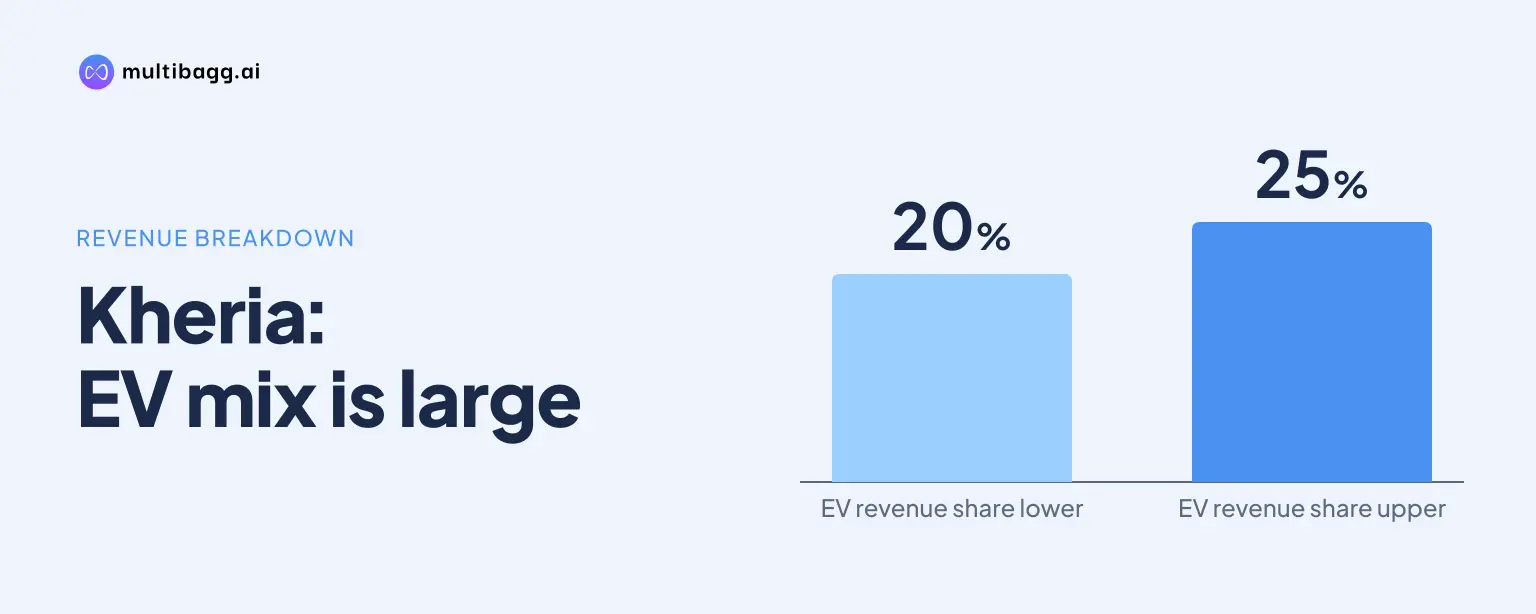
- Kheria Autocomp said EV-car components account for about 20% to 25% of revenue.
- Kheria Autocomp said EV and ICE programme participation follows OEM model decisions.
- Sanand Plant II is planned to add 2,400 metric tonnes of capacity from January 2027.
- Kheria Autocomp said Rs 65 crore of Plant II capital expenditure is planned entirely in FY27.
powered by IRIS
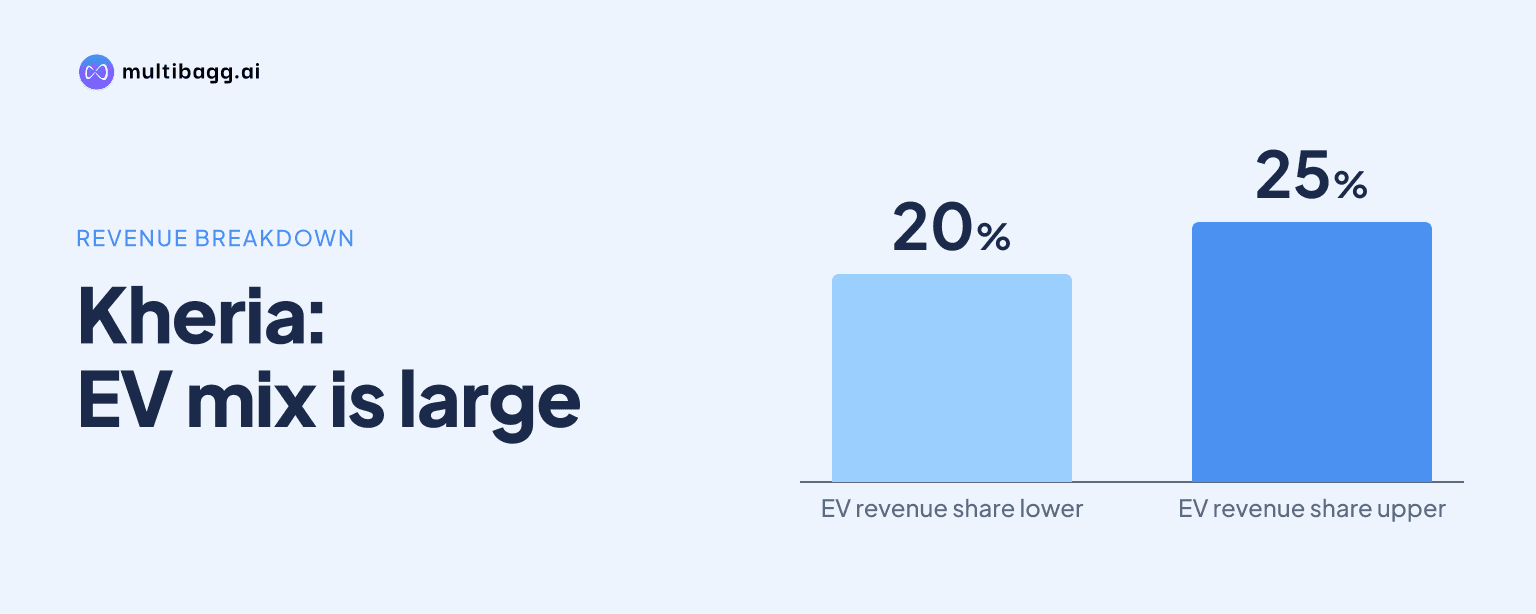
Kheria Autocomp Limited said EV-car components account for about 20% to 25% of revenue, providing its first quantified EV exposure disclosure. Kheria Autocomp said the future mix of electric vehicle and internal-combustion-engine programmes will be determined by original equipment manufacturers, or OEMs, rather than by an independent company choice.
Know Kheria Autocomp inside out
Results, valuation, peers and who’s buying, in one view.
What share of Kheria Autocomp revenue comes from EV components?
Kheria Autocomp said EV-car components contribute approximately 20% to 25% of revenue. Management gave the range in response to an investor asking both for the EV-component revenue mix and whether it had increased from the previous year. The company did not provide an absolute rupee value for EV sales, a reporting-period label for the range, or a separate volume measure.
The disclosure establishes that EV programmes form a measurable part of Kheria Autocomp’s business, but it does not demonstrate a year-on-year increase. Management did not state the prior-year EV revenue percentage, so the current 20% to 25% range cannot be compared with an earlier disclosed base. The five-percentage-point range also means the call does not support a more precise EV contribution figure.
Kheria Autocomp described all of its products as plastic-related components in a discussion on raw-material pricing. During another exchange, the company referred to dashboard components and subcomponents, but did not identify which products are included in the 20% to 25% EV range. It also did not disclose EV-specific margins, customer names, or the number of EV vehicle models it supplies.
Does Kheria Autocomp choose between EV and ICE programmes?
Kheria Autocomp said it follows the vehicle models its OEM customers decide to manufacture, whether those models are EVs or internal-combustion-engine, or ICE, cars. Management said it cannot independently decide to serve only EV or only ICE programmes: if an OEM produces an EV, Kheria Autocomp will go with that EV model, and if it produces an ICE car, it will supply that programme.
This customer-led mechanism means the 20% to 25% EV revenue share is not accompanied by a company target to move a specified proportion of sales from ICE to EV. Management did not give an EV-revenue target for FY27, FY28 or FY29. It also did not forecast whether the current 20% to 25% range would rise, fall or remain unchanged as customer model portfolios develop.
The company said it had begun making parts for two cars introduced during calendar year 2026 by two major OEMs in Gujarat. However, it did not say whether either of the two new cars was an EV or ICE model. Management said it could not name the cars or customers because the relevant disclosure agreements had not been signed.
How much capacity is Kheria Autocomp adding at Plant II?
Kheria Autocomp said Sanand Plant II will add 2,400 metric tonnes of production capacity, compared with 5,400 metric tonnes at its current facility. Management described the current plant as almost at its optimum level because physical space becomes a bottleneck after a certain level of utilisation. It said output might increase somewhat through product-mix changes, but not through adding machines at the existing site.
Kheria Autocomp said it had received the first set of establishment-related approvals and the first set of factory licences for Plant II. Four machines were targeted for delivery in November and another seven machines were expected in December. Management said the project was on track for a January 2027 production start, while also characterising that timing as a hoped-for outcome rather than an unconditional commitment.
The expansion is not identified as an EV-only project. Management said the new facility will have higher-tonnage machines than the existing plants, enabling the manufacture of heavier parts. Yet it did not allocate the 2,400 metric tonnes between EV and ICE programmes, identify any EV-specific orders for the facility, or say that heavier parts would produce a higher profit after tax margin than current parts.
Got a follow-up? Ask IRIS
What utilisation and funding plans has Kheria Autocomp disclosed?
Kheria Autocomp said it hoped to use 20% to 30% of Plant II capacity in the initial period after production begins. In the following year, management said utilisation should be above 90%. In a separate response, it said it hoped to use more than 90% of the installed capacity in FY27-28, while noting that the first three months were not being considered a full year.
The differing utilisation comments describe a rapid ramp after the planned January 2027 start, but they do not provide a quarterly production schedule. Management also said it expected capacity to be utilised in 2028 and hoped to increase capacity in 2029. It did not quantify the potential 2029 addition, saying any such development would be disclosed on the National Stock Exchange site when undertaken.
Kheria Autocomp said Plant II capital expenditure was proposed at Rs 65 crore and that 100% of the spending was planned in FY27, with nothing held for FY28. In a follow-up exchange, management agreed with an analyst’s reference to roughly Rs 35 crore to Rs 40 crore. The call did not reconcile that indicative amount with the Rs 65 crore proposal or provide a machine-wise spending schedule.
For a later capacity expansion, Kheria Autocomp said it was not planning to raise debt and would use internal accruals. It did not state whether that financing position applied to every element of Plant II, nor did it disclose an EV-specific capital expenditure amount. Management said orders for Plant II were sufficient, but did not disclose the order-book value, tenure or vehicle-programme split.
How does Kheria Autocomp manage materials and product mix?
Kheria Autocomp said raw-material prices are passed on to customers under its contracts, limiting the direct effect of crude-price changes on its plastic-related products. Management made that statement when asked how crude-price movements could affect margins. The call did not disclose the timing of price pass-throughs, the contract duration, or whether all customers operate under identical clauses.
Management said it regularly adds parts and changes its product mix in an effort to improve profit after tax, or PAT, margin. It did not identify a numerical PAT-margin target for FY27 or link any expected improvement specifically to EV components, higher-tonnage machines or the two vehicle models added in calendar year 2026. When asked about heavier parts, management said their margin would be similar rather than above the current level.
Kheria Autocomp also said the audited second half had been better than the first half in each of the last two years. Management did not offer an exact margin forecast for the next second half, although it said it hoped for a good second half. That historical comparison concerns overall operating performance and does not establish a separate margin trend for either EV or ICE components.
Conclusion
Kheria Autocomp has disclosed that EV-car components account for about 20% to 25% of revenue, but it has not presented EV as a separately targeted sales strategy. Its EV and ICE exposure follows OEM production decisions, while the two additional car programmes in calendar year 2026 remain unclassified by powertrain. The company’s expansion is broader than EV, adding higher-tonnage capability without an announced EV-specific capacity allocation.
The next item to watch is the planned January 2027 start of Sanand Plant II, following four machine deliveries targeted for November and seven for December. Management’s disclosed milestones are initial utilisation of 20% to 30%, followed by an expectation of above-90% utilisation in the next year, alongside Rs 65 crore of proposed Plant II capital expenditure planned entirely in FY27.
Frequently Asked Questions
Kheria Autocomp said EV-car components account for about 20% to 25% of revenue. It did not disclose the corresponding EV revenue amount in rupees or the revenue contribution from individual EV products.
No. Management provided the current 20% to 25% range after being asked about a year-on-year increase, but it did not give a prior-year percentage. Therefore, the call does not establish the direction of change in EV revenue share.
No. Kheria Autocomp said it will supply EV or ICE programmes according to the vehicle models its OEM customers choose to manufacture. Management did not disclose a target to focus exclusively on EV programmes.
Kheria Autocomp did not classify the two cars launched in calendar year 2026 as EV or ICE models. It said it had started manufacturing parts for the vehicles, but confidentiality restrictions prevented further identification.
Management said it was aiming to begin production in January 2027. It said four machines were targeted for delivery in November and seven in December, and that the first set of approvals and factory licences had been received.