Key highlights
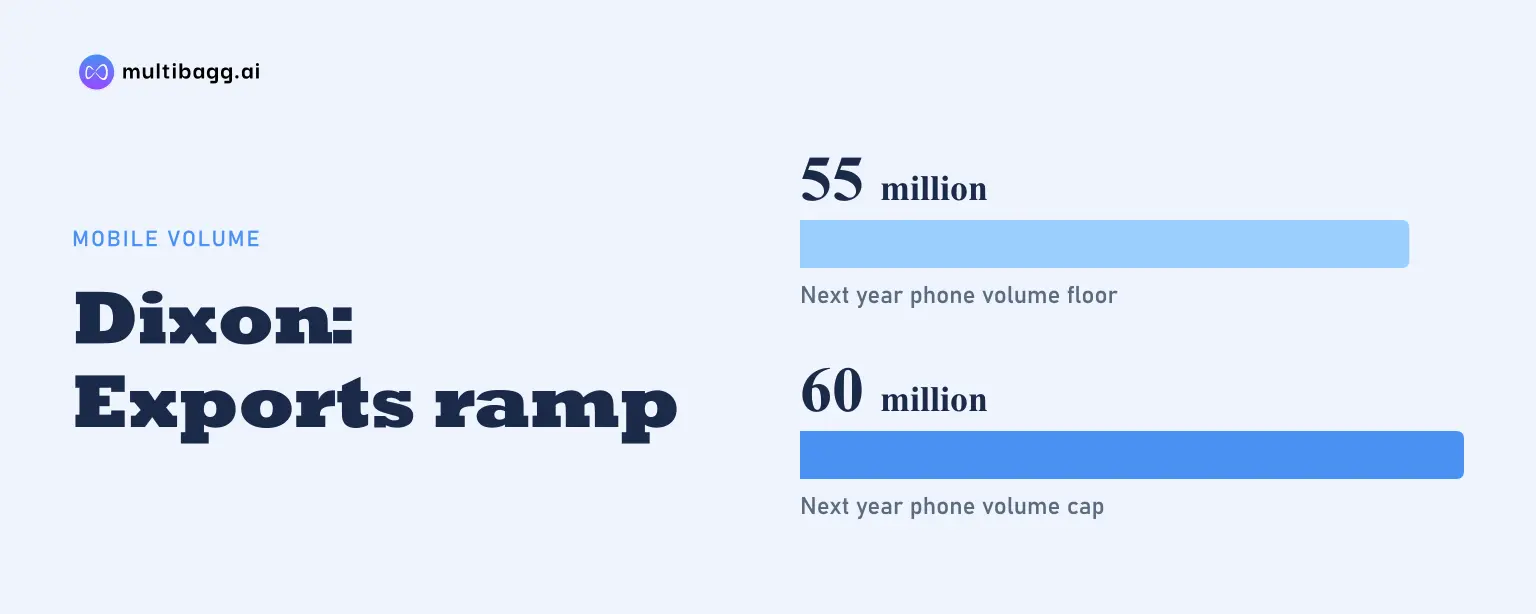
- Dixon expects 55-60 million mobile-phone units in the next financial year, including 18-20 million units from Vivo.
- Dixon expects FY27 mobile volumes of 33-34 million units excluding Vivo, after producing 17.2 million units in H1 FY27.
- Dixon targets 3.5-4 million mobile export units in FY27, with Motorola exports expected to ramp from Q4.
- A new Indian-brand customer could contribute 6-8 million mobile-phone units in the next financial year.
powered by IRIS
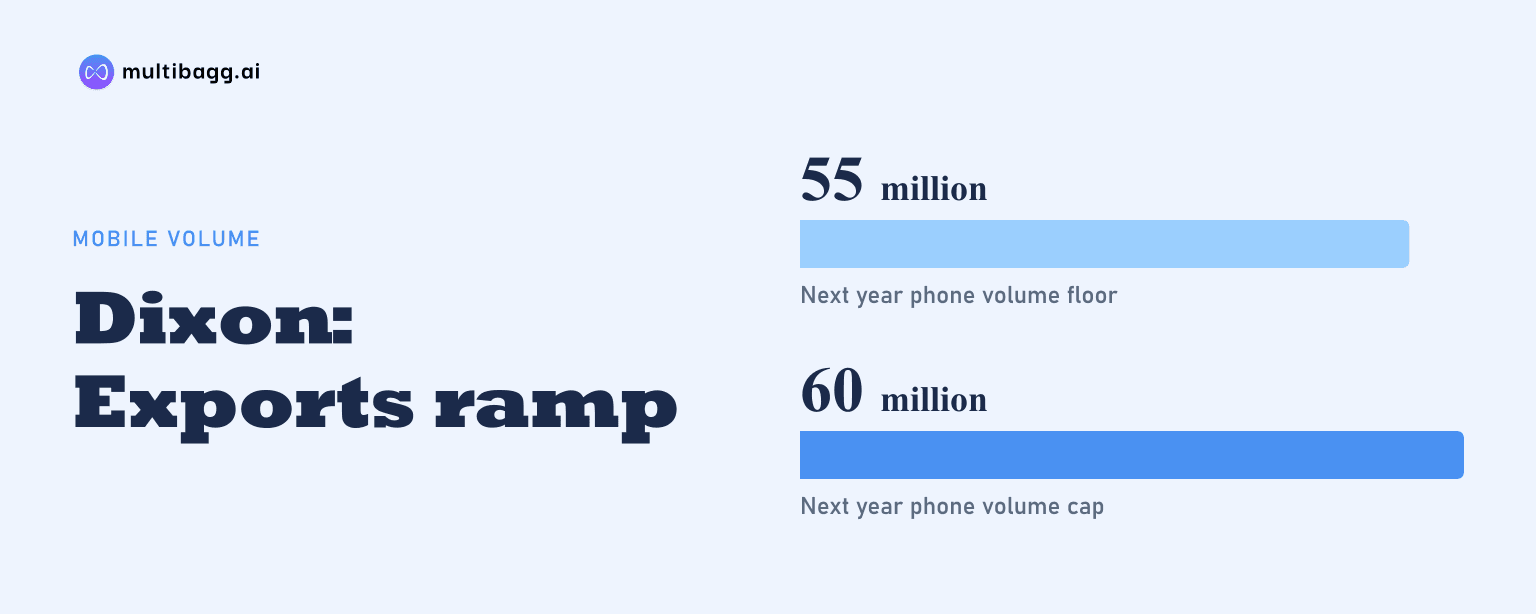
Dixon Technologies (India) Limited expects to manufacture 55-60 million mobile phones in the next financial year, compared with its FY27 outlook of 33-34 million units excluding Vivo, as Vivo could add 18-20 million units and exports and a new Indian brand scale up. Management disclosed the plan on October 30, 2026.
Know Dixon Technologies (India) inside out
Results, valuation, peers and who’s buying, in one view.
How many phones does Dixon expect to manufacture next year?
Dixon expects 55-60 million mobile-phone units in the next financial year, including Vivo volumes. Management set out the outlook during its Q2 FY27 call after reporting about 9.7 million units in Q2 and 17.2 million units in the first half ended September 2026.
The next-year range compares with management’s FY27 estimate of 33-34 million units excluding Vivo. The difference is intended to come from three identified additions: 18-20 million Vivo units, 6-8 million units from a new Indian-brand customer, and a larger export contribution. Management did not give a precise volume split between existing customers and exports within the 55-60 million-unit total.
For the second half of FY27, management expects approximately 17 million more units after the 17.2 million produced in the first half. It indicated Q3 volume of 7-7.5 million units following Diwali, with Q4 returning closer to the Q2 level. This profile places most of the proposed expansion in the next financial year rather than the remaining FY27 quarters.
Why does Dixon expect growth despite a weaker smartphone market?
Dixon expects customer additions, exports and Vivo integration to offset weaker market demand. Management cited industry reports showing that India’s smartphone market declined 26% year on year in Q2 FY27, while saying its own smartphone-manufacturing volumes remained broadly stable year on year.
The contrast means the company’s 33-34 million-unit FY27 outlook relies on its customer position rather than a stated market recovery. Management said mobile volumes were marginally lower year on year, even as mobile revenue increased because selling prices rose by about 35-40% year on year amid higher memory-component prices.
Management said higher memory prices have not interrupted production because memory supply remains available. In electronics manufacturing services, or EMS, covering mobiles, IT hardware, telecom equipment and hearables and wearables, it said input-cost changes are automatically passed through to customers, without a time lag.
The Mobile Phone Manufacturing Scheme, or MPMS, is also part of Dixon’s stated expansion mechanism. Management said anchor customers have committed to incremental sales required under the programme, with exports expected to generate much of that increase. It also identified greater localization of camera modules, display modules and mechanical parts as relevant to the programme, but did not quantify an MPMS-related margin increase.
Got a follow-up? Ask IRIS
What will Vivo contribute to Dixon’s mobile volumes?
Vivo could contribute 18-20 million units to Dixon’s next-financial-year mobile volume, according to management’s volume bridge. The integration process was under way as of October 30, 2026, and management targeted the start of production in Q4 FY27.
Management said Vivo has about a 20-22% market share and total volume of around 30 million units, of which the joint venture was expected to handle roughly 20-21 million units. The slightly lower 18-20 million range was the estimate incorporated into the company-wide next-year outlook, while commercial terms for the venture remained under finalisation.
Dixon estimated Vivo-related capital expenditure of Rs 300-350 crore. Management did not disclose expected earnings before interest, tax, depreciation and amortisation, or EBITDA, per Vivo handset, and did not confirm whether the joint venture’s profitability excluding production-linked incentives would match existing mobile operations.
The timing leaves Q4 FY27 as a starting quarter rather than a full year of Vivo production. Dixon also said construction of a 10 lakh-square-foot higher-capacity Noida facility was almost complete, with operations expected to commence in Q3 FY27. The facility and Vivo integration are therefore separate disclosed elements of the planned capacity ramp.
How much will exports and new customers add to Dixon’s volumes?
Exports and the new Indian-brand customer are expected to add material volume next year, but Dixon has given ranges rather than final commitments. For FY27, management targets 3.5-4 million export units, before the fuller next-year expansion of exports and the new customer contribution.
Motorola, which management described as its anchor customer, is expected to ramp exports from Q4 FY27 under MPMS. Management said the customer could reach about 3.5 million units a quarter, or nearly 14 million annually, with 6-7 million units, or more, intended for exports. Transsion Group feature-phone exports are scheduled to begin in the next fiscal year, followed later by smartphone exports.
The new Indian-brand customer had already begun production by the call date. Management initially said it could contribute 8-10 million units next year, then used a 6-8 million-unit estimate in its later volume bridge. The differing ranges indicate planning assumptions rather than a fixed customer order. Management also said this customer’s average selling price is 25-30% below its current mobile average selling price.
Management expects export volumes to raise capacity utilization and operating leverage. However, the call did not disclose export markets, realized export prices or the share of the 55-60 million-unit target that would be exported. The specific FY27 export target remains 3.5-4 million units, with a significant increase expected in the next financial year.
Conclusion
Dixon’s 55-60 million-unit next-year outlook is based on identified customer and export programmes rather than a forecast of a broad Indian smartphone-market rebound. Its FY27 base is 33-34 million units excluding Vivo, while Vivo, the Indian-brand customer and exports are expected to create the increase despite the 26% year-on-year market decline cited for Q2 FY27.
The next milestones are the targeted start of Vivo production and Motorola’s export ramp in Q4 FY27, followed by planned Transsion feature-phone exports in the next fiscal year. Investors will also watch whether Dixon meets its FY27 export target of 3.5-4 million units, how the Indian-brand volume develops within the disclosed 6-10 million-unit range, and when Vivo commercial terms are finalised.
Frequently Asked Questions
Dixon expects to manufacture 55-60 million mobile phones in the next financial year. Management said the range includes 18-20 million units from Vivo, alongside export growth and volume from a new Indian-brand customer.
Dixon expects FY27 mobile volumes of 33-34 million units excluding Vivo. It produced about 17.2 million units in the first half ended September 2026 and expects roughly 17 million more in the second half.
Dixon targets the start of Vivo production in Q4 FY27 as the integration process progresses. Management’s next-financial-year volume outlook assumes Vivo could contribute 18-20 million units.
Dixon targets 3.5-4 million export units in FY27. Management expects Motorola exports to ramp from Q4 FY27, while Transsion Group feature-phone exports are planned from the next fiscal year.
Management said mobile selling prices rose by about 35-40% year on year because memory prices increased. It said mobile volumes were marginally lower year on year, showing that revenue growth was influenced by higher component-related pricing.