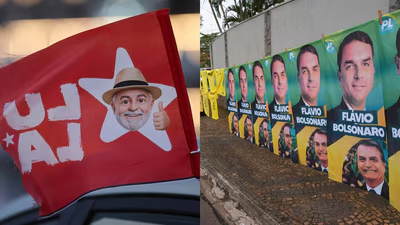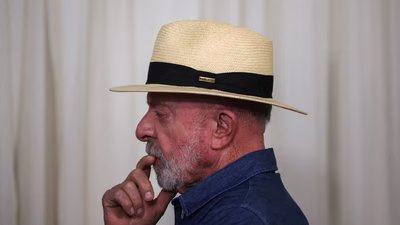
SÃO PAULO—President Luiz Inácio Lula da Silva is 80 years old, recovered from brain surgery and convinced that Brazil’s left can’t survive without him.
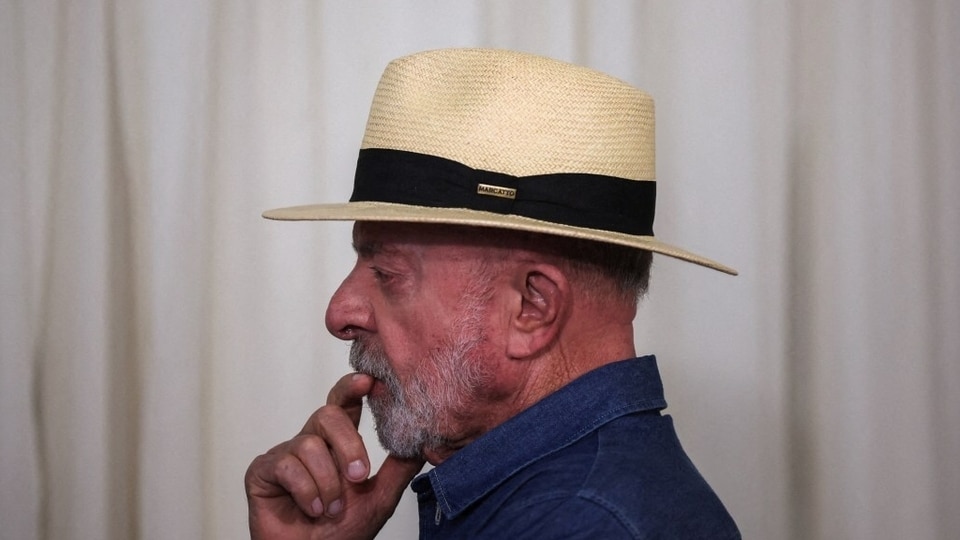
The problem for his movement is that he’s probably right.
A quarter of a century after first winning the presidency, the former union leader is seeking a fourth term, with the first round of voting Sunday set to go to a runoff on Oct. 25. A victory would make da Silva one of the world’s longest-serving democratically elected leaders. He is the last remaining stalwart of South America’s left, which has suffered a string of defeats as the region takes a rightward turn driven by economic and security concerns.
His enduring grip over Brazil’s left for much of this century now risks the future of the very party he co-founded 46 years ago. Under him, the Workers’ Party has become a central pillar of Brazilian politics, but one with no clear successor and no backup plan if he loses.
“There are moments in politics, like in soccer, when you don’t have as many star players as you would like,” da Silva told a podcast aired on YouTube recently. For now, he maintains, he is the only person capable of beating the country’s insurgent right wing.
Sunday’s election—a razor-thin race against Flávio Bolsonaro, a 45-year-old senator and son of former President Jair Bolsonaro—serves as a test of that wager. Da Silva is expected to go through to a runoff with Bolsonaro, but if he loses that race, the country’s left could be shut out of power for years, making it another Latin American political movement that fails to outlive its founders.
Da Silva’s dominance has proved both the Workers’ Party’s greatest asset and its ultimate weakness. As Brazil’s first working-class president, his personal bond with poorer voters transcends his party’s brand.
Yet his towering presence has choked off potential heirs. Handpicked successors have either faltered—like Dilma Rousseff, impeached in 2016—or lost, like Fernando Haddad in 2018.
Brazil’s left turns to da Silva because no one else commands national authority, but each run makes it harder for anyone else to rise up.
“Lula is perhaps the most important political leader of the century,” said João Paulo Rodrigues, leader of the Landless Workers’ Movement. “Anyone you put next to him looks tiny by comparison.”
Rodrigues said he would consider running for president one day, but that there was little point in contemplating a post-Lula future before that moment actually arrived. Jokingly citing Karl Marx, he said: “Mankind always sets itself only such tasks as it is able to solve.”
But with da Silva’s defeat in a likely runoff now a real possibility and new figures fast emerging on the political right, the search for a political heir is more urgent than ever, said Leandro Gabiati, a political scientist and director at Dominium Public Affairs.
Another term would let da Silva manage the transition from the presidency, but out of power, without the influence and machinery of government, the struggle to find the left’s next torchbearer is set to be far more difficult, Gabiati said.
With his 10th grandchild on the way, da Silva has gone to great lengths to prove he is still physically fit for the job, brushing aside comparisons with former President Joe Biden and joking that his new wife, 20 years his junior, can vouch for his youthful stamina.
Concerns about his age resurfaced two years ago following an accident in the palace bathroom—he fell while cutting his nails and underwent emergency surgery to drain a brain bleed. He has since taken to stripping to the waist for social-media videos of himself at the gym pounding a treadmill and doing squats.
Da Silva is already the longest-serving president in Brazil’s democratic history, surviving a military dictatorship, throat and skin cancers, a vast corruption scandal that landed him in jail in 2018 and an alleged assassination plot by Jair Bolsonaro’s allies. Another four-year term would see him match Angela Merkel’s tenure as chancellor in Germany, surpass every U.S. president, including Franklin D. Roosevelt, and trail only a handful of long-serving leaders in modern democracies—mostly prime ministers who face no constitutional term limits.
The son of illiterate farmworkers from Brazil’s impoverished northeast, he spent 13 days traveling by truck to São Paulo state as a child before becoming a metalworker, losing a finger in a factory accident and rising through the union movement to the presidency. Even poorer voters who see him as tainted by corruption still view him as the politician most likely to stand up for them in a brutally unequal country, where the poorest half of the population—more than 100 million people—still hold less than 3% of household wealth.
“The poor always get screwed here but Lula screwed us a bit less,” said Pedro Alves, a construction worker in São Paulo, who said he had managed to put his son into college thanks to a government-backed student loan program expanded under the Workers’ Party.
Even some of da Silva’s fiercest critics acknowledge him to be a political animal like few others with his instinct for crowds and mastery of Brazil’s transactional politics, turning enemies into allies and holding together unwieldy coalitions.
That charm has won over a motley crew of foreign leaders. Former President Barack Obama once called him “my man,” Iran’s Mahmoud Ahmadinejad referred to him as a “good friend,” and President Trump declared they had “excellent chemistry” after what he described as just a 39-second encounter at the United Nations General Assembly last year.
Write to Samantha Pearson at samantha.pearson@wsj.com