Key Points
-
The Vanguard Morningstar Mega Cap Growth ETF has a dirt cheap fee structure.
-
Hyperscalers are going full throttle on artificial intelligence (AI) capital expenditures despite eroding cash flows.
-
The Mega Cap Growth ETF holds key growth stocks such as Eli Lilly, Visa, and Mastercard that aren’t included in Nasdaq-100 ETFs like the Invesco QQQ Trust.
- 10 stocks we like better than Vanguard Morningstar Mega Cap Growth ETF ›
The market’s leadership has changed. Many of the mega-ap growth stocks that drove the indexes to new heights in recent years are now lagging.
The Nasdaq-100, which is the 100 largest non-financial stocks in the Nasdaq Composite (NASDAQINDEX: ^IXIC), is up 12.4% year-to-date (YTD) at the time of this writing. Nvidia (NASDAQ: NVDA), Microsoft (NASDAQ: MSFT), and Amazon (NASDAQ: AMZN) have produced smaller gains, while Meta Platforms (NASDAQ: META), Alphabet (NASDAQ: GOOG) (NASDAQ: GOOGL), and Tesla (NASDAQ: TSLA) are down YTD. This means that six “Magnificent Seven” stocks are underperforming the Nasdaq-100 YTD — the only exception being Apple (NASDAQ: AAPL).
Missed Nvidia in 2009? This Rare Signal Is Flashing Again. In 2009, a “Double Down” signal flashed for a little-known chipmaker called Nvidia. For the first time in years, that same “Total Conviction” signal is flashing for a company 1/100th the size of Nvidia. Continue »
Here’s why the Vanguard Morningstar Mega Cap Growth ETF (NYSEMKT: MGK) is an excellent low-cost way to buy the dip on top growth stocks.
Image source: Getty Images.
The Mega Cap Growth ETF has 67.6% in 10 stocks
The Mega Cap Growth ETF is essentially a more concentrated version of the Vanguard Morningstar Growth ETF (NYSEMKT: VUG). The Mega Cap ETF has 52 holdings compared to 135 for the Growth ETF. The expense ratio of the Mega Cap ETF is 0.05% — only slightly higher than the Growth ETF’s 0.03% expense ratio. It’s worth noting that 0.03% is the lowest you’ll find for any ETF. The largest ETF by net assets in the world is the Vanguard S&P 500 ETF, which also has a 0.03% expense ratio.
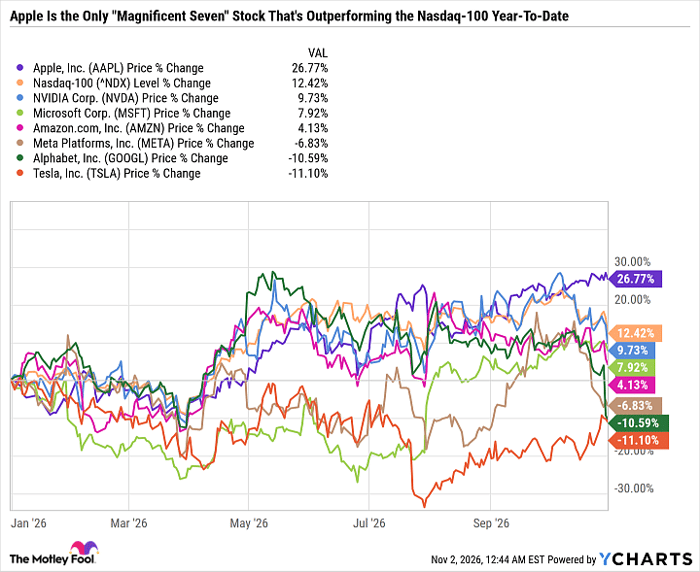
Because of the sheer size of the largest U.S. companies, the top 10 holdings in the Mega Cap Growth ETF make up a staggering 67.6% of the fund — including a combined 44.4% in the six “Magnificent Seven” stocks that are underperforming the Nasdaq-100 YTD.
Investing in leading Nasdaq and NYSE growth stocks
The Mega Cap Growth ETF is a great buy for investors who believe today’s most valuable companies will continue leading the broader market over the long term. But some investors may lean toward buying a Nasdaq-100 index ETF, such as the popular Invesco QQQ Trust (NASDAQ: QQQ), rather than the Mega Cap Growth ETF. The issue with that strategy is twofold.
For starters, the Invesco QQQ Trust has a relatively high expense ratio of 0.18%. And, more importantly, it invests exclusively in Nasdaq-listed non-financial companies — meaning it excludes key growth stocks listed on the New York Stock Exchange (NYSE).
The most notable is Eli Lilly (NYSE: LLY) — the ninth most valuable S&P 500 (SNPINDEX: ^GSPC) stock and the most valuable healthcare company in the world. Eli Lilly is crushing all of the Magnificent Seven stocks YTD and is up 468.6% in the last five years. Visa (NYSE: V) and Mastercard (NYSE: MA) are both high-margin payment processors and key holdings in the Mega Cap Growth ETF. But you wouldn’t find them in the Invesco QQQ Trust because they are listed on the NYSE.
This distinction may seem minor, given that most mega-cap growth stocks are listed on Nasdaq. But I’d argue that investors should be selective when choosing ETFs for their hard-earned savings, especially during periods of intense market volatility.
Building positions in SpaceX, Anthropic, and OpenAI
Another advantage of the Mega Cap Growth ETF over index-based funds is its rapid inclusion of newly public companies. The Mega Cap Growth ETF bought Space Exploration Technologies (NASDAQ: SPCX) in June — the same month of its initial public offering. Whereas SpaceX wasn’t added to the Nasdaq-100 until July and won’t be added to the S&P 500 until June 2027 at the earliest.
You can expect the Mega Cap Growth ETF to scoop up shares of Anthropic and OpenAI at roughly the same pace. But despite their high projected valuations, SpaceX, Anthropic, and OpenAI probably won’t be top 10 or 15 holdings in the ETF until the shares available for public trading, known as the float, make up a significant portion of the total outstanding shares. Even today, SpaceX has a significant number of its Early Release Eligible Shares locked up. And Elon Musk owns 48.4% of the company.
Still, the speed at which the Mega Cap Growth ETF can acquire shares of newly public companies, regardless of the exchange on which they are listed, is an attractive feature for investors seeking positions in the most valuable U.S. growth stocks.
Buying the dip on leading growth stocks
The Mega Cap Growth ETF’s concentration is a double-edged sword. Outsized exposure to the most valuable growth stocks makes the ETF’s performance dependent on a handful of companies and themes.
Nvidia, Microsoft, Alphabet, Amazon, Meta Platforms, and Tesla are underperforming the Nasdaq-100 YTD, in part due to their shared exposure to artificial intelligence (AI) — with Microsoft, Alphabet, Amazon, Meta Platforms, and Tesla all ramping up capital expenditures on AI and eroding their free cash flow. Nvidia’s key customers include these companies and, therefore, it is associated with the AI spending cycle.
Despite these risks, all of these large companies have operating leverage that can sustain strong earnings growth over the long term, attract top talent, and have deep pockets to take risks on big ideas. For these reasons, investors looking to buy the dip of the largest growth companies may want to take a closer look at the Mega Cap Growth ETF rather than overly diversified growth ETFs or index-linked funds that exclude key names.
Should you buy stock in Vanguard Morningstar Mega Cap Growth ETF right now?
Before you buy stock in Vanguard Morningstar Mega Cap Growth ETF, consider this:
The Motley Fool Stock Advisor analyst team just identified what they believe are the 10 best stocks for investors to buy now… and Vanguard Morningstar Mega Cap Growth ETF wasn’t one of them. The 10 stocks that made the cut could produce monster returns in the coming years.
Consider when Netflix made this list on December 17, 2004… if you invested $1,000 at the time of our recommendation, you’d have $342,020!* Or when Nvidia made this list on April 15, 2005… if you invested $1,000 at the time of our recommendation, you’d have $1,270,017!*
Now, it’s worth noting Stock Advisor’s total average return is 885% — a market-crushing outperformance compared to 208% for the S&P 500. Don’t miss the latest top 10 list, available with Stock Advisor, and join an investing community built by individual investors for individual investors.
*Stock Advisor returns as of November 4, 2026.
Daniel Foelber has positions in Nvidia. The Motley Fool has positions in and recommends Alphabet, Amazon, Apple, Eli Lilly, Mastercard, Meta Platforms, Microsoft, Nvidia, Tesla, Vanguard Morningstar Growth ETF, Vanguard S&P 500 ETF, and Visa. The Motley Fool has a disclosure policy.