
China’s ambitions are no longer confined to building the world’s factories, developing advanced technologies or expanding its military capabilities. Beijing increasingly wants to influence how the world is governed, who makes the rules and whose interests those rules serve.
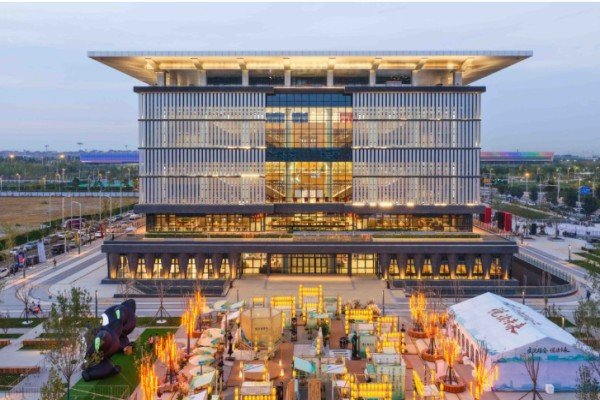
I was reminded of this during my recent visit to Xiong’an (雄安), where I attended the Global Governance Forum from 23 to 25 October 2026. The conference brought together political leaders, diplomats and scholars from across the world. Yet perhaps the most powerful statement about China’s ambitions was not made from the podium. It was the city itself.
Xiong’an is Xi Jinping’s vision of China’s future, translated into concrete, steel, technology and urban planning.
Located in Hebei (河北省)province, roughly 120 kilometres by road from Beijing’s Tiananmen Square, the new city is connected to the capital by high-speed rail, with journeys from Beijing taking approximately 50 minutes. The proximity is significant, but what impressed me most was the ambition behind the project.
Established in 2017, Xiong’an New Area is one of Xi Jinping’s signature initiatives. Chinese authorities have described it as a project of millennial significance, placing its historical importance alongside Shenzhen and Shanghai’s Pudong district.
The comparisons are instructive. Shenzhen became the symbol of Deng Xiaoping’s economic reforms and China’s opening to international investment. Pudong represented China’s emergence as a global commercial and financial power. Xiong’an is intended to represent the next stage: a technologically advanced, environmentally sustainable and meticulously planned urban centre.
Its purpose is partly to relieve Beijing of functions that need not remain in the capital. But the larger ambition is to create a new model of development integrating universities, research institutions, industries, transport, public services and residential communities.

The planning incorporates underground infrastructure, advanced digital technologies, intelligent transport systems and environmental restoration, particularly around the Baiyangdian (白洋淀) wetlands.
I was deeply impressed by the scale of the undertaking and the long-term thinking behind it.
However, Xiong’an is still an experiment, not a completed success story. Attracting people, businesses and investment to a newly created city is considerably more difficult than constructing impressive buildings. Xi himself pressed for faster progress during a visit earlier this year.
Nevertheless, Xiong’an demonstrates something important about Chinese strategic thinking: Beijing is prepared to invest enormous political and financial resources in projects whose intended benefits may take decades to materialise.
For India, that merits attention.
Under Prime Minister Narendra Modi, India has also placed infrastructure at the centre of its development ambitions. Noida International Airport at Jewar, whose first phase Modi inaugurated in March 2026, is one example. The project seeks to improve connectivity, encourage industrial investment and transform the economic prospects of the Delhi–NCR region and western Uttar Pradesh.
Xiong’an and Jewar are fundamentally different projects. One is a new city; the other is an aviation and logistics hub. But both reflect the understanding that infrastructure can reshape economic geography.
The real test for India will be whether such projects generate wider industrial ecosystems, efficient transport connections, employment opportunities and sustainable regional growth. Infrastructure becomes strategically significant when it strengthens the country’s long-term economic capabilities; not merely when it produces impressive inauguration ceremonies.
But Xiong’an also serves another purpose: it is becoming a stage on which China presents its vision of international leadership.
The decision to organise the Global Governance Forum there was therefore hardly accidental.
At the opening ceremony, Foreign Minister Wang Yi conveyed a message from President Xi Jinping and outlined Beijing’s approach to reforming global governance.
China’s Global Governance Initiative emphasises sovereign equality, multilateralism, the centrality of the United Nations, greater representation for developing countries and stronger international cooperation in emerging areas, including artificial intelligence.
These ideas have considerable appeal across the Global South.
Many developing countries believe, with justification, that the existing international system does not adequately reflect contemporary political and economic realities.
India shares several of these concerns. New Delhi has consistently advocated reform of the United Nations Security Council, greater representation for developing countries and a more equitable international economic order.
But there is an important difference between agreeing with China’s stated principles and accepting Beijing’s leadership in defining how those principles should operate.
China is not simply seeking influence within the existing international system. It is attempting to shape the language, priorities and institutional arrangements through which future international decisions will be made.
That is a strategic development India cannot afford to underestimate.
For Beijing, global governance is also an instrument of influence. By convening international forums, building diplomatic networks and promoting initiatives that resonate with developing countries, China seeks to strengthen its position as a leading voice of the Global South.
India must participate in these debates, but with a clear understanding of its own interests.
We cannot ignore the contradictions between Beijing’s international rhetoric and the unresolved difficulties in India–China relations, particularly along the disputed boundary. Principles such as sovereignty, mutual respect and peaceful settlement of disputes must be demonstrated through conduct, not merely proclaimed in international declarations.
At the same time, strategic competition should not prevent constructive engagement.
One of my most memorable encounters at Xiong’an was with Nepal’s former president, Bidya Devi Bhandari. I had the pleasure of interacting with her and was particularly impressed that she addressed the gathering in Nepali.
In an international conference dominated by major world languages, her decision to speak in her own language represented something valuable: cultural confidence and national dignity.
For India, this encounter also offered a diplomatic lesson.
Nepal and India share exceptionally close historical, cultural and civilisational links. But Nepal, like every sovereign nation, has its own interests and foreign-policy priorities.
China is investing considerable diplomatic effort in cultivating relationships across South Asia. India’s response should not be to demand exclusive loyalties from neighbouring countries. Rather, New Delhi must strengthen regional partnerships through reliability, economic opportunities, connectivity and respect for national sovereignty.
Influence in the neighbourhood cannot be sustained by geography and historical familiarity alone. It must be earned.
Another thought-provoking conversation was with Jorge Castañeda, Mexico’s former foreign minister. We discussed Samuel Huntington’s famous thesis concerning the “clash of civilisations”.
We agreed that civilisations do not inherently clash.
Civilisations have interacted, exchanged ideas and enriched one another throughout history. Political rivalries are not the same as civilisational conflicts.
India and China themselves offer a compelling historical example. Buddhism, philosophy, literature and centuries of intellectual exchange connected the two societies long before their contemporary geopolitical disagreements emerged.
This does not mean that strategic rivalries can be dismissed through references to ancient cultural friendship. National interests remain real, and military and territorial disputes cannot be wished away.
But civilisational engagement can create channels of communication that help prevent political competition from becoming permanent hostility.
India should therefore develop a more confident and sophisticated China strategy.
We need greater investment in Chinese-language expertise, serious research into Chinese political institutions and more sustained engagement between Indian and Chinese academics, journalists and policy specialists.
India should also advance its own practical initiatives in areas where the future international order is being negotiated: artificial intelligence, technology standards, development finance, trade, climate cooperation and reform of multilateral institutions.
Our participation in BRICS, the Shanghai Cooperation Organisation, the G20 and other platforms should be guided by this objective—not by a desire to follow Beijing, nor by an instinct to oppose everything China proposes.
India possesses advantages that should not be underestimated: democratic institutions, a large and increasingly sophisticated economy, technological capabilities, extensive international partnerships and a rich civilisational tradition. But these advantages must be converted into sustained national capabilities and a persuasive international vision.
China is attempting to shape the future through infrastructure at home and institution-building abroad. The two efforts reinforce one another: economic capabilities support diplomatic influence, while diplomatic influence creates opportunities to shape international rules.
India need not replicate the Chinese model. Indeed, its democratic institutions and political diversity require a different approach.
But India must demonstrate comparable seriousness of purpose.
My visit to Xiong’an left me with admiration for China’s long-term planning, a clearer appreciation of its diplomatic ambitions and an equally strong conviction that India must define its own path.
The central question is not whether Xi Jinping’s dream city will succeed. Time will answer that.
The more consequential question for New Delhi is whether India can match its growing international aspirations with the infrastructure, intellectual resources, diplomatic imagination and strategic consistency required to shape the future.
China is putting forward its vision of tomorrow. India must ensure that it is not merely responding to that vision but helping determine tomorrow’s rules.
(Dr Yukteshwar Kumar attended the 2026 Global Governance Forum in Xiong’an as former Deputy Mayor of Bath, UK. The views expressed are personal)