Key Points
-
As Tesla gears up to fundamentally change its core businesses, R&D costs are rising quickly.
-
Rising R&D costs were largely driven by AI, Optimus, and other technology development.
-
Tesla’s future businesses could prove lucrative, but they’re also currently increasingly expensive.
- These 10 stocks could mint the next wave of millionaires ›
Tesla (NASDAQ: TSLA) investors have plenty of reasons to look toward the future, and it could certainly be both wild and lucrative. Robotaxis, artificial intelligence (AI), and humanoid robots could open new revenue opportunities and an entirely different future — the possibilities are exciting, no doubt about it.
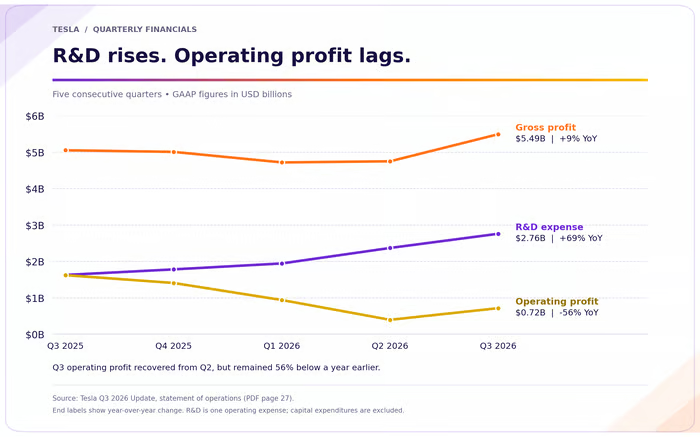
But Tesla remains heavily dependent on selling electric vehicles (EVs), and developing that future comes with a hefty bill. The EV maker’s latest results show just how quickly that bill is growing. Third-quarter research and development (R&D) expenses jumped 69% year over year to $2.76 billion, while operating profit declined 56% to $718 million.
Missed Nvidia in 2009? This Rare Signal Is Flashing Again. In 2009, a “Double Down” signal flashed for a little-known chipmaker called Nvidia. For the first time in years, that same “Total Conviction” signal is flashing for a company 1/100th the size of Nvidia. Continue »
The question facing Tesla investors is a big one: Should they applaud the long-term investment or worry about the pressure on near-term earnings?
The bill is getting bigger
Tesla’s third-quarter earnings pressure wasn’t caused by a deteriorating automotive gross margin. Its automotive gross margin actually improved from 17% to 18.5% year over year, while companywide gross profit increased roughly 9%, from $5.05 billion to $5.49 billion. So what happened, you ask?
The trouble came further down the income statement. R&D expenses increased by $1.13 billion, more than twice the approximately $440 million increase in gross profit. Selling, general, and administrative expenses also rose. Together, those increases overwhelmed the improvement in gross profit and helped push operating profits lower.
Data source: Tesla SEC filings. Chart generated with ChatGPT by author.
Investors knew the bill for Tesla’s sharp turn into more of a technology company, rather than a traditional EV maker, would come due over time. Tesla explained the R&D increase was largely due to costs associated with its AI development and other programs, including Optimus, silicon development, battery technologies, and new vehicles, as well as higher stock-based compensation, per Tesla’s SEC filing.
There’s an important mental note for investors to make here. This R&D spending is related to Tesla’s broader investment push, but it isn’t the same as capital expenditures. Tesla separately expects more than $20 billion in 2026 capex, including computing infrastructure, data centers, manufacturing facilities, and other long-lived assets.
The difference for investors is that R&D generally reduces earnings as incurred, while capital expenditures use cash up front and generally affect earnings over time through depreciation. Tesla faces both pressures as it builds toward its future, which could be wildly lucrative and also wildly expensive.
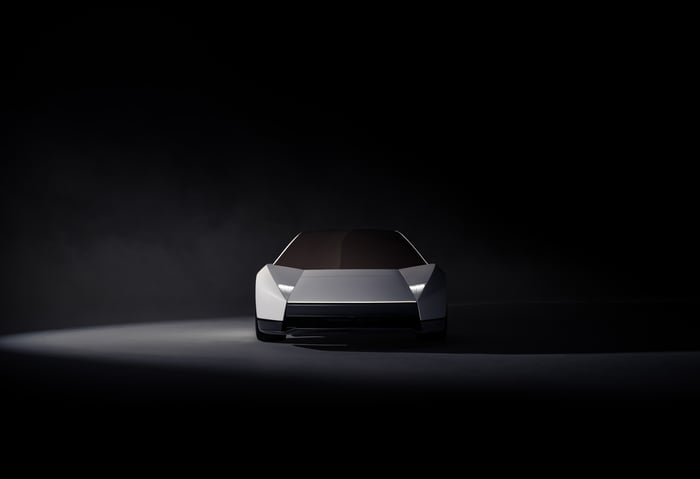
Image source: Tesla.
Spending isn’t the same as succeeding
To be fair, cutting R&D spending just to make one quarter’s earnings look better would likely be shortsighted — which, unfortunately, Wall Street and big business can sometimes be. If Tesla’s investments produce valuable technology and commercially successful products, accepting lower profits today could prove a great move for long-term investors.
That said, a larger research budget doesn’t guarantee a successful product breakthrough, much-needed customer adoption, or improved profitability in the end.
Also, on the downside for investors, you might have considered operating profit improving from the second to the third quarter a silver lining, but that may not be the case. Operating profit improved from $398 million in the second quarter to $718 million in the third, but Tesla benefited from a one-time refund on tariffs during the third quarter. Even with that boost, operating profit was down significantly year over year.
What it all means
For long-term investors, the takeaway is pretty simple. Tesla’s rising R&D expense helps explain today’s operating profit pressure, even as automotive gross margin improved, but the spending itself doesn’t validate tomorrow’s growth story. Investors will want to watch for autonomous technology milestones, a growing number of paying customers for its future businesses, and evidence that new businesses can generate profits.
Tesla is spending heavily to build its future. Investors need that future to eventually start paying off, and that timeline is highly uncertain — which is one word Wall Street, and most investors, don’t like.
Missed AI’s “Act 1”? Act 2 Could Be 14x Bigger
Most investors think they missed the AI boat because they didn’t buy Nvidia in 2005.
But according to our analysts, we’re only at the end of “Act 1″—the R&D phase. “Act 2” is the global rollout, a massive technology build-out that Google’s CEO says could be more profound than fire or electricity.
While everyone watches the chip designers, one “backbone” company provides the critical technology that Nvidia and AMD literally cannot function without. We’ve detailed this under-the-radar player in our new AI Playbook.
Daniel Miller has no position in any of the stocks mentioned. The Motley Fool has positions in and recommends Tesla. The Motley Fool has a disclosure policy.