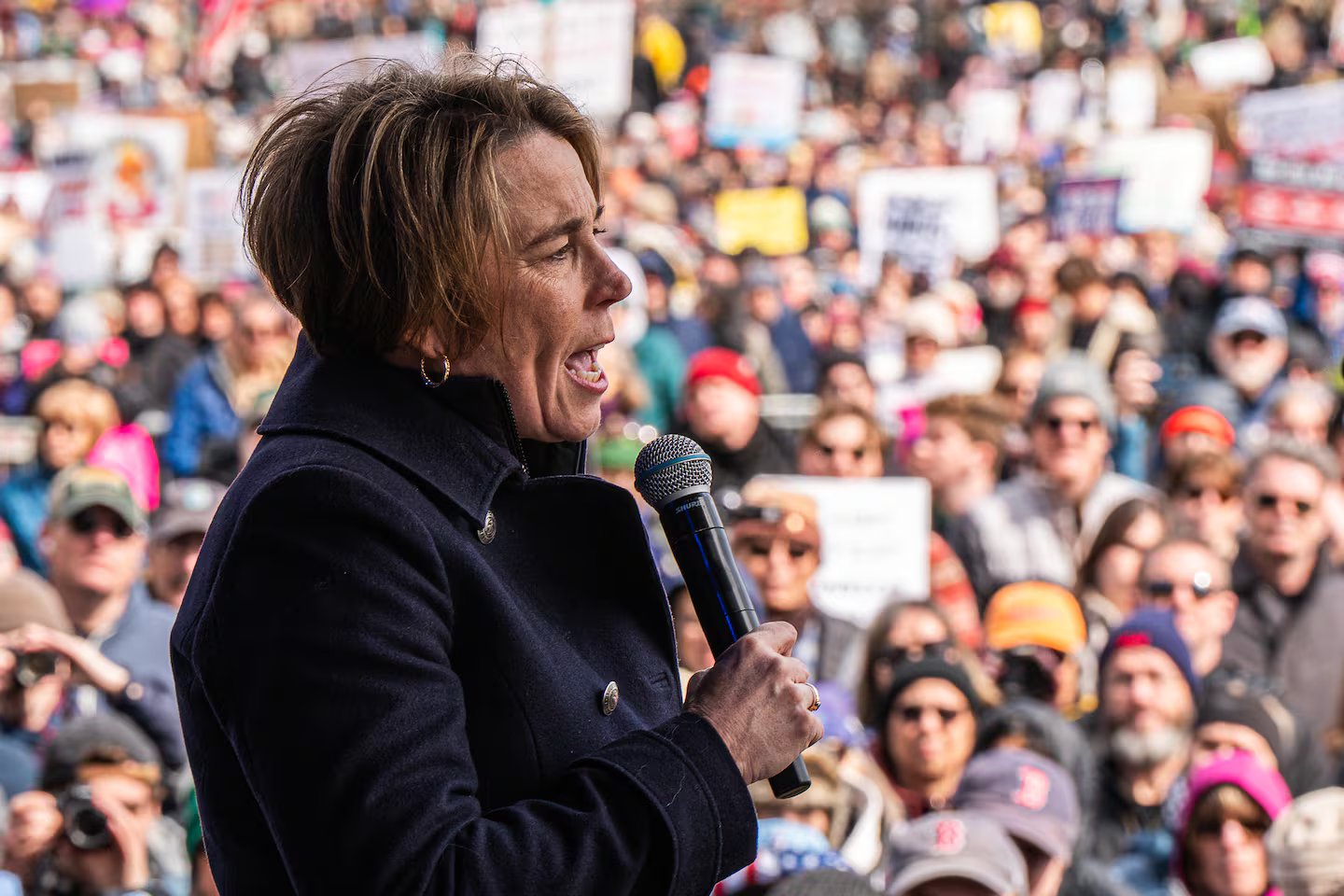
“Her entire publicly elected career, this is what she’s been harping on,” said Sydney Asbury, a former aide to governor Deval Patrick and an adviser to Democrat Jay Gonzalez’s 2018 gubernatorial campaign. “Clearly articulating [her focus] will be critical in a second term, when there is no Trump to have as a foil.”
As attorney general, she sued the Trump administration nearly 100 times and, most often, she succeeded. She regularly appeared on cable news and national shows to bash him. She topped a Trump-endorsed Republican to win the governor’s office in 2022.
As exhausting as Democrats say their fight against Trump is, it’s also provided Healey a singular source of political rocket fuel, helping define the profile she’s crafted over a decade-plus in political office that’s largely coincided with Trump.
Now Healey, 55, is running to keep her seat against a wealthy Republican who has donated to Trump, balancing her constant messaging about affordability (for which she largely blames the president) with promises that a vote for her opponent is a vote for Trump.

Healey, for her part, says her non-Trump work has remained important, citing her signature that made community college tuition-free for residents, provided free school meals for students, and bolstered the state’s effort to corral its housing crisis, to name a few.
“These are all things that I’ve done alongside standing up to Trump, which has been absolutely necessary for the sake of our residents and our economy,” she said in a Globe interview.
Of the 12 years Healey has served in an elected position, Trump has been the dominant political figure in the country for more than 10 of them, reshaping not only the Republican Party, but, by contrast, Democrats, too.

He’s provided Healey with near-constant fodder: When federal health care subsidies expired for nearly 300,000 residents, she tapped a state fund to help mitigate the rising premiums for some; when food benefits were cut, her administration hired extra caseworkers; and when the Trump administration moved to undo national consensus on vaccines, Healey pushed in the opposite direction, requiring insurers to cover COVID shots and other recommended inoculations — the first in the nation to do so.
She stockpiled mifepristone doses, signed abortion protections into law, and filed a bill to provide state dollars to universities imperiled by federal actions — all in the name of standing up to a federal government led or reshaped by Trump. This year, she pushed a law limiting immigration arrests after the Trump administration ramped up deportation operations, which she deemed part of Trump’s “hateful and racist agenda.”
Her administration estimates the Trump administration has cut $6 billion in federal funding from Massachusetts since he took office in 2025.
“You cannot be a governor in the United States right now and not deal with the impact that Donald Trump is having on your residents, your workforce, your economy,” Healey said. “That’s just real.”
For some, that’s made disentangling Healey and Trump difficult, if impossible. Asked in a June Suffolk University/Boston Globe poll what was Healey’s signature accomplishment during her first term, many struggled to name one. For those who did, it was her posture against Trump — and her work on housing — that stood out.
“Trump has created a lot more work for all of us across government,” Healey said. “That just means that we’re sleeping a lot less.”

She’s not necessarily alone.
Trump, who himself has cast the midterms as a referendum on his presidency, has become nearly omnipresent regardless of the office up for election. Among other Democrats who are campaigning as if Trump is their direct opponent is Maryland Governor Wes Moore, who also serves as the president of the National Governors Association and earlier in October accused Trump of preventing him from speaking at an event in his home state.
“I didn’t run for governor because I was excited to fight with the president of the United States,” Moore said. “There is a whole lot we have to wrestle with now that I wish we didn’t have to wrestle with.”
Yes, “there is a Trump exhaustion” among voters, he said. “But it’s not an exhaustion of people talking about him; it’s an exhaustion of his policies.”
Healey has been quick to point to Trump throughout the campaign, citing the war in Iran as the reason for high gas prices and his administration’s tariffs for the inflated cost of everything else.
In her television ads and on the campaign trail, she paints her opponent, Republican Michael Minogue, as a proxy for the Republican president, pointing to his political donations and to the fact that he hosted a fund-raiser for Vice President JD Vance at his Gloucester home. Trump hasn’t endorsed Minogue, nor does it appear he’s commented publicly about the race.
Still, in her first debate with Minogue, she referenced Trump dozens of times. At their second, she name-checked him a dozen more.

Indeed, Trump is “on the ballot,” both Healey and the president himself contend. The question some Democrats are asking: How about when he’s not? After all, if she’s reelected, half of her next term will be under Trump’s presidency, the other half under his successor.
“The important question for any of the Democratic governors in this position is how do you translate that opposition to Trump as a broader case for leadership?” said Amy Dacey, executive director of the Sine Institute at American University and former chief executive of the Democratic National Committee.
Healey, she said, is “running on two records: one as governor and one as a critic of the president.” But “when a president leaves office,” Dacey added, “the political opposition she’s built around the president has to evolve.”
Healey has said her second term will build off her first, with a focus on housing construction and bringing the costs of energy down. Those challenges animated her first run for governor, too, and have been a constant in her first term.
She said voters could also expect to see a focus on artificial intelligence, including protections for the workforce, the economy, and online security.
However, a second term will require a bit of post-Trump cleanup, she said.
“The reality is, with Trump doing all that he’s doing, the lens has absolutely got to continue to be on affordability,” she said. “We want to work on returning funding to the states instead of having a federal government that’s attacking our states and making life more difficult and more expensive for our residents.”
Those who work closely with Healey say the Trump factor has colored the way their sectors have to act. And they look forward to a federal government that, in their ideal world, would be what Chrissy Lynch, the Massachusetts AFL-CIO president, called “normalized.”
“It’s just hard to have those conversations,” Lynch said, “when the federal government is so insane.”
Samantha J. Gross can be reached at samantha.gross@globe.com. Follow her @samanthajgross.