Prime Minister Mark Carney said Wednesday that Canada is not ready to strike a trade agreement with the Trump administration, even with U.S. midterm elections six days away and American tariffs still bearing down on Canadian exporters. Ottawa says it will sign only on terms that serve Canadians—but critics, including The Hub’s co-founders, argue that waiting for American politics to shift risks locking in costs a deal could have avoided.
Speaking to reporters on Parliament Hill on his way into the weekly Liberal caucus meeting, Carney said Ottawa “will pursue” a deal if one presents itself but that Canada’s negotiators are “not in that position right now,” The Canadian Press reported. He added that Canada would agree only to terms in its interest.
Canadian officials have described progress as limited even as talks intensified in recent days. Next Tuesday’s vote will decide control of both chambers of Congress, now held by Republicans, and the Canada tariffs have surfaced on the campaign trail. After Maine Sen. Susan Collins pressed for relief, Trump last Friday exempted 22 products from his 50 percent levy on Canadian goods while adding 100 new ones, effective Oct. 30.
How the August framework collapsed
The current impasse dates to the breakdown of talks in late August. Carney told reporters that the U.S. had introduced, in the final hours, efforts to restrict Canada’s ability to sign other trade deals, calling it a question of sovereignty and rejecting what he called an attitude that Canada is an American subsidiary. U.S. Trade Representative Jamieson Greer told CBC News that Canadian officials had exaggerated the intrusion. If Washington eased its tariffs on steel, aluminum and autos, he said, “we expect other countries to also protect their borders”—a demand aimed chiefly at Chinese goods.
Under the framework reportedly reached in Washington on Aug. 18, the U.S. tariff on Canadian autos would have dropped to 15 percent from 25 percent, and steel and aluminum duties would have been halved to 25 percent, with most Canadian steel covered by quotas, Bloomberg reported. Tariff-free access for most Canadian exports would have been preserved. Ottawa, for its part, would have dropped its existing counter-tariffs and asked provinces to restock American alcohol.
Instead, 50 percent U.S. tariffs imposed under Section 338 of the Tariff Act of 1930 took effect Aug. 22 on $27.6 billion of Canadian goods—about five percent of Canada’s exports, by economist Trevor Tombe’s estimate. On Sept. 8, Ottawa answered with counter-tariffs of 15, 25 or 50 percent on $27.6 billion of U.S. imports, on top of retaliatory measures left over from 2025.
Carney has paired that response with a goal of doubling non-U.S. exports within a decade. His government has signed a strategic partnership with China, a trade agreement with Indonesia and investment and critical minerals deals with the UAE. Budget 2025 set aside $5 billion over seven years for a Trade Diversification Corridors Fund. A Fraser Institute study by Jock Finlayson and Steven Globerman concludes the size and proximity of the U.S. market will make that export target very hard to hit. Research the authors cite suggests shipping costs explain only about a tenth of how distance suppresses trade, The Hub reported.

Walking away has a precedent
Derek H. Burney, who helped negotiate the 1988 Free Trade Agreement and NAFTA as chief of staff to the prime minister, argues that Carney’s stance has a direct antecedent. “While the scale of this disagreement is certainly notable, trade conflict between the two countries is nothing new, and neither is walking away from the bargaining table—I know, because I was part of the team that did it,” Burney wrote in The Hub. He recalls that Canada suspended the 1988 talks 10 days before Washington’s negotiating authority expired over the absence of binding dispute settlement, and that Treasury Secretary James Baker phoned afterward with a compromise that brought Canada back to the table.
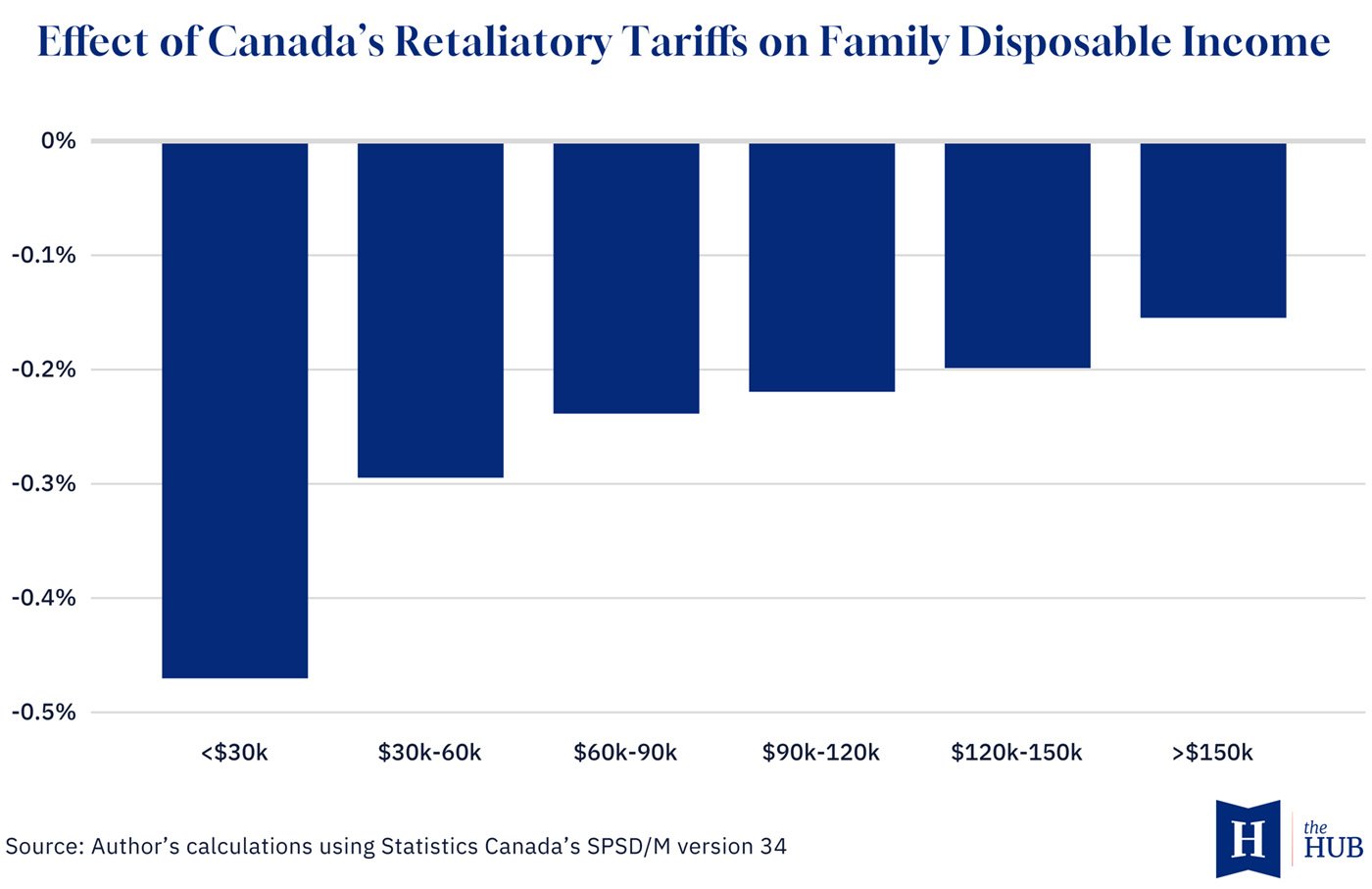
Trevor Tombe, a professor of economics at the University of Calgary, goes further, quantifying what the continued standoff costs Canadian consumers while a deal remains out of reach. He estimates Canada’s retaliatory tariffs will lift overall consumer prices by roughly a quarter of a percentage point, falling hardest on lower-income households and on families with children. “In total, it’s a nearly $4 billion hit to consumers,” Tombe calculated.
Ottawa’s holdout could be a wager on American politics shifting after next Tuesday rather than on leverage of its own, with the costs accumulating at home meanwhile. Retaliatory tariffs alone represent a nearly $4 billion hit to Canadian consumers, with households earning under $30,000 losing the largest share of their income. If the president keeps his delegated tariff powers whatever happens in the House, the standoff could run well past the midterms with no better terms on offer.
Carney has given no timeline for a return to the table. Americans vote next Tuesday.
The Hub’s mission is to create and curate news, analysis, and insights about a dynamic and better future for Canada in a…