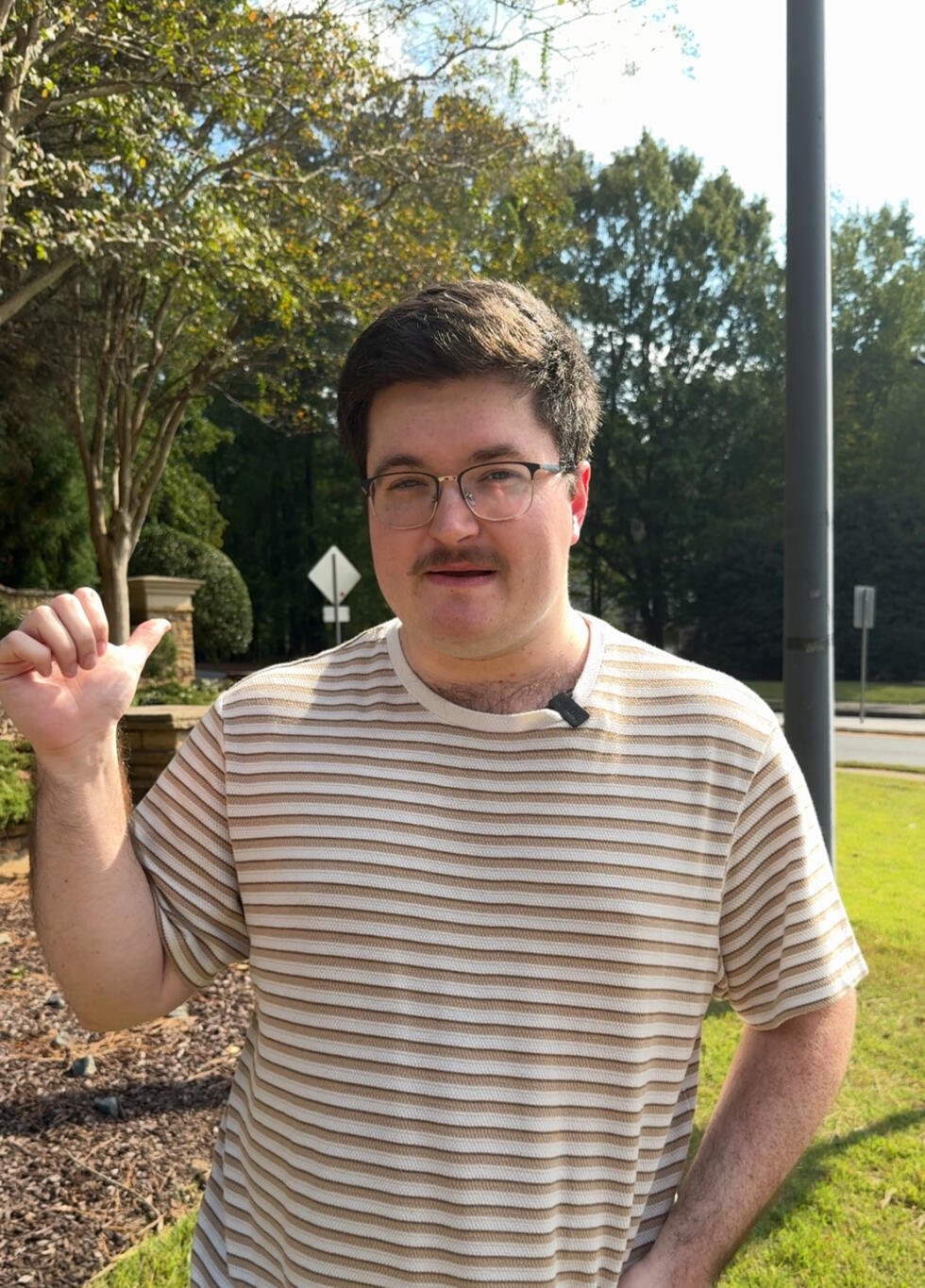
Standing near a nondescript black pole topped with a solar panel on a leafy side street lined by family homes in an Atlanta exurb, Noah* confesses that he feels an immense sense of disquiet as the US heads into the midterm elections.
“I truly think that this is the most observed that Americans have ever been in political history. And I think that Flock is a massive step into these surveillance states that we have the ability to decide whether or not we are okay with,” said the 27-year-old software engineer.
“Flock” refers to a brand of AI-driven surveillance cameras produced by Atlanta-based company Flock Safety, which was started in 2017 by three alumni of the Georgia Institute of Technology, commonly called Georgia Tech. The cameras scan licence plates and capture, analyse and store details of passing vehicles, including location, time, car models and bumper stickers.
The surveillance cameras emerged as a lightning-rod campaign issue across the US amid a backlash against AI, alarm over the sweeping power of the technology and questions about the unchecked growth of the industry as President Donald Trump pushes a pro-tech agenda.
Watch moreAI on the ballot? Voters in US midterms revolt
In Atlanta, capital of the southern state of Georgia and a city that has gained a reputation as one of the country’s fastest-growing technology hubs, candidates were repeatedly grilled about their positions on AI and the little cameras, topped with solar umbrellas, that have sprouted up across the state, earning the wrath of many Georgians.
When the two candidates were asked about the cameras during the only televised debate in the gubernatorial race to replace Georgia’s outgoing Republican Governor Brian Kemp, Democratic hopeful Keisha Lance Bottoms noted that, “the challenge that we have with Flock cameras and other licence-plate reader technologies is that the technology has gotten ahead of the policy”. When pressed on her platform on the issue, Bottoms said she was “not opposed to a moratorium on Flock cameras”.
Her Republican rival, Rick Johnson, said he “would not put a moratorium” on Flock cameras “because I don’t want crime to go up”. The billionaire, whose business connections with a Texas data centre have been under scrutiny in the Atlanta press, said he would instead “fix” the AI camera problem. “I’m telling you, there’s 15 people at Georgia Tech that can solve this in one week,” he said.
The televised exchange nailed the arguments for and against the hi-tech cameras. Flock Safety says the cameras help law enforcement officials fight crime by connecting “vehicle sightings across jurisdictions to uncover patterns, strengthen investigations, and securely collaborate with trusted partners”, according to the company website.
But critics concerned about security breaches and privacy issues are not persuaded. Their numbers are growing across the US, with their opposition getting increasingly vocal, visual and visceral.
Police use Flock to stalk ex-girlfriends, spouses
Strolling down the streets of Woodstock, an affluent, predominantly White area of Cherokee County in northern Atlanta, Noah says he watched the gubernatorial candidates debate the Flock camera issue and was not impressed.
“I was honestly kind of disappointed by how both candidates discussed it. They would either say that they were OK with it, or they would look into it, or they just wanted some sort of guardrail on it, whereas Flock cameras already have guardrails and they’ve been broken over and over and over again,” he noted.
Noah knows a thing or two about Flock guardrail failures. In his free time, the young software engineer volunteers as one of the coordinators of DeFlock Cherokee, a local chapter of a larger, decentralised DeFlock movement that tracks Flock and other AI-driven surveillance cameras across the US.

In Cherokee – a county with a population of around 260,000 – alone, there have been a number of high-profile cases of breaches that have made headlines in recent months. The suspects in most cases are, or have been, law enforcement officials with a duty to protect the people.
In August, the Cherokee County Sheriff’s Office arrested and fired a fourth deputy, Jerry Shellhouse, for allegedly misusing Flock licence plate readers. The office had previously arrested and fired three other deputies for abusing Flock, but missed Shellhouse until they were contacted by a USA TODAY investigative team that found the 57-year-old Cherokee law enforcement official had searched one tag at least 840 times.
County authorities said he had misused the Automated License Plate Reader (ALPR) system between October 2023 and December 2025, before the office updated its Flock policy to include multiple audits a year and limit access to authorised users.
While the details of the Shellhouse case have not been released, news reports reveal a pattern of Flock misuse across the US. Most cases involve a current or former law enforcement official surveilling the movements of an ex-spouse or partner.
In Dallas, another northern Atlanta exurb near Cherokee, a 911 emergency response director was arrested and fired after the USA TODAY team found she had searched more than 2,500 times for cars belonging to her estranged husband and his new girlfriend. The searches were accompanied by persistent stalking of the couple, the report revealed.
At least 100 police department employees across the US were charged with or accused of misusing licence-plate readers for unauthorised purposes, according to a September report by The Washington Post. And cases covered by the media could simply be the tip of the iceberg, analysts warn.
Beneath each case lies a human story of harassment and, at times, tragedy. In Jefferson, a northern Atlanta suburb, a police chief committed suicide in April, according to local officials, before he could face trial for stalking his former girlfriend. Text messages between the police chief and his ex, who confronted him about his repeated harassment, revealed the law enforcement official confessing to being “on a spiral” and promising never to “look again” at the Flock database.
Flock insists that it takes allegations of misuse seriously and regularly updates its guardrails. Last year, the company changed its systems to make officers’ misuse more difficult for the public to unearth, according to InvestigateTV.
But the reports of misuse keep coming, and with them, company rebuttals. In a response to the USA TODAY report, Flock’s public relations manager Paris Lewbel said the company was “committed to setting a baseline for where safeguards and transparency for our industry should be, and welcome further conversations and regulations from local communities about the rules of the road that they want to set for public safety technology”.
Blocking, destroying, locating cameras on apps
Local communities in counties such as Cherokee are having plenty of conversations about public safety in the face of sweeping AI surveillance technology. The problem is, most lack the time or wherewithal to frame policy. And for those who try, such as Noah, it’s an uphill slog against the odds.
Emerging from a coffee shop at a strip mall in Woodstock, a town in Cherokee, Chanel Dennis, 46, said she was against the use of Flock cameras. “It’s an invasion of privacy that shouldn’t be allowed and people are using it for not the purposes it’s intended,” she said. “I think it’s also a problem that we are being taxed to provide these services from private companies.”

At the Woodstock city centre park, Zeke Sims, a 27-year-old resident, said he does not “support the surveillance and the misuse” of Flock cameras.
“There’s been several stories on how the police force and law enforcement have used them to track certain people, specifically exes and stuff like that. I just don’t think it’s something that should be there in the first place,” he said.

Both Dennis and Sims said the use of Flock cameras was an election issue for them in the midterms, although they declined to divulge which party they would be voting for.
On social media, videos show opponents how to place signs, attached to household items such as mops and rakes, to block Flock camera lenses. Photographs of “Get the Flock out” signs on the cameras flood the internet.
Another genre of anti-Flock posts features video clips of people destroying the cameras, but some are AI-generated spoofs.
Meanwhile, community-run campaigns abound. Noah pulls out his phone to display a user-generated DeFlock Cherokee app, which he helped create with a few friends, to pinpoint the location of the cameras. “The website started a couple of months ago, and everyone started flooding in to try and help with research, outreach and everything. It’s been quite a movement,” he said.
DeFlock apps also offer drivers alternate routes to avoid the AI cameras. But in the Atlanta area, finding a Flock-free route is a challenge. A local journalist tried the app to buy an “afternoon sweet treat” but found the route took too long on a working day and he could not avoid a key intersection that had a Flock camera.
‘Flock’s evil twin’
Most Americans are alarmed by the explosive growth of the AI industry and the infrastructure, such as mega data centres, required to power it. Around 70% of US citizens and residents oppose the construction of data centres due to high energy consumption, water use, contamination, sound pollution and other environmental problems, according to polls.
Watch moreThirsty giants: Big tech’s data centres multiply
These concerns cut across ideological divides.
Flock cameras purport to reduce crime, often a key concern for Republican voters. But the statistics on the technology’s crime reduction results so far have been mixed. A recent working paper by researchers at the University of South Carolina found ALPR networks reduced motor theft. But the Arlington, Virginia-based Institute for Justice disputed the study and questioned the interpretation of the findings, adding to the disquiet about a technology that appears to be more than the public is ready for.
In the trade-off between surveillance and security, the alleged abuse of ALPR technology by law enforcement officials has raised alarm bells, even among voters who traditionally rate being tough on crime as a key election issue.
“One of the craziest things about this movement is just how bipartisan it is. One of the most American things is not to trust the government. And this is government master surveillance. I’m seeing very similar rhetoric on both sides and people are uniting across the aisle,” explained Noah.
Across the United States, city, county and town council meetings have seen residents show up to protest and voice their opposition to Flock cameras in desperate bids to slow down contract approvals and draw attention to the issue. At a San Francisco meeting this summer, a resident dressed as Darth Vader sarcastically expressed his support for the cameras. “They are following children in parks and gymnasiums, and we need this. I need this so I can stalk my ex-girlfriend,” he said.
Noah believes raising public awareness about the issue is a civic duty. “The greatest thing somebody can do is just to be loud about it, to tell your neighbours about it, to educate them, and inform them, because most people don’t know,” he said.
But it takes tenacity to keep up the fight, Noah acknowledges. Earlier this week, for instance, DeFlock Cherokee alerted residents about a Tuesday, October 20, meeting, where commissioners were set to vote on a $37 million police security contract including AI surveillance technology for the county. But on the designated day, the vote was postponed to November 3 – the date of midterm elections, increasing the frustration among activists, who viewed it as an attempt to keep the public out.
The targets are also getting more diverse with the AI surveillance options multiplying, pitting activists against a growing army. As a growing number of councils scrap contracts with Flock due to the backlash, other surveillance companies are stepping in to fill the gap.
The latest $37 million police contract bid for Cherokee does not concern Flock, but another company, Axon, also promising AI-driven monitoring. DeFlock Cherokee campaigns now describe Axon as “Flock’s evil twin” and warn that, “Axon clearly sees itself as the alternative to Flock for agencies that want out, yet it’s the same kind of mass surveillance company, with all the same problems.”
As the surveillance systems expand with new players entering the scene, Noah admits that the challenges can at times be daunting. But he’s determined to keep at it.
“I’m very motivated to keep pursuing anti-surveillance action. It’s partially just because I see how much support I get for it and how widespread the backlash against mass surveillance is. It can definitely be exhausting at times, because the surveillance state has a way of sort of firing on all cylinders,” he said. “It’s an enormous ecosystem that I’ve spent months, if not years, researching, and I feel overwhelmed by it. So I can’t imagine how overwhelmed and in the dark the average person feels about it. And I feel like I have an obligation to try to educate and fight on their behalf.”
*Full name withheld upon request due to security concerns.